HR AI tools
Software applications that use artificial intelligence to automate or assist HR tasks across the employee lifecycle, from sourcing and screening candidates to drafting onboarding documents and summarising performance conversations.
Michal Juhas · Last reviewed May 8, 2026
What are HR AI tools?
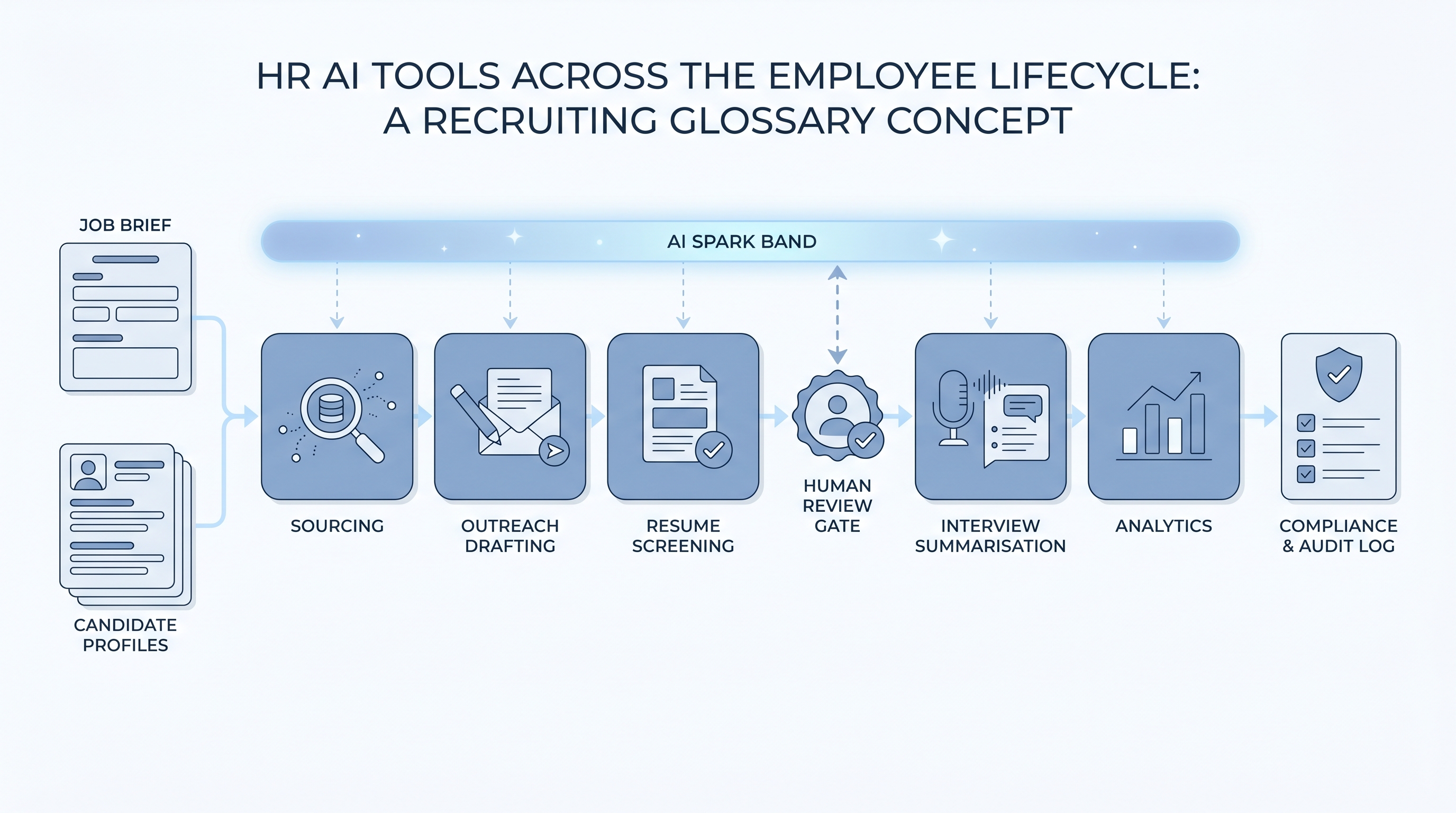
HR AI tools are software applications that use artificial intelligence to automate or assist tasks across the HR function. The category spans the full employee lifecycle: sourcing and screening candidates, drafting job descriptions and outreach messages, scheduling interviews, summarising conversations, generating onboarding documents, and flagging anomalies in workforce data.
In talent acquisition, HR AI tools show up most visibly in the hiring pipeline. A sourcing agent that ranks candidates by fit, a drafting assistant that personalises outreach at scale, a resume screener that scores applications against job criteria, and an interview tool that turns transcripts into structured notes are all HR AI tools. Each sits between a data input and a decision or draft, then waits for a human to review before anything moves forward.
The practical definition that matters in vendor conversations and compliance reviews: an HR AI tool applies a model (language, ranking, or classification) to HR data and produces an output that a person then approves, edits, or rejects. It is not the same as traditional HR software, which executes rules you configure rather than generating outputs from learned patterns.
In practice
- A People Analytics lead asking whether the company's HR AI tools passed a bias audit before the last renewal uses the term as a broad compliance category covering sourcing, screening, and employee-facing tools under one umbrella.
- A TA manager describing their stack might say “we run three HR AI tools and each needs its own data processing agreement,” meaning sourcing, outreach drafting, and screening tools with separate vendor contracts.
- A recruiter encountering “HR AI tools” in a vendor demo for the first time often expects a single platform; in practice the term refers to a category of tools at different maturity levels spread across one HR team.
Quick read, then how hiring teams use it
This section is for recruiters, TA leads, HRBPs, and ops practitioners who need shared vocabulary for vendor evaluations, team onboarding, and tooling decisions. Skim the plain-language section for a fast picture. Use the second section when you are auditing, buying, or configuring real tools.
Plain-language summary
- What it means for you: HR AI tools sit between you and a repetitive HR task. They produce a draft or a score, then wait for you to approve, edit, or reject before anything reaches a candidate or an employee record.
- How you would use it: Pick one task with high manual volume and a clear quality bar: outreach drafting, resume triage, or interview note cleanup. Run it in parallel with your manual process for two weeks, compare outputs, then expand if error rates are acceptable.
- How to get started: Name the most time-consuming HR task your team repeats every week. That is the candidate for your first AI tool, not necessarily the one the vendor's demo highlights.
- When it is a good time: When the same task recurs daily, when the quality bar is defined and measurable, and when you have someone who owns prompt review and error handling.
When you are running live reqs and tools
- What it means for you: HR AI tools are integration points. They read from and write back to your ATS, HRIS, or comms stack. Each integration carries a data contract, a failure mode, and a compliance question about where that data lands.
- When it is a good time: After the process the AI tool assists is documented, stable, and measured. Tools amplify what is already there; they do not fix broken process.
- How to use it: Scope the AI tool to one workflow segment (sourcing, screening, or outreach). Keep write-back permissions narrow: drafts to review queues, not directly to candidate records. Log model version and timestamp on every AI output for audit. Read ATS API integration for what stable integration actually looks like.
- How to get started: Map the API connections the tool needs and test them in a sandbox before any live req depends on them. Ask the vendor for a runbook of known failure modes, not only a demo of the happy path.
- What to watch for: Silent partial failures where the tool runs but writes nothing; score drift when the underlying model updates; and vendor API deprecations that break workflow automation months after go-live without anyone noticing.
Where we talk about this
On AI with Michal live sessions, HR AI tools appear across both the AI in recruiting and sourcing automation tracks. The AI in recruiting track covers how to evaluate and layer AI tools into a hiring stack without creating GDPR exposure or HRIS integration debt. The sourcing automation track covers how to wire AI drafting and scoring tools into workflow automation that fires without manual triggers. If you want the full room conversation with real vendor names and honest integration failure stories, start at Sourcing Lab and bring your actual stack questions.
Around the web (opinions and rabbit holes)
Third-party creators move fast and tooling changes monthly. Treat these as starting points, not endorsements, and verify anything before you connect candidate data.
YouTube
- Search “HR AI tools 2025 review” for practitioner-led walkthroughs of the current landscape, including which tool categories teams actually kept after the trial period ended.
- Search “AI for HR teams” to find independent evaluations of recruiting AI, onboarding automation, and performance tools from ops professionals who ran them in production rather than in demos.
- r/humanresources has threads on AI tool evaluations from HR generalists and HRBPs, including candid takes on which tools survived the trial period and which created more admin work than they removed.
- r/recruiting covers AI tools from the TA side: what sourcers and recruiting leads are running, which integrations break without warning, and what vendors omit from their sales process.
Quora
- Search “What HR AI tools are actually worth using?” for practitioner answers across company sizes; useful context before entering any demo cycle.
HR AI tools by function
| Function | What the AI does | Key risk to manage |
|---|---|---|
| Sourcing | Ranks and surfaces matching candidates | Semantic search bias in ranking criteria |
| Outreach drafting | Generates personalised messages at scale | Tone drift and GDPR consent at first contact |
| Resume screening | Scores and triages inbound applications | Adverse impact on protected groups |
| Interview summarisation | Turns transcripts into structured notes | Accuracy gaps in technical or accented speech |
| Analytics | Predicts pipeline gaps and conversion rates | Model drift when hiring patterns shift |
Related on this site
- Glossary: AI hiring tools, AI recruiting tools, AI in recruiting, Applicant tracking software, Human-in-the-loop, AI bias audit, Adverse impact, ATS API integration, Workflow automation, Scorecard, Resume parsing
- Blog: AI sourcing tools for recruiters
- Live cohort: Sourcing Lab
- Membership: Become a member