Interview transcription
AI-powered or automated capture of spoken interview audio into a structured text record, used to reduce note-taking burden, support structured evaluation, and create a searchable audit trail for hiring decisions.
Michal Juhas · Last reviewed May 30, 2026
What is interview transcription?
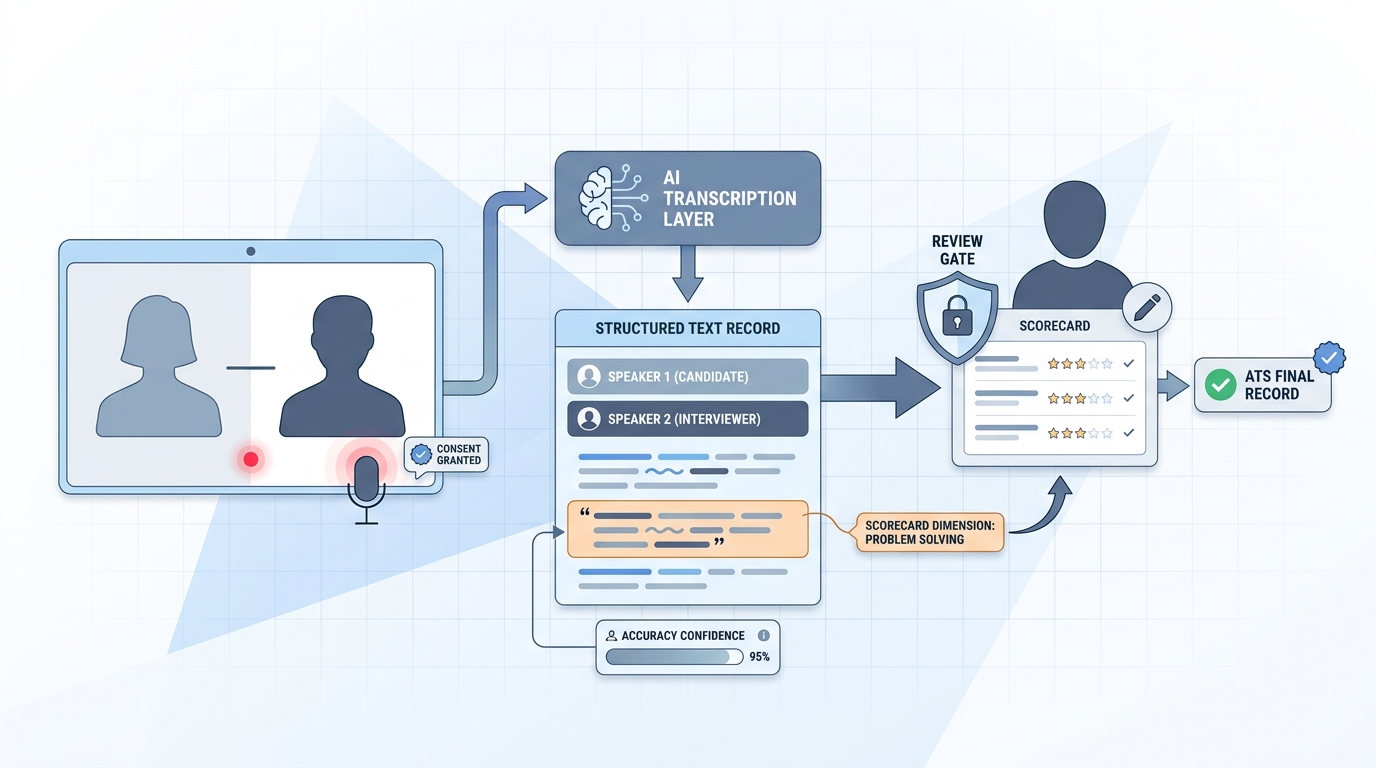
Interview transcription converts spoken interview audio into a text record. AI-powered versions go further: they split the transcript by speaker, summarise key moments, and map candidate responses to scorecard criteria. The goal is to give interviewers a reliable reference during debrief so evaluations are based on what was actually said, not what each person remembers.
In practice
- A recruiter joins a Zoom interview with transcription running in the background. Instead of typing notes during the call, they focus on follow-up questions. After the call ends, they review the transcript, highlight three evidence clips, and paste them into the scorecard before the hiring manager debrief.
- A TA ops lead notices that interview feedback quality varies wildly across the panel. They pilot a transcription tool tied to the ATS scorecard so every interviewer sees the same evidence prompts when submitting their rating, rather than writing from memory hours later.
- An HRBP doing an audit pulls transcripts from a borderline hire decision to verify that the documented rationale matches what the panel actually discussed. Without transcription, the audit relies on notes that were written retrospectively.
Quick read, then how hiring teams use it
This is for recruiters, interview coordinators, TA ops professionals, and HR partners who want a shared vocabulary around interview data capture. Skim the first section for the essentials. Use the second when you are evaluating tools, writing your data policy, or designing a structured debrief process.
Plain-language summary
- What it means for you: Instead of typing notes during the interview, an AI tool captures what was said so you can stay present in the conversation and review the evidence afterward.
- How you would use it: Enable recording at the start of the call (with candidate consent), let the tool produce a transcript and summary, then use that record to fill in your scorecard before the debrief, not instead of it.
- How to get started: Check whether your current video interview platform (Zoom, Teams, Google Meet) already has a transcription add-on, or whether your ATS vendor has partnered with a transcription tool. Start with one interview panel, review the output quality for two weeks, and only expand after you have a data retention policy in place.
- When it is a good time: When interviewers are consistently submitting incomplete scorecards, or when debrief conversations are dominated by recall ("I think she said...") rather than evidence.
When you are running live reqs and tools
- What it means for you: Transcription data is personal data. Storage, access controls, deletion schedules, and lawful basis need to be decided before you flip the feature on across your hiring pipeline.
- When it is a good time: After you have a scorecard template, a consent disclosure script, and a vendor DPA that matches your GDPR or state privacy obligations. Not as a bolt-on after a privacy incident.
- How to use it: Map transcript segments to scorecard dimensions in your calibration workflow. If the tool does not do this automatically, at minimum share a transcript link in the debrief doc so panel members can quote evidence rather than rely on memory.
- How to get started: Run a pilot with one job family, one interview stage, and interviewers who are already strong at structured evaluation. Measure whether scorecard completion rates and evidence quality improve before rolling out broadly.
- What to watch for: Speaker diarisation errors (the tool mixes up who said what), transcripts stored beyond your retention window, and interviewers reading the AI summary instead of the scorecard prompts.
Where we talk about this
On AI with Michal workshops, interview transcription comes up in sessions on structured hiring, AI interview intelligence, and candidate data governance. We discuss where transcription adds value in high-volume pipelines versus executive search, and what data policies need to exist before you turn on recording. Join a AI Sourcing Lab to hear how other TA teams have navigated consent, ATS integration, and debrief design in practice.
Around the web (opinions and rabbit holes)
Third-party creators move fast. Treat these as starting points, not endorsements. Do not copy stranger scripts that move candidate data across vendors without checking the privacy terms first.
YouTube
- Search "interview transcription AI recruiting" on YouTube for tool demo walkthroughs of Fireflies, Otter.ai, and Grain in interview contexts, including how they connect to Zoom and ATS workflows.
- "Structured interviewing" content from SHRM and LinkedIn Talent Solutions explains the calibration problem that transcription is often deployed to solve.
- r/recruiting has threads on whether interview transcription tools actually change how panels evaluate candidates, with honest takes on adoption challenges.
- r/humanresources covers the GDPR and consent side, including how HR teams handle candidate objections to being recorded.
Quora
- Is it legal to record job interviews? collects jurisdiction-specific answers worth reading before setting a policy.
Transcription vs manual notes
| Dimension | Manual notes | AI transcription |
|---|---|---|
| Coverage | Selective, recall-dependent | Full record of what was said |
| Objectivity | Filtered by note-taker | Unfiltered, but model errors exist |
| GDPR surface | Low | Higher: audio + text are personal data |
| Scorecard support | Gaps common | Evidence clips linkable to criteria |
Related on this site
- Glossary: AI interview intelligence, Applicant tracking system, Behavioral interview, Calibration session, GDPR recruiting data
- Live cohort: AI Recruiting Accelerator
- Membership: Become a member