GDPR and recruiting data
Rules under the EU General Data Protection Regulation that govern how organisations collect, store, process, and delete personal data about candidates and employees throughout the hiring lifecycle.
Michal Juhas · Last reviewed May 27, 2026
What is GDPR and recruiting data?
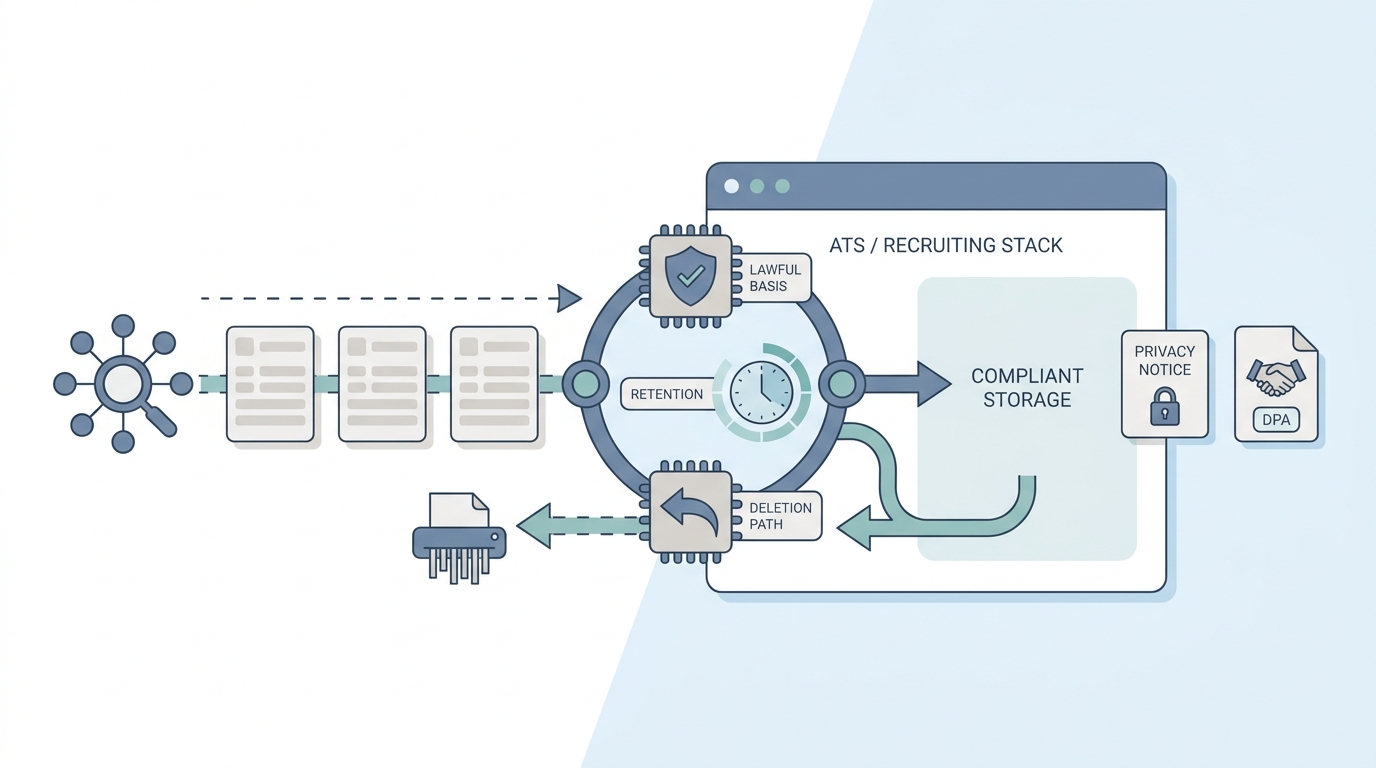
GDPR (General Data Protection Regulation) is the EU framework that treats every candidate profile, application, and interview note as personal data requiring a lawful basis to collect, a defined retention period, and a clear deletion path. Recruiters sourcing EU-based candidates must comply whether their organisation is based in the EU or not.
In practice
- A sourcer who saves a LinkedIn profile to an ATS without notifying the candidate is likely in breach of GDPR transparency requirements, even if the data was publicly visible.
- When a candidate emails "please delete my data," that is a formal erasure request under Article 17 and requires a documented response within 30 days.
- Adding an AI screening tool that auto-rejects candidates without human review may trigger Article 22 rights, requiring a human review capability before the tool goes live.
Quick read, then how hiring teams use it
This is for recruiters, sourcers, TA ops, and HR partners who need shared vocabulary in compliance reviews, vendor calls, and data audits. Skim the first section for a fast shared picture. Use the second when setting up tools, running enrichment, or onboarding a new AI screening platform.
Plain-language summary
- What it means for you: Every candidate record is regulated personal data. You need a reason to store it, a limit on how long you keep it, and a way to delete it when asked.
- How you would use it: Check lawful basis before sourcing outreach, add a privacy notice to every application form, and set ATS retention rules to auto-delete old profiles.
- How to get started: Ask your DPO or legal team for the current retention schedule. If one does not exist, draft a simple table mapping each data category to a retention period and a deletion owner.
- When it is a good time: Before adding any enrichment vendor or AI screening tool to your stack.
When you are running live reqs and tools
- What it means for you: Each new tool that processes candidate data is a GDPR processor. You need a Data Processing Agreement before you send it data, and it must appear in your Records of Processing Activities.
- When it is a good time: During vendor procurement, not after go-live. Retroactive DPAs slow rollouts and create enforcement exposure.
- How to use it: Map each tool to a lawful basis, a retention period, and a data category. Review the map when tools change or when sourcing expands to new EU jurisdictions.
- How to get started: Pull your current ATS retention settings and compare them to your written policy. Most teams find mismatches in the first review.
- What to watch for: Using legitimate interests for everything without completing the balancing test, and AI tools that claim GDPR compliance but cannot produce their own data handling documentation on request.
Where we talk about this
On AI with Michal live sessions, GDPR appears as a practical constraint on sourcing automation and AI tool selection rather than a legal lecture. The GDPR and first-touch candidate outreach module runs before any webhook build so teams understand lawful basis before wiring candidate data across vendors. AI Sourcing Lab sessions flag Article 22 when discussing automated screening. Bring your actual stack to AI Recruiting Accelerator to get feedback on where your GDPR gaps are most likely to sit.
Around the web (opinions and rabbit holes)
Third-party creators move fast. Treat these as starting points, not endorsements, and verify any regulatory guidance against official ICO or EDPB publications before acting on it.
YouTube
- The ICO (UK Information Commissioner) channel publishes short guides on legitimate interests and rights requests that apply directly to recruiting contexts.
- Search "GDPR HR data retention" for practitioner-facing explainers from privacy law firms that cover the retention schedule question in practical terms.
- r/GDPR has threads on candidate data retention, AI screening, and erasure requests from practitioners dealing with real operational questions.
- r/recruiting occasionally covers GDPR for sourcing and shows how teams handle consent in practice.
Quora
- Does GDPR apply to recruitment? collects practitioner and legal answers; quality varies, so cross-check specifics with your DPO.
GDPR basis comparison
| Scenario | Likely lawful basis | Key risk |
|---|---|---|
| Application via careers site | Contract performance | Must delete if withdrawn |
| Proactive sourcing outreach | Legitimate interests | Requires balancing test |
| Silver-medalist pool | Consent | Must maintain consent records |
| AI screening tool output | Legitimate interests | Article 22 if fully automated |
Related on this site
- Glossary: GDPR and first-touch candidate outreach, EU AI Act (hiring use cases), Candidate data enrichment, Human-in-the-loop (HITL), Background screening integration, Applicant tracking system (ATS)
- Guides: Sourcers
- Live cohort: AI Sourcing Lab
- Membership: Become a member