Joint employment liability for staffing placements
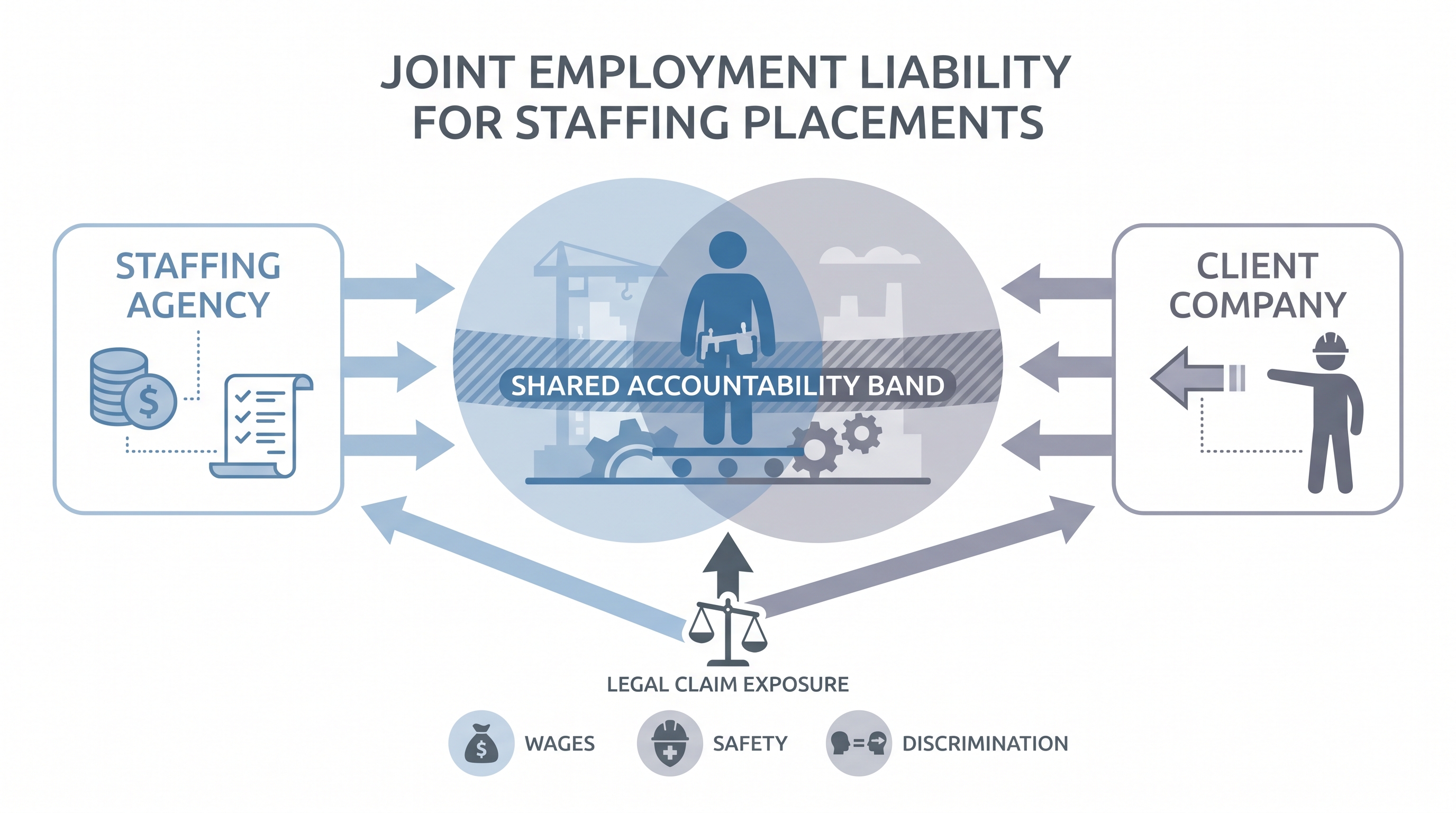
Joint employment liability in staffing placements arises when a court or regulator finds that both the staffing agency and the client company qualify as employers of the same placed worker, exposing both to wage and hour claims, discrimination suits, and workplace safety obligations regardless of what the staffing agreement says.
Michal Juhas · Last reviewed May 7, 2026
What is joint employment liability in staffing placements?
Joint employment liability in staffing placements arises when a staffing agency and the company where a worker is placed are both legally recognized as that worker's employer. Two separate legal persons can hold employer status simultaneously under statutes like the Fair Labor Standards Act, Title VII, and the National Labor Relations Act.
The agency is usually the employer of record: it handles payroll, benefits, and formal HR records. The client directs day-to-day tasks, controls the worksite, and often evaluates performance. When that split crosses a legal threshold, a court or regulator can require both entities to defend claims, pay damages, and adjust practices, regardless of what the staffing agreement says about who bears responsibility.
Joint employment is not a rare edge case. The Department of Labor, the NLRB, and state labor agencies all enforce it routinely in staffing, construction, agriculture, and logistics. For recruiting and HR leaders who work with staffing agencies, understanding where the agency's authority ends and the client's begins is the first step to managing this exposure.
In practice
- A staffing agency places five customer support contractors with a fintech client. The client's supervisors set their daily call schedules, approve their time-off requests, and include them in the company's performance review cycle. When one contractor files an overtime claim, the client's supervisory conduct makes both the agency and the client jointly liable for the unpaid wages and penalties, even though the staffing agreement names the agency as the sole employer.
- A TA leader at a professional services firm extends a contract employee for a third consecutive year without involving the staffing agency in any supervision decisions. When the worker files a discrimination claim, plaintiffs' counsel names both entities. The agency's indemnification clause covers only payroll errors, so the agency absorbs legal costs it did not anticipate when drafting the original agreement.
- An agency operating in California places contractors with multiple startups. One startup assigns them client email addresses and includes them in the company org chart. The state's ABC test finds employment by both entities, and both face back taxes, benefits reimbursement, and civil penalties that neither had budgeted for.
Quick read, then how hiring teams use it
This page is for agency principals, in-house TA leaders, HR business partners, and operations managers who manage staffing vendor relationships or place workers at client sites. Skim the first section for the core concept. Use the second when you are reviewing a staffing agreement, handling a contractor complaint, or advising a hiring manager on what they can and cannot ask a placed worker to do.
Plain-language summary
- What it means for you: If you use a staffing agency, you may legally be a second employer of the workers they place. That means a contractor's wage claim, harassment complaint, or OSHA violation can land on your desk even if the agency is listed as the sole employer in the contract.
- How you would use it: Before a contractor starts, review what supervisory actions your managers will take. If they set schedules, approve leave, or conduct performance reviews, document that those decisions follow the agency's guidelines rather than your own HR policy.
- How to get started: Ask your staffing vendors to walk you through their work order template. Check that it defines task scope, prohibits on-site assignment changes without agency approval, and names who handles complaints. Compare what it says against what your managers actually do today.
- When it is a good time: At contract renewal, at the six-month mark on any long-tenure placement, and whenever a contractor raises a concern directly to your HR team rather than to the agency.
When you are running live reqs and tools
- What it means for you: Your ATS and vendor management system should flag contractor placements by tenure and whether the client's supervisors have a pattern of HR-like actions. Long-term placements where the agency has no ongoing involvement carry the highest joint employer risk.
- When it is a good time: Set a review trigger at nine months on any single-client exclusive placement. Check whether the client's managers have taken actions that blur the employer boundary. Involve employment counsel before the 12-month mark.
- How to use it: Work order documentation, rate-change approval logs, and disciplinary records should live with the agency, not in the client's HRIS. If a client requests a rate change, the agency issues the approval. If the client wants to extend an assignment, the agency issues a new work order. These paper trails matter when claims are filed.
- How to get started: Audit your three longest active placements. Who conducted the last performance review? Who approved the last leave request? Who decided the last extension? If the answer is the client's team in each case, your exposure is higher than the indemnification clause suggests.
- What to watch for: Clients who add contractor names to internal org charts, issue client email addresses, or include contractors in company-wide incentive programs without consulting the agency. Each action adds factual support for a joint employer finding. Flag these to legal before they accumulate into a pattern.
Where we talk about this
On AI with Michal live sessions, joint employment and contractor compliance come up in the AI in recruiting track when agency founders and TA leaders discuss how to use AI-assisted sourcing, screening, and placement workflows without inadvertently expanding the employer relationship on the client side. The Sourcing Lab cohort addresses the commercial and legal structure of staffing alongside the tools, so participants understand the boundaries before building automations that touch client-side task management or contractor data.
Around the web (opinions and rabbit holes)
Third-party content on joint employment spans labor law commentary, HR practitioner forums, and agency owner discussions. These are starting points, not endorsements. Verify any clause language or test interpretation with employment counsel before relying on it in a live agreement.
YouTube
- Joint employer rules explained for staffing agencies covers the FLSA, NLRB, and state-level standards from agency and HR perspectives.
- Co-employment vs. joint employment: what staffing agencies need to know distinguishes the business arrangement from the legal conclusion and explains why both terms appear in the same contracts.
- How to limit joint employer liability in a staffing contract walks through work order drafting, indemnification clauses, and common mistakes that create exposure.
- Joint employer rules and staffing agencies in r/humanresources surfaces HR practitioner views on managing vendor relationships and contractor tenure risks.
- Joint employment liability for contract workers in r/RecruitmentAgencies includes agency owner accounts of claims, insurance responses, and client relationship dynamics.
- How long before contractor reclassification risk increases in r/recruiting covers assignment duration and what tenure thresholds trigger compliance reviews.
Quora
- What is joint employment liability and how does it affect staffing agencies? collects practitioner and legal perspectives on the split-employer structure and where it creates the most exposure.
Employer control split in a staffing placement
| Function | Agency responsibility | Client responsibility | Joint risk if boundary blurs |
|---|---|---|---|
| Pay rate and changes | Agency approves and executes | May request changes via agency | Client sets rates directly |
| Daily task direction | Work order defines scope | Client directs within scope | Client assigns work outside scope |
| Performance reviews | Agency conducts formal reviews | Client provides task feedback | Client runs HR-style reviews |
| Leave approvals | Agency policy governs | Client communicates schedule needs | Client approves leave unilaterally |
| Termination decisions | Agency decides and communicates | Client can request removal | Client fires or disciplines directly |
Related on this site
- Glossary: Co-employment risk for staffing agencies, Agency indemnification clauses
- Glossary: Client pass-through compliance for agency vendors, Agency markup in contract staffing
- Glossary: Backfill periods and replacement guarantees, Candidate right to represent
- Glossary: Client exclusivity in agency agreements, Agency invoice payment terms
- Workshops: Sourcing Lab
- Course: Starting with AI: the foundations in recruiting
- Membership: Become a member