Direct sourcing
Building and engaging talent pipelines in-house, without agency intermediaries, through proactive outreach to passive candidates, talent community management, and referral network activation.
Michal Juhas · Last reviewed May 24, 2026
What is direct sourcing?
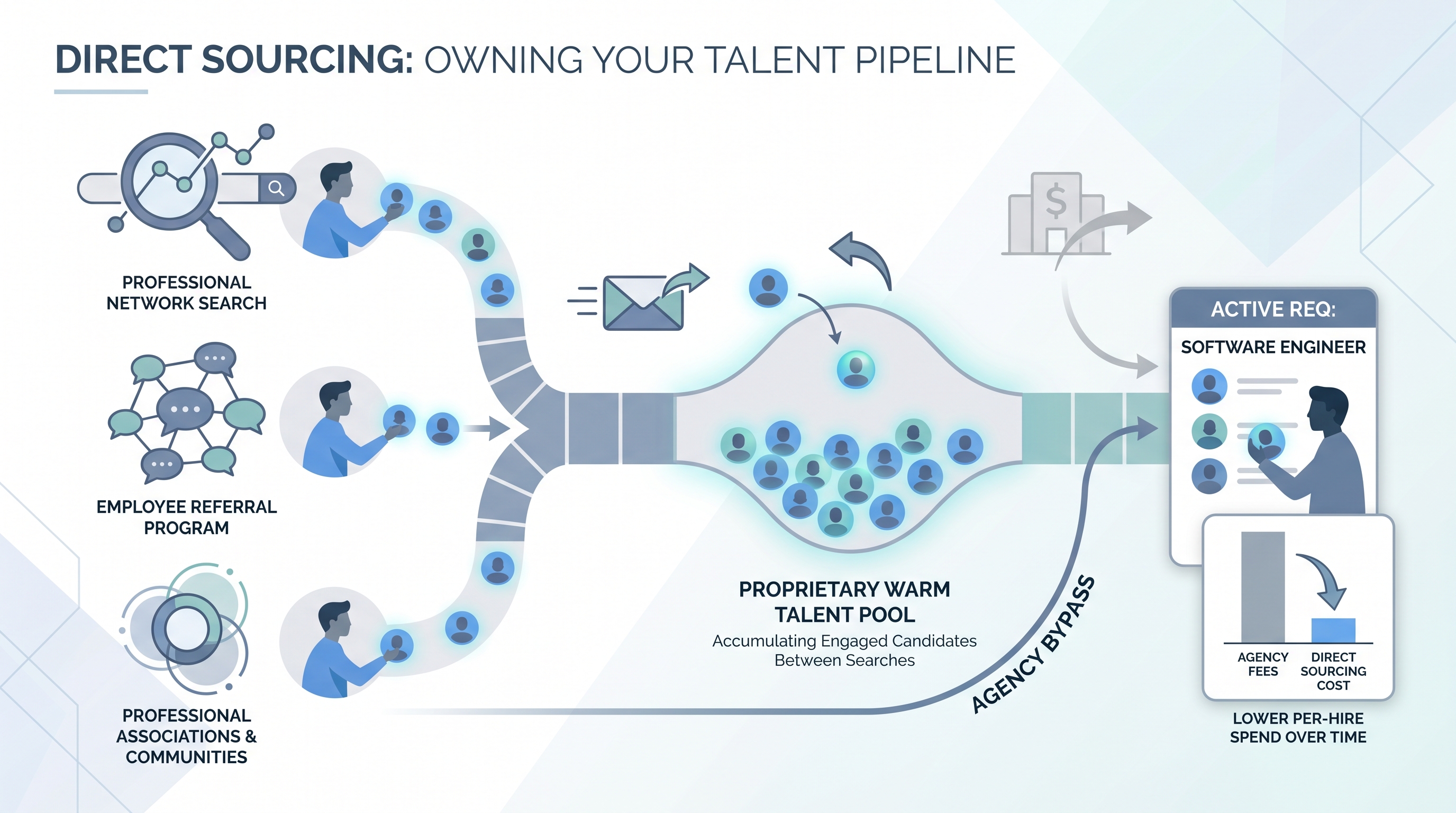
Direct sourcing is the practice of building talent pipelines in-house, without agency intermediaries. A sourcer identifies passive candidates through Boolean search, semantic tools, professional networks, and referral programs, reaches out proactively, and maintains relationships until a relevant role opens.
The contrast is agency sourcing, where a third-party firm handles the identification and initial outreach in exchange for a placement fee. Direct sourcing moves that work and cost inside the team, with the payoff compounding over time as the organization builds an owned talent pool rather than renting access to an agency's network on every search.
In practice
- When a sourcer at a growth-stage company says "I already have three people I've been talking to for this role," they are describing the output of a direct sourcing program: a warm pipeline built before the req opened.
- A TA leader who reports that time-to-fill dropped by 30 percent without increasing headcount is usually describing a direct sourcing motion that moved candidates from cold outreach to active pipeline before the role was formally approved.
- A team that sources 200 profiles, sends 200 messages, and then lets 39 engaged non-hires go cold without a nurture sequence is doing direct sourcing without a pipeline strategy, which is a common and expensive pattern.
Quick read, then how hiring teams use it
This is for sourcers, recruiters, and TA leaders building in-house talent acquisition capability. Skim the first section for a shared vocabulary. Use the second when you are designing a sourcing workflow, evaluating tools, or making the case for a direct sourcing investment to finance or HR leadership.
Plain-language summary
- What it means for you: Instead of calling an agency every time a req opens, you build a list of people you already know are a potential fit and reach out to them first.
- How you would use it: Pick one role family that repeats at least quarterly. Build a sourcing query for it. Run outreach. Track replies. Maintain the pipeline between active searches.
- How to get started: Identify the last three roles where an agency was used that matched an existing role category. Pull the agency-submitted candidate list. Those are the profiles you should have been sourcing directly.
- When it is a good time: When the same role type opens more than twice a year, when agency fees on that role type represent a meaningful percentage of your TA budget, and when your sourcer has tools and time to run outreach without it competing with active pipeline management.
When you are running live reqs and tools
- What it means for you: Direct sourcing requires a system: a place to store contacts and their status, outreach templates that can be personalized at scale, and a nurture sequence that keeps warm candidates engaged between searches. Without a system, sourcing becomes a series of one-off campaigns with no compounding return.
- When it is a good time: After you have a sourcing query that produces consistent results, an outreach template with a reply rate above 20 percent, and an ATS pipeline or proprietary talent pool structure that can hold warm candidates without promoting them to active applicants prematurely.
- How to use it: Build a sourcing workflow in three stages: discovery (find profiles), qualification (shortlist by fit), and outreach (personalized message sequence). Use AI for discovery and first-draft message generation. Use human review before any message goes live.
- How to get started: Set up a sourcing tag or pipeline stage in your ATS for "warm, not yet active." Add anyone who replies positively to outreach to that stage. Build a 90-day re-engagement sequence so they hear from you again before the next relevant role opens.
- What to watch for: Message quality eroding when AI-drafted templates are reused without review, candidate pipelines that are built but never nurtured, sourcing data that sits in a spreadsheet outside the ATS and cannot feed deduplication-merge-rules or suppression logic, and compliance gaps when sourcing across EU platforms without a documented lawful basis.
Where we talk about this
On AI with Michal live sessions, direct sourcing is often the first practical exercise: participants define a target profile, build a search, draft outreach, and evaluate what AI can and cannot do at each step. The sourcing automation track covers the full pipeline from discovery through nurture automation, and the AI in recruiting track connects sourcing to interview and offer workflows. Start at Sourcing Lab and bring a live role you are actively sourcing.
Around the web (opinions and rabbit holes)
Third-party creators move fast. Treat these as starting points, not endorsements, and double-check anything before you wire candidate data to a new tool.
YouTube
- How to Build a Direct Sourcing Program (search) covers strategy, channel selection, and pipeline management from TA practitioners who have run these programs at scale.
- AI Tools for Candidate Sourcing in 2024 and 2025 (search) includes tool demos and comparisons relevant to in-house sourcing teams.
- Boolean Search vs AI Sourcing: What Actually Works (search) gives a practitioner comparison of manual and AI-assisted discovery methods.
- How do you build a direct sourcing pipeline without an agency? in r/recruiting is a candid thread on what tools and habits actually produce results.
- AI sourcing tools: what have you tried and what actually works? in r/recruiting covers real practitioner experiences with discovery and outreach tools.
- Making the case for direct sourcing to leadership in r/humanresources covers how TA leaders have presented the build-versus-buy argument internally.
Quora
- What is direct sourcing in recruitment and how does it work? collects answers from sourcers, TA leaders, and workforce strategy consultants on channel selection and pipeline management.
Direct sourcing vs. agency sourcing
| Dimension | Direct sourcing | Agency sourcing |
|---|---|---|
| Cost per hire | Lower over time | Higher per placement (fee percentage) |
| Speed to first candidate | Slower (pipeline build time) | Faster (agency network ready) |
| Talent pool ownership | In-house, grows over time | Rented, resets each engagement |
| Niche specialty coverage | Weaker without investment | Stronger for first-time hires |
| Data and compliance control | Full control | Depends on agency's data practices |
Related on this site
- Glossary: Boolean search, Multi-channel talent sourcing, Proprietary talent pool, Candidate data enrichment, Prompt chain, Semantic search
- Blog: AI sourcing tools for recruiters, Boolean search vs AI sourcing
- Guides: Sourcers
- Live cohort: Sourcing Lab
- Self-paced: Starting with AI: the foundations in recruiting
- Membership: Become a member