Most favored nation (MFN) pricing in agency contracts
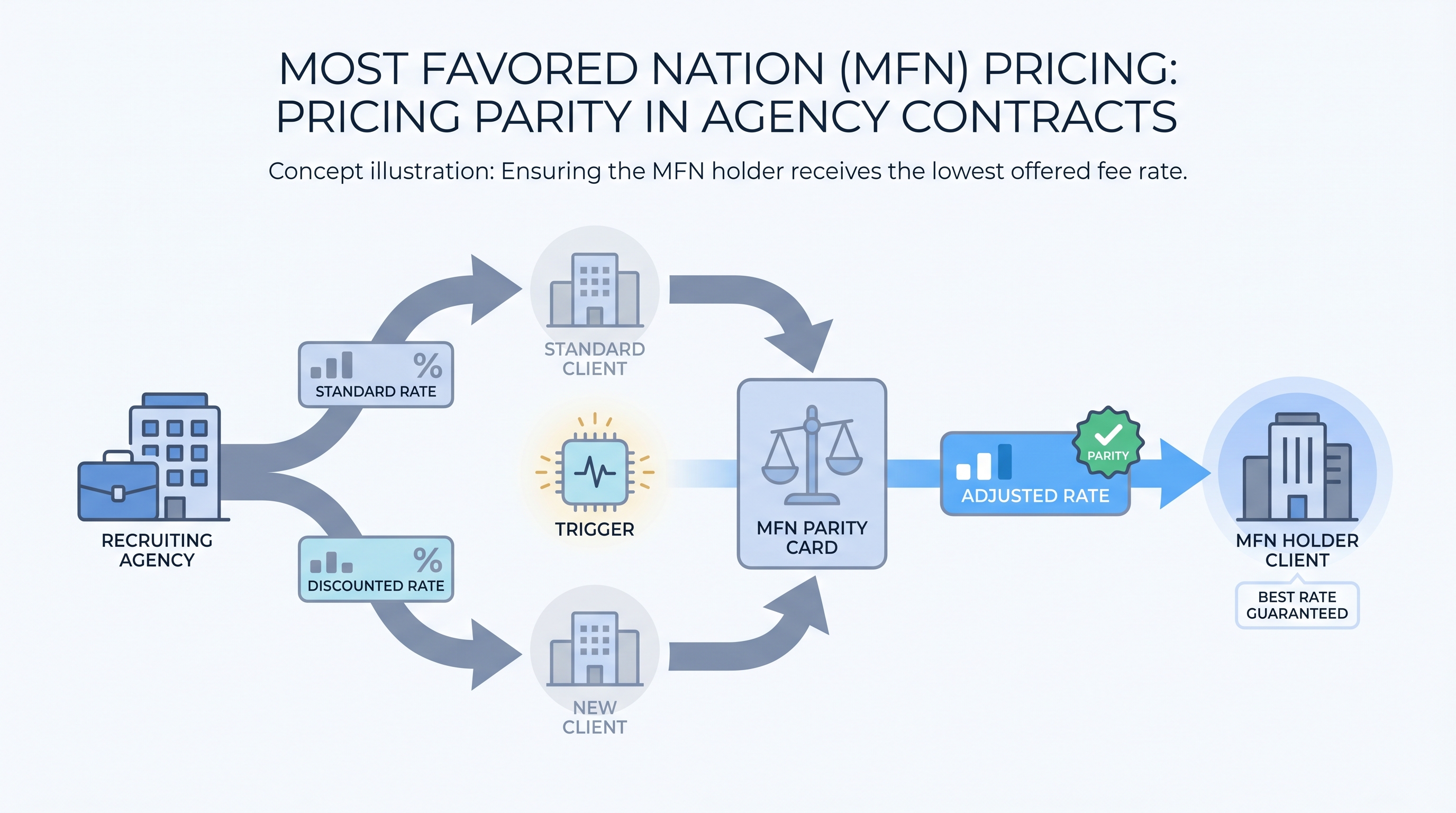
A most favored nation (MFN) pricing clause in an agency contract requires the agency to offer a client terms no less favourable than those it gives to any other client for comparable services. If the agency agrees to lower fees elsewhere during the contract term, the MFN holder is entitled to the same rate.
Michal Juhas · Last reviewed May 7, 2026
What is most favored nation (MFN) pricing in agency contracts?
A most favored nation (MFN) pricing clause requires a recruitment or staffing agency to offer a client terms no less favourable than those it offers to any other client for comparable services. If the agency agrees to a lower contingency fee, a reduced markup rate, or an enhanced guarantee period with another buyer during the contract term, the MFN holder is entitled to the same improvement.
MFN clauses originate in international trade law and enterprise software licensing, where large buyers use them to prevent vendors from reserving their best terms for newer or smaller accounts. In staffing and recruitment, they appear most often in master services agreements governing vendor-of-record programmes, large contingent workforce accounts, and RPO engagements where enterprise procurement teams manage multiple supplier relationships simultaneously.
For agency owners, the clause is a commercial constraint that limits pricing flexibility across the entire client portfolio. For TA and procurement leaders, it is a tool for ensuring rate discipline and pricing transparency at scale, without running a retender every time a vendor adjusts its rate card for another account.
In practice
- A global technology company's procurement team discovers during a quarterly vendor review that two of its business units are paying different contingency rates to the same agency. The MSA contains an MFN clause. The agency applies the lower rate across all units at the next review cycle and adds a service-category carve-out to prevent the clause from reaching its executive search pricing.
- A staffing agency principal negotiating a new enterprise MSA pushes back on a broad MFN clause by proposing a scoped version limited to the same service category and a comparable volume band, with a 12-month lookback and a 90-day notice window before any rate adjustment is required.
- A TA leader approves a discounted contingency rate for a niche engineering hire without checking whether the company's MSA with the same agency contains an MFN provision. Procurement flags the discrepancy in the next vendor review, and the team runs a cross-functional session to align on rate approval governance before any future bespoke agreements.
Quick read, then how hiring teams use it
This page is for agency owners, operations managers, in-house TA leaders, and procurement teams who negotiate, sign, or manage recruitment and staffing agreements. Skim the first section for the definition and the risk picture. Use the second when you are reviewing an MSA with an MFN clause, negotiating scope limits, or assessing whether a planned rate change will trigger a review obligation.
Plain-language summary
- What it means for you: If your agency's contract with a client contains an MFN clause, any lower rate you agree with any other comparable client can be claimed by the MFN holder. It is a pricing parity obligation that applies across your entire client portfolio, not just the account in front of you.
- How you would use it: Read the MFN clause before accepting any client-side promotional request or signing a new account at a discounted rate. Check the scope definition, the trigger mechanism, and the notice window before you confirm a rate.
- How to get started: Pull your three highest-revenue client MSAs and check whether they include an MFN clause. If they do, confirm the scope, the lookback period, and whether your current rate across other clients already triggers an obligation.
- When it is a good time: Before signing any new client at a below-standard rate, and at every MSA renewal where the commercial landscape has shifted and new introductory deals are in play.
When you are running live reqs and tools
- What it means for you: MFN clauses make every rate concession a portfolio-wide event, not a one-off negotiation. A discount offered to close a new logo in Q3 can reset the floor rate for a long-standing enterprise account in Q1 of the following year.
- When it is a good time: Before any bespoke rate discussion with a client whose MSA contains an MFN clause, and when launching a promotional rate for a new service line that may be caught by the scope definition in an existing agreement.
- How to use it: Maintain a rate register across all active client agreements. Log any commercial variation, including introductory rates, pilot pricing, and promotional discounts, against the service category and volume band. Review against active MFN clauses before confirming any variation.
- How to get started: Add an MFN flag to your contract management system or MSA log so every account shows whether a parity obligation exists and what the trigger window is. Review this flag before any commercial variation is approved by an account manager or director.
- What to watch for: Broad MFN clauses with no service-category carve-outs, no volume thresholds, and no lookback cap. These are the most commercially dangerous because they can propagate a pilot rate or a competitive tender rate across unrelated, high-margin accounts with a contractual right the client can exercise retrospectively.
Where we talk about this
On AI with Michal live sessions, agency contract structure, including MFN clauses, fee negotiation frameworks, and vendor-of-record programme governance, comes up in the AI in recruiting track when agency principals discuss how to manage scalable, commercially sustainable client relationships. The Sourcing Lab cohort covers both agency and in-house TA perspectives so participants understand what they are agreeing to before the signature.
Around the web (opinions and rabbit holes)
MFN clause commentary in the staffing and recruitment context is spread across employment law blogs, staffing industry association resources, and commercial contract negotiation guides. These are starting points, not endorsements. Verify any legal or contractual position with counsel before relying on it in a live MSA negotiation.
YouTube
- What is a most favored nation clause? covers MFN clause mechanics in commercial contracts, including how triggers and lookback windows are typically defined.
- Staffing agency contract negotiation: MFN and pricing clauses walks through practical approaches to scoping and limiting MFN obligations in agency MSAs.
- Vendor management and pricing parity in procurement explains how enterprise procurement teams use MFN clauses to manage multi-supplier panels and rate discipline.
- MFN clauses in vendor contracts in r/procurement includes procurement professional perspectives on how MFN scope is defined and enforced in practice.
- Staffing agency pricing and MSA negotiation in r/RecruitmentAgencies covers agency owner experiences with enterprise client contract demands, including MFN provisions.
- Contract clause negotiation tips in r/legaladvice offers general perspectives on MFN clause limits and carve-out strategies.
Quora
- What is a most favored nation clause in a contract and how does it work? collects practitioner and legal perspectives on MFN mechanics, scope risks, and typical negotiation positions.
MFN clause design and agency risk
| Clause design | Triggers | Agency risk | Recommended position |
|---|---|---|---|
| Broad: all services, all clients, no volume limit | Any fee reduction with any client | Very high | Reject; insist on category and volume carve-outs |
| Scoped: same service category and volume band only | Same-category rate reduction at comparable volume | Manageable | Accept with pilot, tender, and non-profit exclusions |
| Time-capped: 12-month lookback with forward sunset | Rate reduction within the preceding 12 months | Low | Preferred structure; add a 90-day notice window |
| Reciprocal: agency gets MFN on client preferred vendor rates | Mutual obligation activated by either party | Balanced | Negotiate for any broad-scope MFN as a counterweight |
Related on this site
- Glossary: Master services agreement for agency services, Agency markup and contract staffing
- Glossary: Agency invoice and payment terms, Agency indemnification clauses
- Glossary: Client exclusivity in agency agreements, Agency escrow and retainers
- Glossary: Backfill periods and replacement guarantees, Client concentration risk for agencies
- Workshops: Sourcing Lab
- Course: Starting with AI: the foundations in recruiting
- Membership: Become a member