Master services agreement (MSA) for agency services
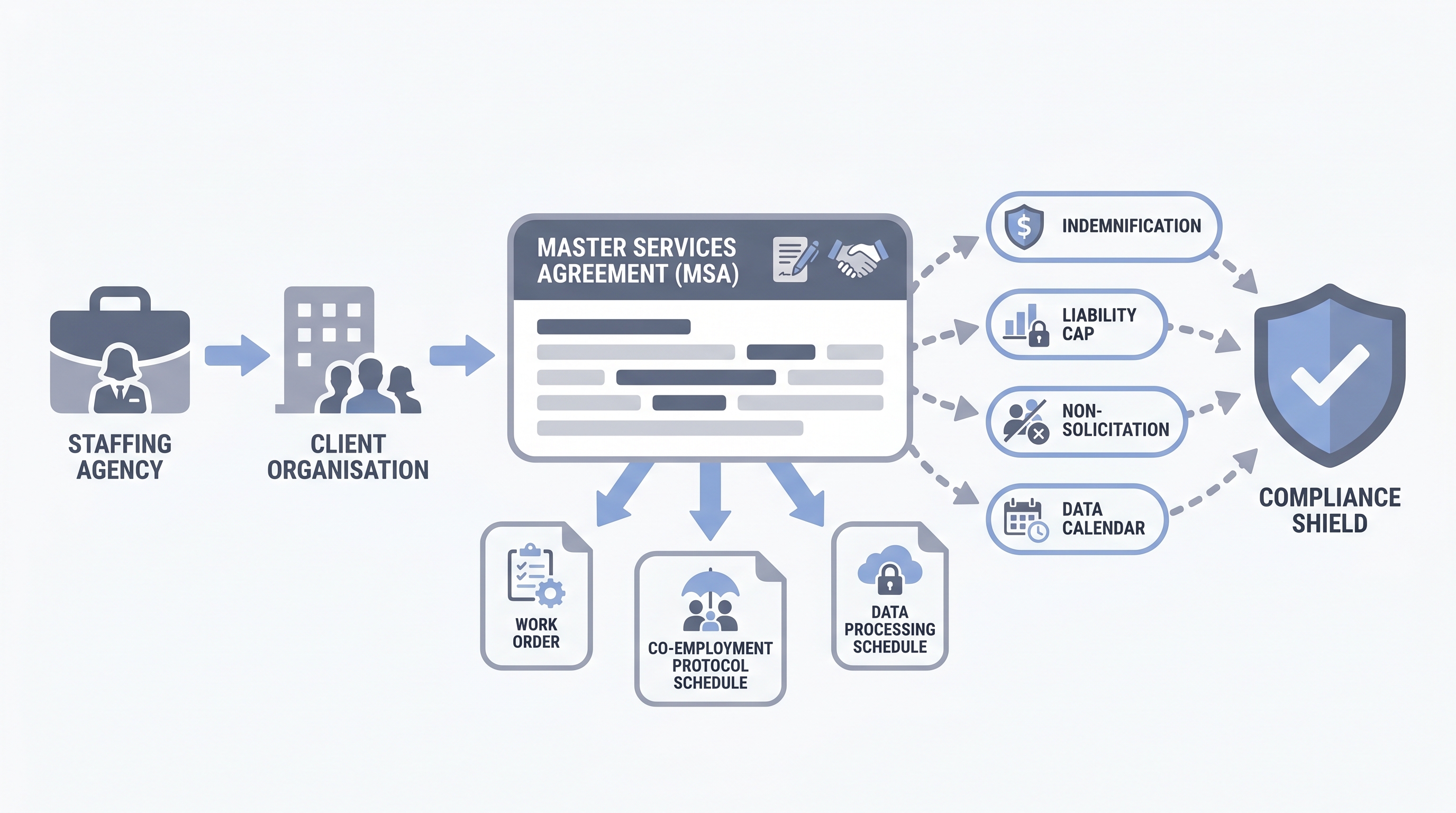
A master services agreement (MSA) is the governing contract between a recruitment or staffing agency and a client organisation that sets standing terms, including fee structures, liability allocation, data responsibilities, and contractor supervision boundaries, under which individual placements and work orders operate.
Michal Juhas · Last reviewed May 7, 2026
What is a master services agreement (MSA) for agency services?
A master services agreement is the governing contract between a recruitment or staffing agency and a client organisation that sets the standing terms for the entire relationship. Every placement order, work order, or statement of work issued under it inherits those terms by default, which means the MSA sets the liability, compliance, and commercial framework for every engagement that follows.
Most agencies use a two-tier structure: the MSA covers the relationship-wide terms, and a short child document covers the specifics of each individual placement. This keeps placement orders brief and legally clean, because the MSA already handles what happens when something goes wrong.
For contract staffing agencies placing contractors across enterprise accounts, the MSA is an ongoing operational document, not a once-signed formality. It governs data sharing, employer-of-record status, supervision boundaries, and fee disputes for the life of each client relationship. Most agency disputes trace back to an MSA signed quickly at deal close and never revisited as the relationship, contractor population, and regulatory landscape changed.
In practice
- An agency owner reviews a new enterprise client's proposed MSA and discovers a liability cap set at fees paid in the preceding three months, eliminating meaningful protection on a contract staffing deal with 40 active contractors. After negotiation, the cap is raised to 12 months and a co-employment protocol schedule is added.
- A staffing firm's legal counsel adds a co-employment protocol schedule to the standard MSA template after a client's HR team begins conducting annual performance reviews with agency contractors, creating a documented supervision boundary before any legal challenge arises.
- A mid-market recruitment agency negotiates a 12-month non-solicitation clause down to six months and narrows its scope from any candidate known to the client to candidates specifically introduced by the agency, removing a provision that would have blocked placements from the client's own public job postings.
Quick read, then how hiring teams use it
This page is for agency principals, operations managers, in-house TA leaders, and legal or compliance teams who negotiate, sign, or manage recruitment and staffing agreements. Skim the first section for the definition. Use the second when you are reviewing a new MSA, renewing an existing one, or responding to a client request to accept their standard terms.
Plain-language summary
- What it means for you: The MSA is the rulebook for your entire relationship with a client, not just one placement. It sets who is responsible when something goes wrong, how and when you get paid, and what you are allowed to do with candidate data.
- How you would use it: Review it before signing, especially the indemnification, liability cap, data processing, and non-solicitation clauses. Do not accept the client's standard terms without reading the specific provisions that govern your exposure.
- How to get started: Start with a redline of any client-proposed MSA against your own standard terms. Flag clauses that expand your liability beyond the fee on a single placement or that hand enforcement obligations to you for the client's internal policies.
- When it is a good time: Before signing with any new client, at every formal renewal, and whenever the engagement scope changes materially, such as moving from permanent placement to contract staffing.
When you are running live reqs and tools
- What it means for you: The MSA governs every active placement in that client account. When a contractor raises a pay dispute or the client requests candidate data for an unrelated purpose, the MSA determines what your obligations are and who pays if something goes wrong.
- When it is a good time: Before any placement starts, before deploying AI tools that touch candidate or contractor data shared with the client, and when a client requests changes to how contractors are managed on site.
- How to use it: Maintain a live MSA log per client: expiry date, liability cap, data processing schedule reference, co-employment protocol status, and last review date. Cross-reference with your indemnification schedule so you know which exposures sit with you and which sit with the client.
- How to get started: Pull your three highest-revenue client MSAs and check whether they include a co-employment protocol schedule, a data processing agreement, and a liability cap above the trailing three months of fees. Most do not. Fix the gaps at next renewal.
- What to watch for: Client-imposed technology tools that route work to or monitor agency contractors. If a client's task management or AI system is directing contractor daily output, that system may be creating supervision behaviour not captured in the original MSA. Add a notification clause requiring the client to inform you before deploying automated management tools that affect your contractors.
Where we talk about this
On AI with Michal live sessions, agency contract structure, including MSAs, supplier compliance frameworks, and contractor management risk, comes up in the AI in recruiting track when agency owners discuss how to run scalable, compliant operations. The Sourcing Lab cohort covers the business and legal side of agency agreements so both in-house TA leaders and agency principals understand what they are agreeing to and why each clause matters.
Around the web (opinions and rabbit holes)
Third-party content on MSAs for staffing and recruitment agencies spans employment law commentary, staffing industry association guidance, and HR legal forums. These are starting points, not endorsements. Verify any legal position with employment counsel before relying on it in a live agreement or audit response.
YouTube
- Master services agreements for staffing agencies explained covers the key clauses agency owners encounter when negotiating enterprise client MSAs.
- Staffing agency contract negotiation tips walks through practical redline approaches on indemnification and liability caps.
- Co-employment clauses in staffing MSAs discusses how the supervision boundary clause interacts with employer-of-record status.
- MSA negotiation in r/RecruitmentAgencies includes agency owner accounts of common client-proposed clauses and how practitioners push back.
- Staffing agency liability and indemnification in r/recruiting surfaces recruiter and agency perspectives on what liability exposure looks like in practice.
- Non-solicitation clauses in staffing contracts in r/humanresources covers HR and legal perspectives on how non-solicitation scope is typically defined and challenged.
Quora
- What should a staffing agency look for in a master services agreement? collects practitioner and legal perspectives on the clauses that carry the most operational risk.
MSA clause risk by engagement type
| Clause | Highest risk scenario | Typical agency position | Negotiation lever |
|---|---|---|---|
| Indemnification | Broad mutual indemnity covering conduct the client directed | Limit to agency-caused losses only | Add a carve-out for client supervision behaviour |
| Liability cap | Cap set at one placement fee or three months of fees | 12 months of fees minimum on contract staffing | Tie cap to the value and duration of the active contractor population |
| Non-solicitation | Any candidate known to the client, indefinitely | Candidates introduced by the agency, six months | Narrow scope plus time limit plus public-posting exception |
| Data processing | Candidate data used for unrelated client purposes | Purpose limitation, deletion schedule, breach notice | Add a formal data processing schedule as an MSA schedule |
| Co-employment | No protocol schedule, no tenure cap | Employer-of-record clause, prohibited behaviours list | Add a co-employment protocol schedule with a tenure trigger |
Related on this site
- Glossary: Agency indemnification clauses, Co-employment risk for staffing agencies
- Glossary: Client pass-through compliance for agency vendors, Client exclusivity in agency agreements
- Glossary: Agency invoice and payment terms, Joint employment liability for staffing placements
- Glossary: Agency data room and due diligence, Backfill periods and replacement guarantees
- Glossary: GDPR and first-touch outreach, Workflow automation
- Workshops: Sourcing Lab
- Course: Starting with AI: the foundations in recruiting
- Membership: Become a member