Online interview platforms
Software category covering platforms built for conducting hiring conversations via video or audio, either live or asynchronously, with purpose-built features for question delivery, panel scheduling, scored rubrics, and ATS integration.
Michal Juhas · Last reviewed May 9, 2026
What is an online interview platform?
An online interview platform is software built for conducting hiring conversations over video or audio, either live or asynchronously. The category covers a wide range: purpose-built tools like HireVue and Spark Hire that run structured one-way or live video interviews; AI notetaking layers like BrightHire and Metaview that add transcription and summary drafts to any call; and ATS-native interview kits in Greenhouse, Lever, or Ashby that embed question banks and panel scheduling without a separate vendor.
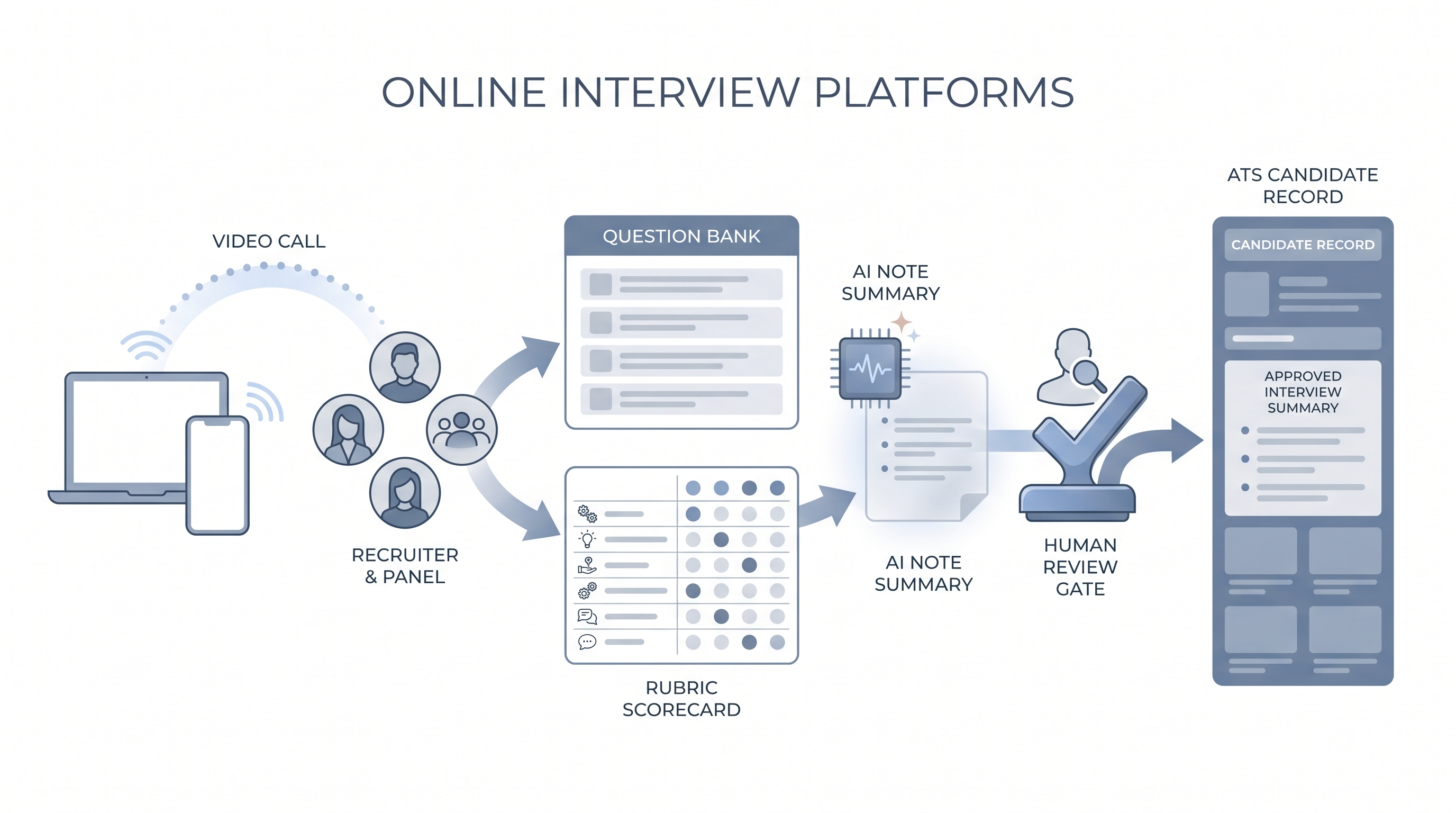
What separates a dedicated online interview platform from a general video tool is the recruiting-specific layer on top of the connection: structured question delivery, panel feedback forms, scored rubrics per competency, and ATS integration so candidate records update automatically after the call ends.
In practice
- A TA coordinator replaces ad-hoc Zoom links with a dedicated platform so every panel for a senior engineering role gets the same five behavioral questions, a rating scale per question, and a consolidated scorecard before the debrief, rather than whoever typed notes first driving the conversation.
- Sourcers and recruiters refer to it as "the interview tool" in standups. Candidates encounter it as a scheduling link or a self-serve recording prompt, rarely by its product name.
- Finance and legal call it "the recording vendor" during contract reviews, because their concern is where transcripts land, for how long, and which sub-processors have access, not how the question rubric is structured.
Quick read, then how hiring teams use it
This is for recruiters, sourcers, TA, and HR partners who need shared vocabulary for vendor evaluations, panel setup, debrief reviews, and compliance conversations. Skim the first section for a fast picture. Use the second when you are deciding how an online interview platform fits into your ATS, structured interview process, and data governance setup.
Plain-language summary
- What it means for you: A single place where panelists receive their questions, record scores, and leave feedback, instead of one person emailing a document, another filling a form, and a third trying to remember to update the ATS.
- How you would use it: Pick a role where panel feedback is inconsistent. Configure question kits with a rubric. Send panelists a link. Compare feedback completion rates and debrief quality before and after.
- How to get started: Before opening a vendor portal, write the three to five questions every panelist should answer for the role. Map each to a competency. Then decide whether your ATS can hold that structure or whether a separate tool is genuinely needed.
- When it is a good time: When structured interviewing is inconsistent across panels, when scheduling runs through email chains, or when hiring managers ask to see all scores before the debrief call starts.
When you are running live reqs and tools
- What it means for you: An online interview platform enforces structure at scale: the same questions, the same rubric, the same feedback form, logged to the ATS without manual entry. That is how debrief data becomes usable instead of relying on recalled impressions.
- When it is a good time: After your scorecard is stable and panelists trust the rubric. Deploying a platform on an unstable interview process automates the inconsistency rather than fixing it.
- How to use it: Wire it to your ATS so stage changes, feedback submissions, and calendar confirmations flow automatically. Log which question version was active per cohort. Keep AI-generated notes behind a human-in-the-loop review gate before anything reaches the official ATS record.
- How to get started: Audit your current process on one req: how are questions delivered, how is feedback collected, where does it live? Map that to what the platform replaces versus what needs a policy decision first (recording consent, transcript storage, AI scoring).
- What to watch for: Low feedback form completion (panelists skipping the rubric), recording consent gaps across jurisdictions, AI scoring features that have not been through a bias audit, and data retention policies that conflict with your DPA.
Where we talk about this
On AI with Michal live sessions we cover online interview platforms as part of the broader hiring tool evaluation: when your ATS-native interview kit is sufficient, when a dedicated platform is worth the vendor overhead, and how to handle AI note summaries inside a GDPR-compliant review workflow. If you want those conversations grounded in your real stack and compliance context, start at Sourcing Lab and bring your current interview setup, your ATS name, and any open DPA questions.
Around the web (opinions and rabbit holes)
Third-party creators move fast and tooling changes often. Treat these as starting points, not endorsements, and double-check anything before you wire candidate data.
YouTube
- Search "structured video interview setup recruiting" filtered to the past year for independent practitioner walkthroughs that show real question banks and rubric design, not vendor marketing demos.
- Search "AI interview notetaker comparison" for honest assessments of BrightHire, Metaview, and similar tools, including what happens when candidates object to recording.
- r/recruiting carries regular threads on interview platform decisions, including which ATS-native kits are "good enough" and when teams actually buy a dedicated tool.
- r/humanresources covers the compliance and DPA side more deeply, useful when the legal review is the real bottleneck in your vendor evaluation.
Quora
- What is the best video interview platform for hiring? collects a range of practitioner answers across company sizes (read critically; some are vendor-adjacent or dated).
Online interview platform versus general video tool
| Factor | Dedicated online interview platform | General video tool (Zoom, Teams) |
|---|---|---|
| Question delivery to panelists | Built-in question bank per role | Manual (doc, email, or separate tool) |
| Panelist scorecard | Native rubric and rating scale | Separate document or ATS form |
| ATS integration | Automatic stage and feedback sync | Manual update after each call |
| AI notetaking | Often native or tightly integrated | Requires a separate add-on |
| Recording consent management | Dedicated consent modules | Manual process, no tooling |
| Setup overhead | Higher (vendor DPA, onboarding) | Near zero (already in use) |
Related on this site
- Glossary: Async screening, One-way video interview, Scorecard, Human-in-the-loop (HITL), Applicant tracking software, AI hiring software, Interviewing platform, Best video interview software
- Blog: AI candidate screening
- Guides: Talent acquisition managers
- Course: Starting with AI: the foundations in recruiting
- Live cohort: Sourcing Lab
- Membership: Become a member