AI for Talent Acquisition Managers
TA leadership tied to the AI adoption ladder: governance, pilots, stage signals, example climbs from Chatting to Systemizing and beyond, plus consulting and courses.

If this is your job
You translate executive urgency into policy, budget, and coaching rhythms. Recruiters feel the clock on every req. Vendors promise magic. Legal and People partners ask sensible questions about fairness and data. Your job is not to ban AI. It is to make safe use easier than unsafe use, and to keep experiments tied to outcomes executives recognize. The AI adoption ladder (cornerstone below) is the map for that: it shows where your org really is and which rung to fund next so you do not buy Automating while everyone is still in Chatting.
This page is for TA leaders who must answer three questions at once: How do we move faster? How do we stay defensible? How do we get recruiters to actually use the approved path? Your organization sits on an AI adoption ladder whether or not the slide deck says so: shadow Chatting in every browser tab competes with Systemizing you fund with SSO and libraries. The cornerstone section below anchors governance and pilots to real rungs; then we go into plays you can ship.
How to think about AI adoption on the TA leader desk
These principles apply at every rung: Governance follows speed matters whether people are in Chatting or Automating. Use the cornerstone ladder section to decide which rung you are funding this quarter.
Governance follows speed. If the sanctioned workflow is slower than a personal chat tab, you will get shadow AI no matter what the policy says. Your first job is to make the approved stack faster and easier to find than rogue tabs.
Pilot one workflow, not one vendor. Vendors sell platforms; your team ships intake-to-outbound handoffs. Anchor pilots on a repeatable recruiting motion with baseline metrics, then evaluate tools against that motion.
Measure adoption before hiring lift. If nobody uses your template library, the model quality score is irrelevant. Track login rates to approved assistants, time-on-task for drafting after templates ship, and recruiter satisfaction with the assisted steps.
Tell the truth to executives. AI might shorten cycle time in specific steps while hiring outcomes lag until intake stabilizes. Separate "time saved drafting" from "quality of hire" so you do not claim victory on the wrong curve.
Where the pressure actually shows up
Shadow AI. The approved path feels slower than a personal chat tab. People paste reqs and resumes into tools IT never approved because that tab is one click away.
Governance theater. A forty-page policy nobody reads, while the real work stays off-books. Rules without tooling bounce; recruiters route around them until something breaks in public.
Vendor noise. Every demo shows happy paths. You still have to answer what happens to candidate data, who retrains models, and what the audit trail looks like when a regulator or journalist asks.
Change fatigue. "AI training" that does not connect to live reqs trains nobody. Slide decks do not change behavior; templates tied to real openings do.
Proof for the C-suite. Leaders want time-to-fill and quality; they also hear horror stories about biased screening. You need a story that is neither hype nor fear.
Cross-functional friction. Legal wants constraints. IT wants SSO. Finance wants ROI. Recruiters want minutes back today. You broker those pulls without promising magic.
Where you are on the AI adoption ladder (cornerstone)
Start here. TA leadership owns whether the company stays stuck in Chatting (fast shadow tools, zero audit trail) or climbs to Systemizing and Automating with evidence. The shared vocabulary is the AI adoption ladder: Offline → Chatting → Systemizing → Automating → AI-Native. Your roadmaps should sequence training, templates, and integrations in that order for hiring workflows, not buy a platform and hope behavior follows.
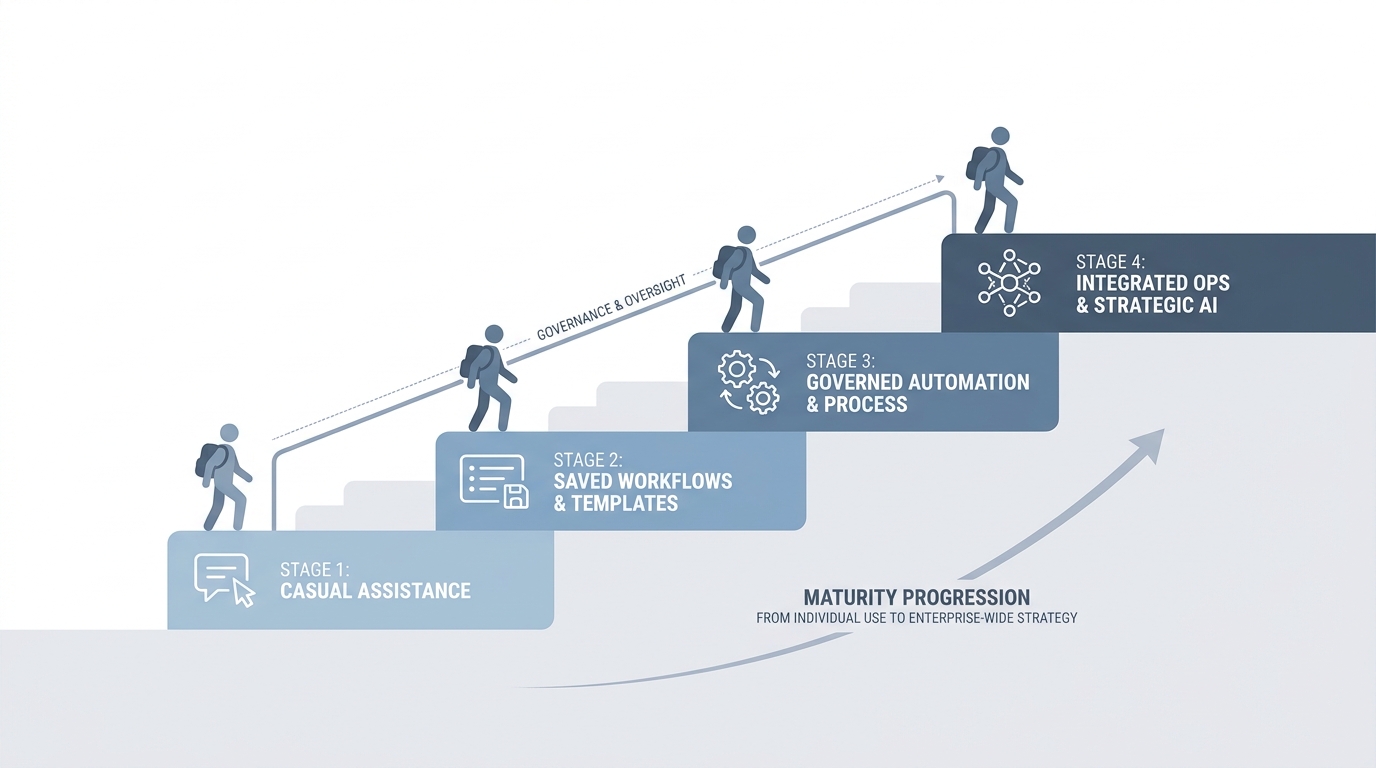
Explore the stages interactively on the AI adoption ladder page. Pair this page with the AI adoption ladder glossary entry when Legal asks "what stage are we funding?"
Signals TA leaders often recognize
- Offline / fear-led Chatting: Officially cautious; recruiters still paste into personal chat because the approved path is slower.
- Chatting at scale: Lots of individual hero prompts; no owners; success dies when two people leave.
- Systemizing: Prompt library with named owners, enterprise workspace, exemplars where recruiters already work; audits become possible.
- Automating: ATS routing, SLA bots, draft queues with human gates; ranking only with documented override and Legal alignment.
- AI-Native TA: Process design assumes models plus structured fields + QA; vendors plug into a maturity story executives can inspect.
Example climbs
- Chatting → Systemizing (ninety days): One pilot workflow (intake plus HM packet only); refuse second automation until weekly active use crosses your threshold; tie to rungs on AI adoption ladder in your steering deck.
- Systemizing → Automating: Connect one webhook after prompts stabilized for eight weeks: e.g. stage change posts checklist to Slack. Measure failure rate before candidate-facing sends.
- Toward AI-Native: Rewrite one role family's workflow assuming structured intake is mandatory; finance sees cost per step drop without you hiding human review.
Use the stage language from AI adoption ladder in exec updates so "we need budget for AI" becomes "we are moving from Chatting to Systemizing on intake, here is the artifact."
High-leverage use cases (with examples)
A single prompt library with owners. Chapters for intake, outreach shells, debrief patterns, and hiring-manager briefing formats. Each chapter has a named owner and a refresh cadence, because models and vendors drift.
Example: A "chapter owner" for outbound rotates quarterly. They run one lunch-and-learn with two redacted examples from last month. Attendance is short; the artifact update is mandatory. Libraries die when nobody owns refresh.
Pilot design that fits recruiting ops. One workflow, one role family, clear baseline metrics: time-to-qualified slate, hiring-manager satisfaction, candidate experience signals you already collect. Expand only after the audit trail and escalation paths work.
Example: Pilot only high-volume engineering reqs in one site. Baseline time-to-first-qualified slate for four weeks. Introduce approved assistant for intake + packet prep only. Compare the next four weeks. Do not change screening vendors mid-pilot.
Coach the craft, not the slide. Live teardowns of real (redacted) strings, packets, and outreach. People adopt what they saw work on a req like theirs. Sample session you can run Tuesday at nine: bring one anonymized Boolean string that returned noise, one outreach that got a strong reply, and one packet the hiring manager praised. Spend ten minutes on each: what changed between bad and good. No vendor slides; only artifacts.
Faster approved paths. If recruiters currently paste a resume into personal ChatGPT for a summary, your approved tool must beat that path on clicks and seconds. Concrete checklist: SSO so they do not hunt passwords; a pinned prompt that opens pre-filled; output format that matches your ATS note fields so they are not rewriting. Pilot metric: median time from "open tool" to "paste-ready summary" drops from six minutes to two on five shadowed sessions.
Routing and handoffs before silent ranking. Examples that recover quickly if wrong: auto-schedule screens when both calendars sync; Slack ping when a candidate stalls in stage three; nightly digest of reqs past SLA. Bad example to postpone: auto-drop candidates below a score threshold with no human row in the audit log.
Executive narrative packs. Monthly one-pager skeleton:
- Shipped: e.g. "Intake template v2 live for engineering; fourteen recruiters active."
- Adoption: e.g. "Seventy-two percent of reqs used approved assistant for intake brief this month versus forty-one percent last month."
- One failure: e.g. "We shipped ranking assist without Legal review; paused after week one; fix is scheduled."
- One risk: e.g. "Vendor contract renewal in sixty days; need decision on EU data residency."
Paste bullets into the assistant; it formats; you fix numbers.
Vendor evaluation scorecards. Build one table row per vendor with columns your Legal and IT actually asked for: where data is processed, retention period, whether humans can override scores, export format for audits, support response SLA. Example row fill: "Candidate summaries stored in region X for ninety days; employer claims must not be stored without source URL field." Use AI to merge three email threads from stakeholders into one draft table; owners still validate.
What we often see effective TA programs do
They publish non-negotiables in one page: what never goes into consumer chat, what must stay in ATS fields, who approves exceptions. Short beats comprehensive. Example lines that teams actually follow: "No full resumes in personal ChatGPT; use Enterprise workspace link on the wiki." "Candidate emails only in tools on the approved list; ask IT ticket EXC-001 for exceptions." Pair enforcement with relief. If recruiters cannot paste resumes into tool X, tool Y with SSO must produce the same summary in fewer clicks by next sprint. Pair means both ship together: if IT misses the SSO deadline, pause the ban until the relief path exists, or you recreate shadow AI on day one.
They review prompts quarterly with anonymized real outputs, not hypotheticals. Bias shortcuts show up in actual drafts faster than in policies. Bring three redacted packets from last quarter: one great, one mediocre, one that caused a complaint. Circle language that generalized gender or age; fix the template, not "awareness."
They sequence automation where failure is recoverable (scheduling, routing) before anything that affects candidate ranking. Example sequence: first automate interview scheduling; only later pilot assisted ranking with Legal sign-off and human override logged.
Read AI adoption maturity levels and what is AI-native work when you need shared vocabulary with executives. The AI adoption ladder glossary entry helps when you sequence pilots honestly.
What tends not to work
Enterprise-wide "AI transformation" without a workflow anchor. Everyone gets a license, nobody gets a playbook. Six months later usage is random.
Measuring only cost per hire while ignoring adoption. You cannot attribute hiring lift to AI if half the team never adopted the workflow you think you rolled out.
Letting vendors own your policy story. They will emphasize speed; you still sign the answers on fairness and data.
Ignoring middle managers. Team leads need the same exemplars as IC recruiters; otherwise pockets of shadow AI persist.
A simple rollout shape
Phase A (two to three weeks): document shadow paths without shame. Interview five recruiters. Learn where they paste today. Ask literally: "Show me the last three places you copied a resume or JD." Log tool names and rough weekly frequency.
Phase B: ship one approved alternative that beats shadow speed on that path. Promote it in standups with numbers. Example win to share: "Median intake brief time went from twenty-two minutes to nine for eight people last week."
Phase C: add governance checkpoints once adoption crosses a threshold you define (for example seventy percent weekly active use on approved intake templates). Checkpoint means Legal reviews the template text once, not every click.
Phase D: expand to a second workflow only after audit trails work. Second workflow might be outreach shells only after you can show who generated which summary for which req ID.
Where teams get hurt
Rules without tooling bounce. Example that repeats: "Stop using shadow AI" email with no approved ChatGPT Enterprise seats ready; recruiters nod and keep old habits.
Give SSO where possible, exemplars in the tools recruiters already open, and escalation paths when someone pastes the wrong data class. Escalation example: "If you pasted PHI by mistake, open incident INC-HR-02 and loop Security; do not forward the chat log in Slack."
Cross-border teams face different expectations for automated decision-making. Label pilots clearly when Legal needs to review before scale. Practical note: if EU candidates are in scope, your pilot doc should say whether a human always clicks advance for that population, even if US candidates get assisted sorting.
Buying an "AI suite" without workflow ownership often yields shelfware. The moat is habits and templates your team maintains, not the logo on the contract. Ask on day thirty of any subscription: "Who owns the prompt library?" If the answer is still "nobody," you are paying for shelf space.
Automation and stack notes
Ops-minded TA leaders often intersect n8n and Make when stitching ATS events into approved steps. Many teams anchor structured hiring data in Greenhouse.
Courses, live sessions, and consulting on AI with Michal
Courses. Starting with AI gives your ICs a shared foundation so your TA policies land on trained habits. For recruiting-specific depth tied to sourcing discipline, First Principles Sourcing aligns with pods that want stronger upstream definition before automation.
Live sessions. Public dates on Sourcing Lab helps when you want external accountability for leaders and ICs together.
Teams. When you need one vocabulary across TA, HRBP partners, and hiring managers, start at AI sessions for teams.
Consulting. For a focused sprint that maps current workflows, aligns leadership, and delivers an implementation roadmap for recruiting AI, see Recruiting AI Workflow Advisory. For broader executive framing across functions, Using AI in Your Business and Improving Your Processes with AI are common complements. Ongoing 1-on-1 support for leaders implementing change: Individual AI Implementation Mentoring. Browse everything under consulting or write via contact.
Membership. membership keeps playbooks fresh after an initial engagement.
FAQ
- What is the first step TA leadership should fund on the AI adoption ladder?
Fund Systemizing before Automating: one enterprise-approved workspace, one prompt library with owners, and one pilot workflow with baseline metrics. Skip new vendor seats until recruiters actually use the sanctioned templates weekly.
- How do we reduce shadow AI without blocking productivity?
Make the approved path faster: SSO, templates, and exemplars that live inside tools recruiters already open daily. Pair enforcement with coaching so people understand why specific pastes are risky, not just that rules exist.
- What should TA managers measure first?
Start with adoption of approved workflows and time saved on repeat drafting after templates ship. Layer hiring outcomes once the process stabilizes so you do not confuse model novelty with quality of hire.
- Vendor demo looked amazing. How do we evaluate tools without buying shelfware?
Score against one pilot workflow only: data residency, logging, human override, export for audits, and whether recruiters kept using it after week four. Run redacted real reqs through the tool with Legal in the loop before scale.
- What rollout mistakes create the most regret?
Buying platforms before workflow owners exist, banning shadow AI without a faster approved alternative, measuring only cost-per-hire while ignoring adoption, and letting vendors own your fairness story without TA signing it.
- How do we recognize AI nonsense or overclaim in vendor pitches?
Ask for references in your industry, live teardown on your anonymized reqs, and written answers on bias monitoring and candidate notices. If throughput doubles but nobody can explain why a profile advanced, pause.
- When should we bring in external help?
Use outside support when executive decks outpace recruiter habits, when Legal and IT need one coordinated roadmap, or when pilots stall after sixty days. Email hello@aiwithmichal.com with org size and constraints. Recruiting-focused sprints are outlined in recruiting AI workflow advisory and the full menu is under consulting.
- What internal training order works best for TA orgs?
Train ICs on shared prompts and data rules first, then managers on pilot metrics and governance. Public workshops and team workshops pair well with the Starting with AI course so everyone shares vocabulary.
Skill bundles that pair with this role
Packaged skills and integration paths in the store help you move from one-off prompts to repeatable workflows. Browse bundles below or explore the full skill bundles catalog.
No matching bundles in the catalog from this device. Open the store or skill bundles to see what is available.
For teams
Private workshops and implementation support for rolling out AI responsibly across TA and HR.
AI workshops for teamsTeaching notes based on workshop delivery and recruiting practice. Tools and regulations change; verify current employer policies and vendor terms before production use.