Psychometric assessments for hiring
Validated measurement instruments including cognitive ability tests, personality inventories, and situational judgment tests deployed at structured hiring funnel stages to produce scored, normed data that supplements interviewer judgment in candidate selection decisions.
Michal Juhas · Last reviewed May 15, 2026
What are psychometric assessments for hiring?
Psychometric assessments for hiring are standardized, validated instruments that measure specific psychological constructs relevant to job performance and produce scored results that can be compared across candidates and cohorts. The instruments in common use span cognitive ability tests, personality inventories, situational judgment tests, and work sample exercises. Each type measures something different and carries a different predictive validity profile depending on the role family.
The case for using assessments rests on consistency. Every candidate sees equivalent content under equivalent conditions, and scores are interpreted relative to a published norm group rather than the interviewer reviewing the last ten people they spoke with. That reproducibility is what makes an assessment score defensible in a compliance review, whereas an unstructured interview impression is not.
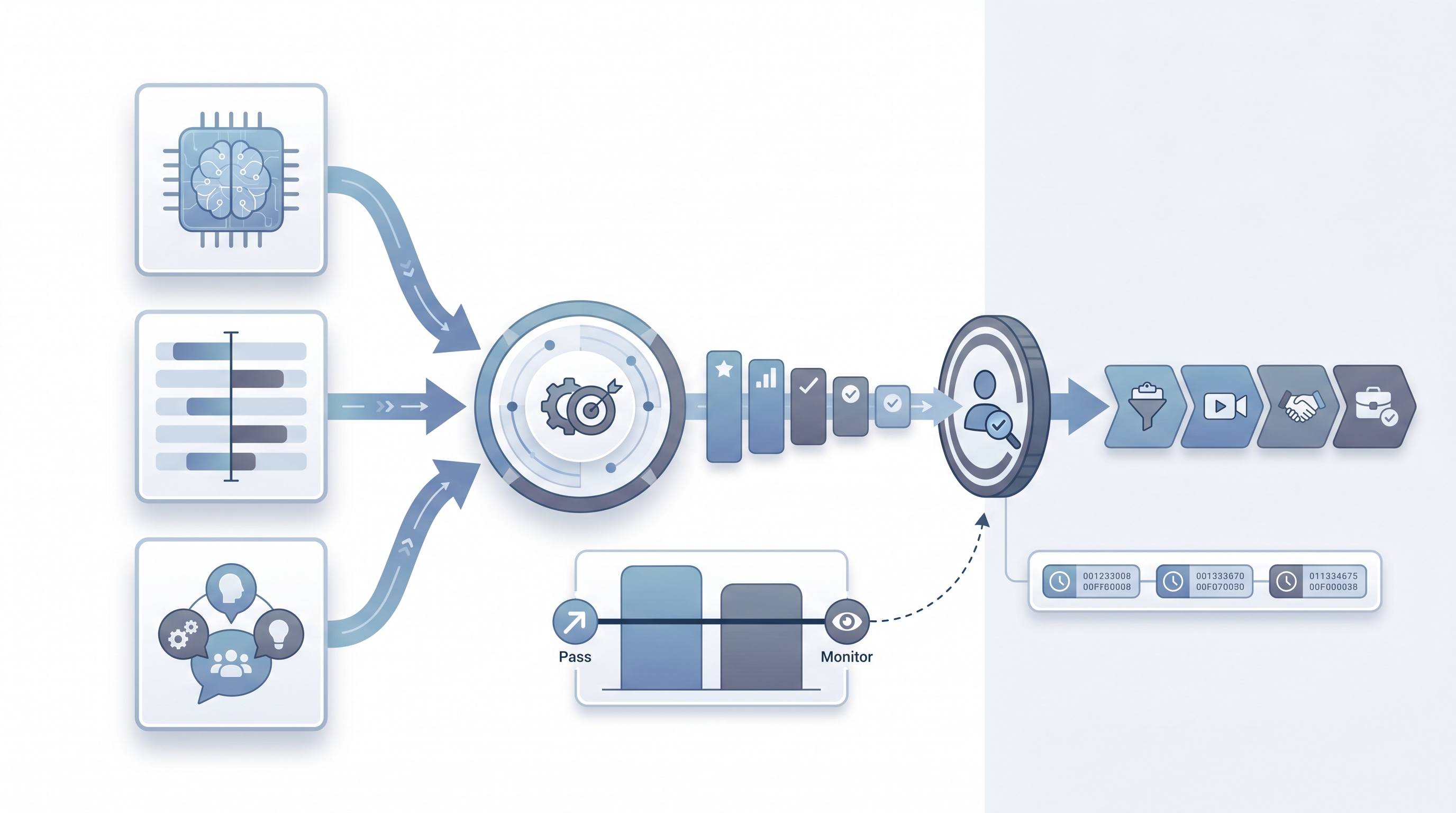
In practice
- A TA team adding a 20-minute verbal reasoning screen to a customer support pipeline finds candidates below the 40th percentile in the first cohort had 90-day quality scores 30 percent lower on average. They set a soft threshold, keep it under review, and calculate group pass rates before expanding to a second site.
- A recruiter at a fintech firm uses a Big Five inventory for team-lead searches. A hiring manager asks why a candidate who interviewed well flagged amber on conscientiousness. The recruiter explains the score is one input alongside structured interview data, and the debrief explores whether the interview evidence contradicts or confirms the instrument.
- An HRBP evaluating two assessment vendors asks both for a GDPR compliance statement and a criterion validity coefficient for analyst roles. One vendor produces a peer-reviewed study with a 0.31 validity coefficient. The other sends a marketing whitepaper. The HRBP shortlists only the first.
Quick read, then how hiring teams use it
This is for recruiters, sourcers, TA, and HR partners who need shared vocabulary in vendor evaluations, compliance reviews, and hiring manager debriefs. Skim the first section for a fast shared picture. Use the second when you are selecting an instrument, setting cut scores, or reviewing results in a live req cycle.
Plain-language summary
- What it means for you: A psychometric assessment gives every candidate the same test under the same conditions and scores results against a reference population, rather than leaving it to interview impressions that vary by interviewer.
- How you would use it: Pick one instrument that matches the competency most important for the role, confirm it has criterion validity evidence for that role type, and agree on the cut score and adverse impact review cadence before the first invite goes out.
- How to get started: Identify the single most predictive competency for the role. Ask three vendors for an independent technical manual and a validity study for that competency. Run a retrospective pilot on closed reqs before using as a live gate.
- When it is a good time: After role requirements are documented, after a compliance partner has confirmed lawful basis for data processing, and after your ATS can receive and store scores with the model version logged alongside each result.
When you are running live reqs and tools
- What it means for you: Psychometric scores are selection inputs, not selection decisions. Each score has a standard error of measurement, so a candidate at the 60th percentile could genuinely sit anywhere from the 52nd to the 68th. Treat scores as one signal alongside structured interview data from a shared scorecard.
- When it is a good time: After your sourcing and screening baseline is stable, when you have enough volume per role family to calculate group pass rates each cohort, and when you have a named owner for reviewing adverse impact reports before expanding deployment.
- How to use it: Log the instrument version and norm group with every cohort result. Review group pass rates against the four-fifths rule each cycle. Brief hiring managers on what the instrument measures and does not measure before the first debrief. Keep the score field separate from the stage-advance field in your ATS to preserve compliance independence.
- How to get started: Pilot on a closed req first. Score retrospectively against your own performance ratings for recent hires in the same role family. If the correlation is weak, replace the instrument before using it as a live gate. See hiring assessment tools for an evaluation checklist.
- What to watch for: Vendors who report completion rates but not group-level pass rates; AI scoring layers without a logged model version per result; instruments calibrated on a general workforce norm group for a specialist role; and personality vendors claiming strong validity without an independently audited study.
Where we talk about this
On AI with Michal live sessions, psychometric assessments appear in the compliance and vendor evaluation modules of the AI in recruiting track. Participants work through a structured criteria card, practice reading a technical manual, and calculate four-fifths adverse impact ratios on vendor-supplied data. The sourcing automation track adds the operational layer: how to trigger assessment invites from ATS stage changes and route scores back without manual entry. Join a session at Sourcing Lab with your real vendor shortlist and ATS setup.
Around the web (opinions and rabbit holes)
Third-party creators move fast. Treat these as starting points, not endorsements, and verify before wiring any instrument to a candidate-facing selection process.
YouTube
Search with Filters - Upload date to find recent IO psychology and HR practitioner content alongside vendor overviews.
- Psychometric testing in hiring decisions: validity and fairness (criterion validity, norm groups, and what to ask vendors)
- Adverse impact assessment four-fifths rule EEOC (how to calculate and document the threshold for compliance)
- Personality tests at work Big Five validity research (practitioner and researcher perspectives on when trait inventories add signal)
- r/IOPsychology has active debate on which assessment validity claims hold up versus which are vendor marketing, with named studies and practitioner critique.
- r/recruiting has frank threads on candidate drop-off during assessments and which platforms survive production ATS traffic.
- r/humanresources captures HRBP perspectives on lawful basis documentation and how to brief legal on psychometric deployment.
Quora
- Quora search: psychometric assessment hiring covers practitioner answers on instrument choice, debrief practice, and candidate communication; quality varies, so verify specific claims before acting.
Assessment types compared
| Instrument | What it measures | Predictive strength | Key compliance note |
|---|---|---|---|
| Cognitive ability | Reasoning speed and accuracy | High (meta-analytic) | Adverse impact risk for some groups |
| Personality inventory | Trait tendencies vs. norm group | Moderate, role-dependent | Construct mismatch if role fit is poor |
| Situational judgment | Role-scenario decision-making | Moderate | Item bank needs regular refresh |
| Work sample | Actual task performance | High, role-specific | Development and scoring cost is higher |
Related on this site
- Glossary: Psychometric testing for recruitment, Pre-employment assessment tools, Candidate assessment tools
- Glossary: Adverse impact, AI bias audit, Explainable AI hiring, Human-in-the-loop (HITL)
- Glossary: Scorecard, Hiring assessment tools, ATS API integration
- Blog: AI sourcing tools for recruiters
- Live cohort: Sourcing Lab
- Membership: Become a member
- Course: Starting with AI: the foundations in recruiting