Talent intelligence
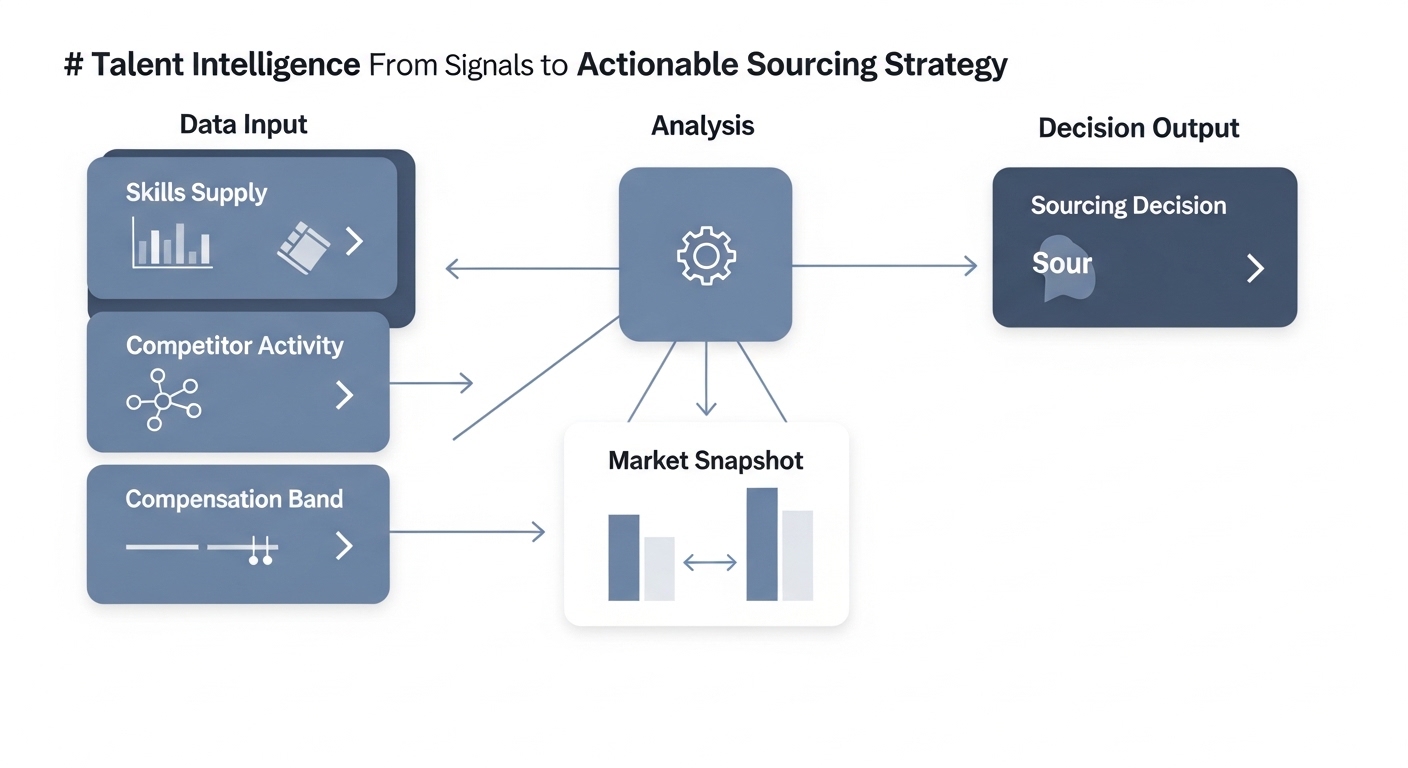
Structured analysis of external talent market data, including skills availability, competitor hiring patterns, and compensation benchmarks, to inform sourcing strategy and headcount decisions before a search starts.
Michal Juhas · Last reviewed May 29, 2026
What is talent intelligence?
Talent intelligence is the practice of pulling structured data about the external talent market, such as how many people hold a given skill in a region, what competitors are hiring, and what compensation ranges look like at the 50th and 75th percentile, and using that data to make better sourcing and headcount decisions before a search starts.
It sits between market research and sourcing planning. Without it, intake calls rely on anecdote. With it, a recruiter can say: there are roughly 400 active candidates with this skill set in the metro, median salary is 20 percent above the current band, and two main competitors opened six similar reqs last month.
In practice
- A sourcing team at a mid-size tech company uses a licensed platform to pull skill counts by city before deciding whether to open a remote req or restrict to headquarters, saving two weeks of cold searching in the wrong market.
- A TA leader quotes competitor hiring velocity from public job postings during a board update to explain why the engineering pipeline is slower than last quarter.
- A recruiter checks whether a niche certification is genuinely scarce or just underrepresented in common search strings before telling a hiring manager the role is unfillable.
Quick read, then how hiring teams use it
This is for recruiters, sourcers, TA, and HR partners who need the same vocabulary in debriefs, vendor calls, and planning sessions. Skim the first section when you need a fast shared picture. Use the second when you are deciding how to scope a search or pitch a headcount delay.
Plain-language summary
- What it means for you: Before sourcing starts, someone has checked whether the candidates you need actually exist in the target market, at the right budget, in the volume required.
- How you would use it: Pull a skill and location count from a platform or public source, check competitor hiring activity, and share a one-paragraph market snapshot with the hiring manager before week one ends.
- How to get started: Pick one open req with a vague "this is hard" narrative. Spend 30 minutes in a free or licensed tool counting active profiles, then compare that number to ATS yield on similar past reqs.
- When it is a good time: At intake, before posting, and any time a hiring manager questions why pipeline is slow.
When you are running live reqs and tools
- What it means for you: Talent intelligence turns a sourcing plan from a guess into a defensible decision. It also gives you the data to push back when a req scope is unrealistic.
- When it is a good time: At the start of every search new to the team, whenever compensation is below market, and quarterly for roles the team fills repeatedly.
- How to use it: Combine a licensed platform (Lightcast, LinkedIn Talent Insights, or similar) with ATS historical yield data. Feed outputs into the intake deck, not a separate report no one reads.
- How to get started: Map one skill family across three cities. Note the count, growth trend, and top employer concentrations. Use that as a sourcing priority decision, not just a slide.
- What to watch for: Aggregated data can be 3 to 12 months stale. Treat counts as directional, not precise. Cross-reference with live search results before quoting numbers to stakeholders.
Where we talk about this
On AI with Michal live sessions, talent intelligence comes up in sourcing strategy blocks where we map a skill market before any Boolean string is written. The AI Recruiting Accelerator covers how to pull and refresh market data as part of a repeatable sourcing workflow, not a one-off slide. If you want structured practice reading market data with peers, start at Recruiting OS.
Around the web (opinions and rabbit holes)
Third-party creators move fast. Treat these as starting points, not endorsements, and double-check anything before you act on data that affects headcount or compensation decisions.
YouTube
- Search for "Lightcast labor market analytics tutorial" on YouTube for vendor-produced walkthroughs on how to read supply-demand signals for a specific skill and location.
- SHRM and ERE publish conference session recordings that include talent intelligence case studies from in-house TA teams worth watching before choosing a platform.
- r/recruiting has threads on which data platforms practitioners actually use versus which ones get bought and forgotten after the first quarterly review.
- r/humanresources covers the headcount planning and workforce analytics angle that sits adjacent to talent intelligence tooling.
Quora
- Searches for "how do companies use talent intelligence in recruiting" on Quora surface a range of practitioner definitions that vary by company size, industry, and whether a dedicated TA ops function exists.
Related on this site
- Glossary: Ideal candidate profile sourcing, Sourcing funnel metrics, Competitor talent mapping, Talent acquisition metrics, Boolean search
- Blog: AI sourcing tools for recruiters
- Live cohort: Recruiting OS
- Membership: Become a member