Temp-to-perm conversion fee
A temp-to-perm conversion fee is the charge a staffing or recruitment agency levies when a client directly hires a contractor the agency placed, converting the worker from a temporary assignment to a permanent employee.
Michal Juhas · Last reviewed May 8, 2026
What is a temp-to-perm conversion fee?
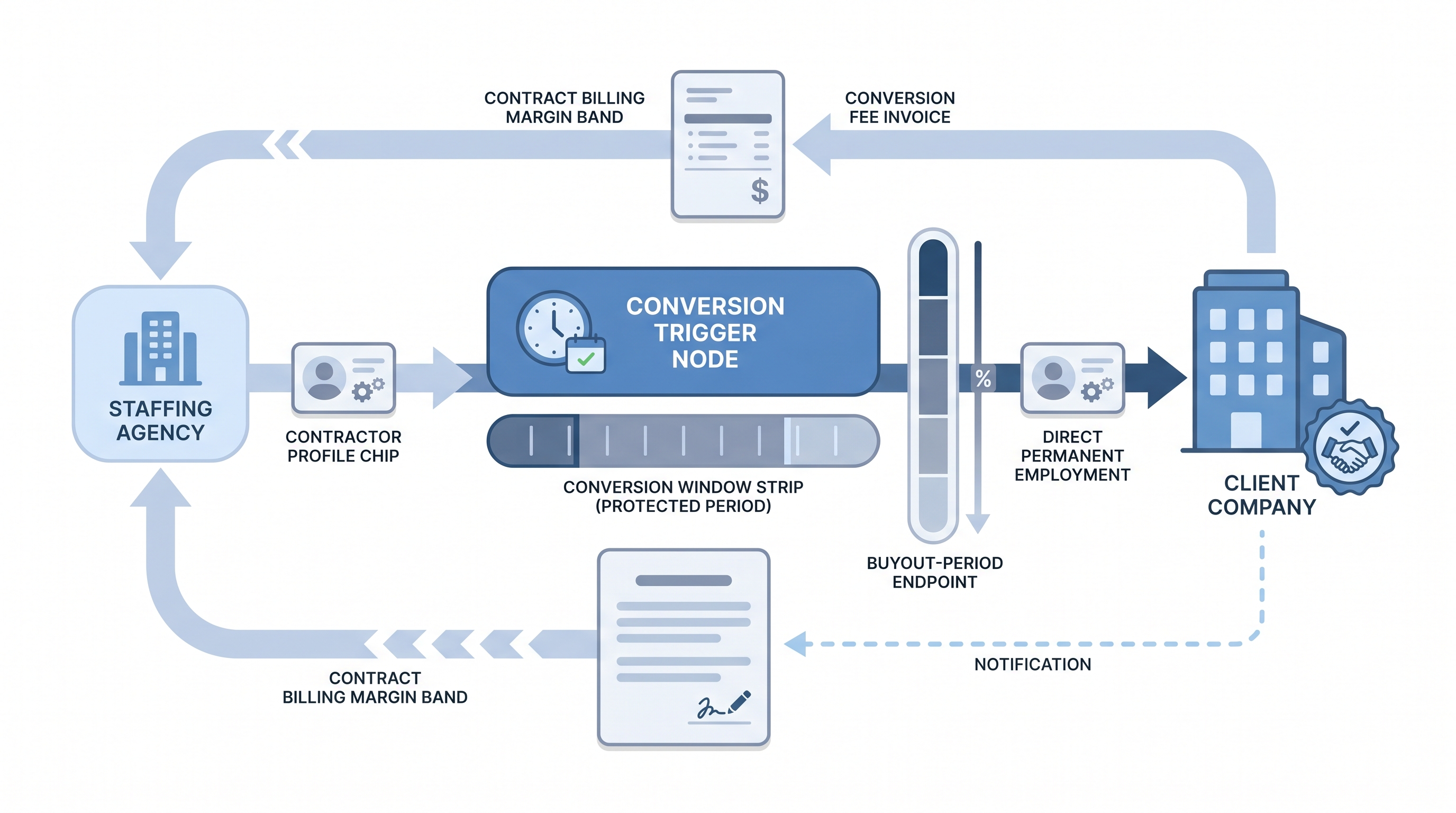
A temp-to-perm conversion fee is what a staffing or recruitment agency charges when a client hires one of its placed contractors directly. The worker transitions from a temporary assignment to a permanent employee, ending the agency's billing relationship and triggering the fee.
The arrangement is common across professional staffing, IT contracting, and specialist recruitment. The agency sourced, vetted, and placed the worker. If the client now wants to employ that person permanently, the fee compensates the agency for the lost ongoing margin and the original sourcing investment.
Conversion fees are sometimes called buyout fees, contract-to-hire fees, or temp-to-hire fees depending on the market. They are distinct from a placement fee on a direct permanent hire because the starting point is an existing temporary assignment, not a new search.
In practice
- A client's engineering team has been working with a contract developer for five months through a staffing agency. The CTO wants to make her permanent. The staffing agreement specifies an 18 percent of annual salary conversion fee with a twelve-month buyout period. The agency invoices at the conversion rate and the CTO signs off.
- A client lets a contractor's agreement lapse and quietly rehires the same person two months later under a new title. The agency's staffing agreement included a nine-month conversion window. The client owes the full fee even though no formal conversion notice was given.
- An agency ops lead runs a monthly audit of active contractors, flags every agreement within sixty days of its conversion window expiry, and sends a short note to the account manager to confirm the contractor's status. Two potential disputes are caught before they become invoice arguments.
Quick read, then how agency teams use it
This is for agency recruiters, billing managers, and ops leads who need to understand, draft, and enforce conversion fee clauses without relying on informal precedent. Skim the first section for the vocabulary. Use the second when you are reviewing a specific clause or handling a conversion dispute.
Plain-language summary
- What it means for you: If a client decides to hire your placed contractor permanently, they owe you a conversion fee. The fee compensates you for losing the contractor's ongoing margin and for having invested in finding and placing that person.
- How you would use it: Write the conversion fee structure, calculation method, conversion window, and buyout period into every staffing agreement before any contractor starts work. Never rely on verbal agreements or email precedents.
- How to get started: Review your last twelve months of contract placements. For any active contractor approaching six months of tenure, confirm the conversion window and sliding-scale formula are in the signed agreement. If they are not, negotiate an addendum before the contractor's next renewal.
- When it is a good time: Conversion fees apply whenever a client hires a placed contractor within the conversion window, whether the client initiates a formal offer or simply ends the contract and rehires the same person later.
When you are running live contracts and billing
- What it means for you: Conversion fee billing is separate from ongoing contract margin and requires its own invoice type and calculation workflow. If your system conflates the two, you will lose revenue or bill incorrectly.
- When it is a good time: The moment a conversion notification arrives, pull the placement record, calculate the fee against the agreed formula, and issue the invoice within the payment timeline specified in the agreement. Do not wait for the client to confirm the start date.
- How to use it: Tag every contract-to-hire eligible placement in your recruitment agency software with the conversion window expiry and the fee formula reference. Set an alert thirty days before expiry. Keep a log of conversion window dates the way you track invoice due dates.
- How to get started: Build a one-page conversion fee clause template aligned with your standard master services agreement and run it through legal once. Use that template for all new clients rather than negotiating from scratch each time.
- What to watch for: Clients who let contracts lapse and rehire within the window, roles that are materially renamed to obscure a conversion, part-time or fractional roles where the salary base is disputed, and delayed conversion notifications that push the invoice outside your terms window.
Where we talk about this
On AI with Michal live sessions, conversion fee structures come up in the agency operations and contract staffing modules alongside margin, billing, and MSA negotiation. The fee design connects directly to how agencies price contract placements and manage the risk of losing contractors to direct hire. If you want the full room discussion on how to write conversion clauses that hold under dispute, start at Sourcing Lab and bring your actual MSA language.
Around the web (opinions and rabbit holes)
Third-party perspectives on conversion fees range from agency operations forums to HR and procurement guides. Treat these as starting points, not endorsements, and validate any contract language with your legal counsel before applying it to a live agreement.
YouTube
- Temp to Perm Conversion Fees Explained for Staffing Agencies walks through how conversion fees are structured, calculated, and enforced in contract staffing.
- How to Negotiate Staffing Agency Fees as an Employer covers the client-side view of conversion, buyout, and direct hire fee discussions.
- Contract to Hire: What Employers and Candidates Need to Know covers how conversion works from both the employer and contractor perspectives.
- Temp to perm conversion fee dispute in r/recruiting captures real-world disputes, negotiation outcomes, and what agency operators wish they had written in the contract.
- Staffing agency buyout fees in r/humanresources shows the client and HR perspective on when conversion fees feel fair and when they generate friction.
- Contract to hire: how do conversion fees work? in r/RecruitmentAgencies shows agency operators discussing clause language, window lengths, and calculation methods.
Quora
- What is a staffing agency conversion fee? collects practitioner and HR professional explanations of how the fee works from both sides of the agreement.
Temp assignment vs direct hire vs conversion
| Factor | Temp assignment | Direct permanent hire | Temp-to-perm conversion |
|---|---|---|---|
| Agency billing | Ongoing margin on contractor | Single placement fee | Conversion fee at time of hire |
| Client commitment | None (can end contract) | Full employment obligation | Employment obligation after conversion |
| Agency sourcing cost | Absorbed in ongoing margin | Separate search fee | Already partially recovered via contract margin |
| Fee protection | N/A | Replacement guarantee may apply | Conversion window plus sliding scale |
| Best for | Flexible capacity or trial period | Known permanent need | Evaluating fit before committing |
Related on this site
- Glossary: Agency markup and contract staffing, Agency invoice and payment terms, Retained search vs contingency
- Glossary: Master services agreement for agency services, Agency indemnification clauses, Backfill and replacement guarantee
- Glossary: Recruitment agency software, Co-employment in staffing agencies, Statement of work for recruiting projects
- Blog: AI sourcing tools for recruiters
- Workshops: Sourcing Lab
- Course: Starting with AI: the foundations in recruiting
- Membership: Become a member