Statement of work (SOW) for recruiting projects
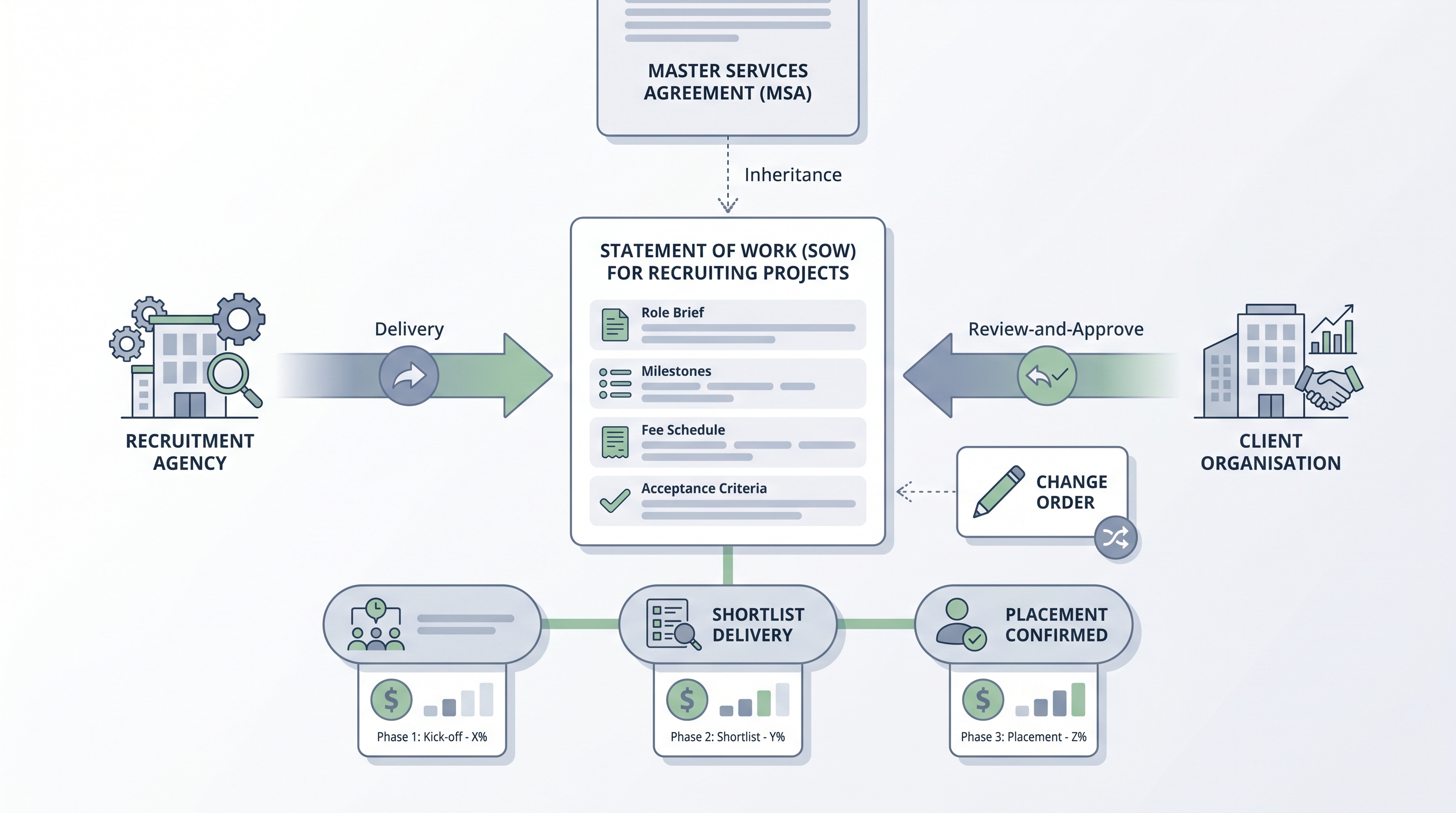
A statement of work (SOW) for recruiting is a child document issued under a master services agreement that records the specifics of a single engagement: role title, deliverable milestones, fee schedule, timeline, and acceptance criteria, giving both the agency and client a written basis for invoicing and dispute resolution.
Michal Juhas · Last reviewed May 8, 2026
What is a statement of work (SOW) for recruiting projects?
A statement of work is a project-level document that defines what a recruiting agency will deliver, on what timeline, and what it costs. In most structured agency-client relationships, it sits under a master services agreement as a child document: the MSA sets the standing commercial and compliance terms, while the SOW records the specifics of a single engagement.
The concept started in project-based services industries. In recruiting, it became important as agencies moved beyond single contingency placements into more complex arrangements: retained executive search, recruitment process outsourcing (RPO), contract staffing headcount programmes, and talent market-mapping projects. These engagements involve multiple milestones, phased invoicing, and deliverables harder to define than "candidate placed."
For agency owners and TA leaders, the SOW is the document you point to when a client asks why an invoice is due or when a delivery dispute emerges mid-search. A well-drafted SOW means both sides agreed in writing on what "done" looks like before the work started.
In practice
- A retained executive search firm sends a three-part SOW with milestone invoicing: one-third on signing, one-third on shortlist delivery of five profiled finalists, and one-third on placement. When the client delays feedback, the agency cites the SOW clause suspending the delivery clock during client review periods.
- An RPO provider creates a monthly SOW for each hiring programme, defining throughput targets, quality acceptance criteria such as pass rate at hiring manager review, and escalation steps when targets are missed for two consecutive weeks.
- A staffing agency adds a change-order schedule to its SOW template after a client expands a three-person contract team to 12 mid-programme without adjusting the original fee schedule, creating a documented amendment process that prevents future scope-creep disputes.
Quick read, then how hiring teams use it
This page is for agency principals, operations managers, in-house TA leaders, and legal or finance teams who negotiate, sign, or manage recruitment project documents. Skim the first section for the definition. Use the second when you are scoping a retained search, an RPO programme, or any multi-milestone recruiting project.
Plain-language summary
- What it means for you: The SOW is the written record of exactly what the agency will deliver, when, and how much it costs. It protects both sides by making "done" measurable before the work starts.
- How you would use it: Issue one whenever the engagement has more than a single fee-on-hire structure: retained searches, headcount programmes, market mapping, or RPO projects all benefit from a clear SOW.
- How to get started: Draft milestone descriptions in plain language, define acceptance criteria for each milestone, set payment timelines in days from delivery of a specific artefact, and add a signed change-order process for scope changes.
- When it is a good time: Before the search starts, not after the first invoice is disputed. Revisit the SOW whenever the client changes the brief or expands scope.
When you are running live reqs and tools
- What it means for you: The SOW is the document that determines whether an invoice is payable. When milestone criteria are vague, clients can delay payment by claiming the deliverable was not complete. Specific, measurable acceptance criteria remove that lever.
- When it is a good time: Before any retained search, RPO programme, or contract staffing headcount project starts. For contingency placements, a simple placement confirmation under an existing master services agreement is usually sufficient.
- How to use it: Tie each invoice to a specific SOW event: signed agreement, shortlist submitted, candidate started. Align milestone invoice dates with your factoring cycle if you use recruitment factoring and agency cash flow. Add a client-delay clause so late feedback suspends the delivery clock.
- How to get started: Pull your last three retained or project-based searches. For each one, check whether the SOW defined acceptance criteria clearly enough that the client could not dispute a milestone in good faith. If not, revise the template.
- What to watch for: Scope creep without a signed change order, vague "candidate quality" language that gives clients room to reject a compliant shortlist, and data sharing that goes beyond what the SOW or master services agreement data schedule covers.
Where we talk about this
On AI with Michal live sessions, agency contract structure, including SOWs, placement confirmations, and milestone invoicing, comes up in the AI in recruiting track when agency owners discuss how to run scalable, compliant, and commercially predictable operations. The Sourcing Lab cohort covers both the commercial and operational side of agency agreements so agency principals and in-house TA leaders understand what they are agreeing to and why milestone language matters.
Around the web (opinions and rabbit holes)
Third-party content on statements of work for recruiting and staffing spans legal commentary, agency owner forums, and HR operations resources. These are starting points, not endorsements. Verify any legal position with employment counsel before relying on it in a live agreement.
YouTube
- Statement of work vs master services agreement explained covers the parent-child document relationship that most agencies use for structured client engagements.
- How to write a statement of work for a staffing project walks through milestone and acceptance criteria drafting for project-based recruiting.
- Retained search engagement structure and invoicing discusses how milestone invoicing works in executive search practice.
- SOW and milestone invoicing in r/RecruitmentAgencies includes agency owner accounts of how phased invoicing plays out in practice and what milestone language holds up under dispute.
- Retained search contracts and client disputes in r/recruiting surfaces recruiter perspectives on how vague SOW language creates payment friction.
- How to protect your agency from scope creep in r/smallbusiness covers change-order practices that apply directly to recruiting project engagements.
Quora
- What should a statement of work include for a recruiting engagement? collects practitioner and legal perspectives on which SOW clauses carry the most operational weight.
SOW versus placement confirmation
| Factor | SOW (project-based) | Placement confirmation (contingency) |
|---|---|---|
| Fee trigger | Milestone delivery | Candidate starts or invoiced on hire |
| Document length | Multi-page with schedules | Single page or short email |
| Deliverable type | Research, shortlist, headcount targets, RPO throughput | Single hire |
| Scope change process | Written and signed change order | Informal email or verbal |
| Cash flow implication | Milestone-tied, may align with factoring | Single invoice on start date |
| Data handling annex | Often required for multi-candidate datasets | Covered by parent MSA |
Related on this site
- Glossary: Master services agreement (MSA) for agency services, Agency indemnification clauses
- Glossary: Recruitment factoring and agency cash flow, Agency invoice and payment terms
- Glossary: Agency data room and due diligence, Retained search vs contingency recruiting
- Glossary: GDPR and first-touch outreach, Client exclusivity in agency agreements
- Glossary: Backfill periods and replacement guarantees, Workflow automation
- Workshops: Sourcing Lab
- Course: Starting with AI: the foundations in recruiting
- Membership: Become a member