Video recruitment platform
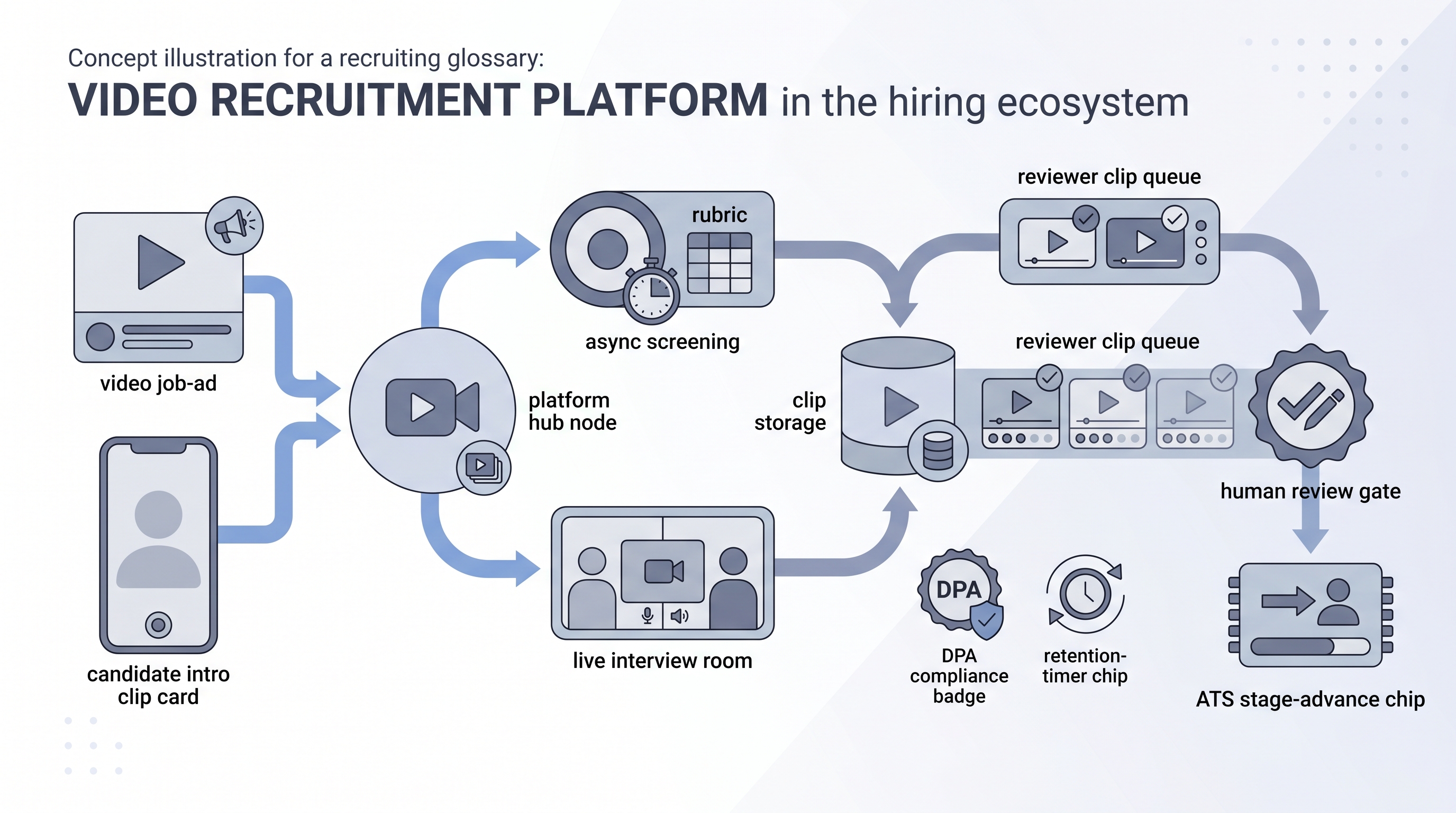
A video recruitment platform is a purpose-built system that uses video across multiple hiring stages, combining job-ad videos, candidate intro clips, async pre-screening, and live interview rooms in shared clip storage with ATS integration.
Michal Juhas · Last reviewed May 15, 2026
What is a video recruitment platform?
A video recruitment platform is a purpose-built system that uses video across multiple stages of the hiring process. Unlike a single video conferencing tool, a platform combines some mix of video job ads, candidate intro clips, async pre-screening sessions, live interview rooms, a shared reviewer workspace, and ATS stage triggers. Vendors such as Spark Hire, HireVue, VidCruiter, Willo, and Hireflix each weight those modules differently, so what a platform includes varies by vendor.
The unifying premise is shared clip storage, a single candidate consent and data retention framework, and ATS integrations that move candidates between stages automatically when a clip is submitted or reviewed. That is the case for buying a platform over a point solution: fewer vendor contracts, one DPA, and one integration to maintain when the ATS publishes a schema update.
In practice
- A TA ops team replaces three separate tools (a video conferencing account, a scheduling link, and a shared review folder) with one platform contract. The main operational gain is a single data processing agreement and a clip library hiring managers can access without requesting access to individual recruiter email threads.
- Recruiters and sourcers often use "video platform" and "video interview software" interchangeably in vendor calls. The distinction matters when procurement reviews the contract scope: a platform fee usually covers async and live modes, while a point solution only covers one.
- Hiring managers typically describe the experience as "watching clips in batches," regardless of whether the platform adds AI scoring layers. The human review step stays; the platform organizes the queue and routes reviewers to the right clips.
Quick read, then how hiring teams use it
This is for recruiters, sourcers, TA, and HR partners who need the same vocabulary in vendor evaluations, debrief conversations, and data protection reviews. Skim the first section for a shared picture. Use the second when deciding how a video platform fits into your ATS and screening workflow.
Plain-language summary
- What it means for you: One vendor handles the video layer across multiple stages: job ad clips, pre-screen recordings, live sessions, and a review dashboard, rather than a separate tool per stage.
- How you would use it: For the stages where video genuinely changes candidate quality or scheduling throughput. Video job ads can lift apply rates for some roles; async screens reduce scheduling load; live rooms replace phone screens when face-to-face signal matters before an onsite.
- How to get started: List every stage where you currently use video or plan to. Check whether your ATS marketplace already includes a native video option before evaluating a standalone platform. If not, request an integration architecture diagram from each vendor before any demo goes live with real candidates.
- When it is a good time: When you hire more than 50 people per year, use video at more than one stage, and manage separate tool contracts for each. Consolidation reduces your data-processing agreement surface and the number of candidate-data-in-transit agreements legal needs to review.
When you are running live reqs and tools
- What it means for you: A video recruitment platform is a data layer decision as much as a tooling one. Clip files are personal data under GDPR, CCPA, and some state biometric laws. The platform vendor holds that data; your DPA defines who can delete it and when.
- When it is a good time: After you have stable screening questions, a rubric for at least one role, and a confirmed ATS integration in a staging environment. Launching platform-wide before those pieces exist means inheriting the vendor workflow rather than shaping it to your process.
- How to use it: Wire the ATS integration in staging first. Confirm the stage-move trigger writes to the candidate record in real time rather than in a daily batch. Set a clip retention period shorter than the vendor default and verify it fires. Add a rubric to each screening prompt before inviting candidates.
- How to get started: Pilot on one role with high application volume, a stable job description, and two reviewers who commit to a five-business-day review window. Resolve consent language with legal before the first invite is sent. Read AI bias audit and adverse impact before enabling any automated scoring layer the vendor surfaces by default.
- What to watch for: Clip completion rates below 50 percent usually point to a broken mobile experience or an overly long question set. AI scoring overlays that are enabled by default and require opt-out rather than opt-in. Data residency gaps between where clips are stored and what your DPA requires.
Where we talk about this
At AI with Michal AI in recruiting sessions, video recruitment platforms appear as a procurement and integration case study: which ATS connectors work at production scale, what happens when the connector breaks mid-campaign, and what "automated scoring" means in a candidate consent form. If your organization is evaluating a platform or renegotiating a contract, bring the current vendor list and ATS architecture to Sourcing Lab and work through it with practitioners who have run the integrations live.
Around the web (opinions and rabbit holes)
Third-party creators move fast. Treat these as starting points, not endorsements, and double-check anything before you wire candidate data.
YouTube
- Video Recruitment Platform Comparison: Spark Hire, HireVue, Willo surfaces vendor feature tours and practitioner walkthroughs comparing ATS integration depth and candidate experience across platforms.
- How to Choose a Video Interview Platform for Recruiting covers the evaluation criteria practitioners use when narrowing a shortlist for mid-market teams.
- Async Video Screening: What Completion Rates Actually Look Like gives real numbers from teams that have run high-volume pilots, useful before you set internal benchmarks.
- What video platform does your team actually use? in r/recruiting collects honest answers from practitioners on which platforms survive past the first month of production use.
- HireVue alternatives for video screening in r/recruiting compares enterprise and mid-market options including what made teams switch and what broke.
- Async video interview completion rates and ghosting after submission in r/recruiting surfaces the candidate experience problems teams discover after launch, not before.
Quora
- What is the best video recruitment platform for hiring? collects practitioner perspectives across company sizes and industries (quality varies; read critically).
Video recruitment platform vs. point solutions
| Factor | Video recruitment platform | Point solution (single stage) |
|---|---|---|
| ATS integration | One integration covers all video stages | Separate integration per tool |
| Candidate consent | One DPA and consent form | One consent form per vendor |
| Clip storage | Shared across stages and reviewers | Siloed per tool |
| Cost | Higher platform fee | Lower entry cost per tool |
| Flexibility | Vendor roadmap controls feature rollout | Best-of-breed mix per stage |
| Setup complexity | One project with broader scope | Easier first deploy, harder at scale |
Related on this site
- Glossary: One-way video interview, Video interview software, Async screening, Scorecard, Human-in-the-loop (HITL), AI bias audit, Adverse impact, Applicant tracking software, Sourcing funnel metrics
- Blog: AI candidate screening
- Guides: Talent acquisition managers
- Course: Starting with AI: the foundations in recruiting
- Live cohort: Sourcing Lab
- Membership: Become a member