Agency submittal funnel reporting
The tracking and analysis of how candidates submitted by external recruiting agencies convert through each hiring stage, from initial submittal through screening, interview, offer, and hire, used to evaluate agency quality and inform preferred supplier decisions.
Michal Juhas · Last reviewed May 9, 2026
What is agency submittal funnel reporting?
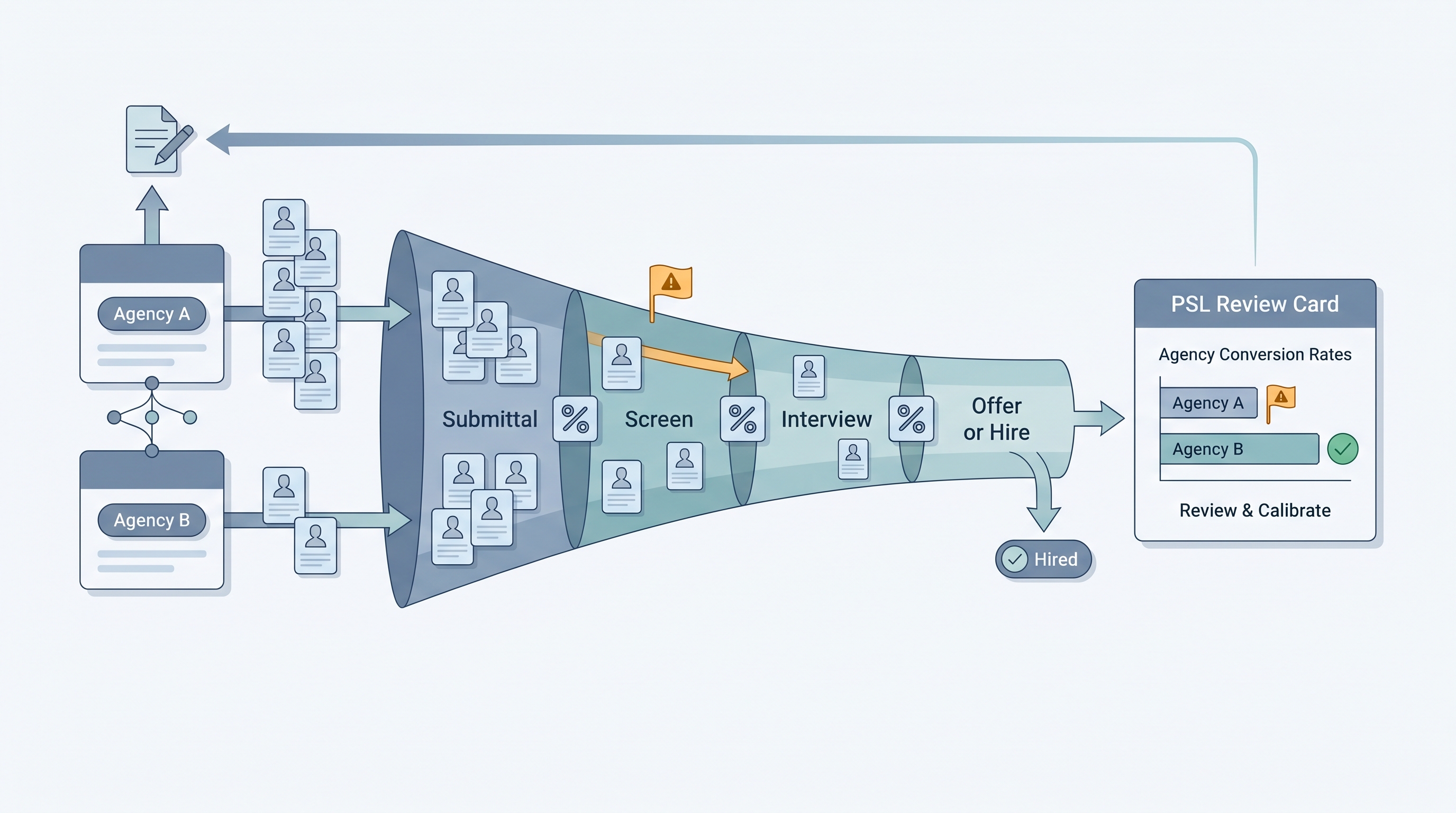
Agency submittal funnel reporting tracks how candidates presented by external recruiting agencies move through each stage of the hiring pipeline, from the moment a resume lands in the recruiter's inbox through screening, interview, offer, and hire. The goal is not just to count submittals but to measure conversion at every stage so teams can evaluate which agencies are delivering hireable candidates, not just profile volume.
The core question it answers is: out of every ten candidates an agency submits, how many reach interview, and how many result in a hire? That ratio is the clearest signal of agency quality for a specific role family, and it is the number PSL reviews should be anchored to.
In practice
- A TA ops lead pulls a quarterly submittal report from the ATS segmented by agency and requisition type. Agency A sends twice the volume of Agency B but has a 6% submittal-to-interview rate versus Agency B's 38%. Agency B renews on the PSL; Agency A is given one quarter to improve with structured intake calls.
- A head of talent at a 400-person company notices the time-from-submittal-to-feedback metric has crept to 11 days. She shares the data with hiring managers in a monthly debrief, pointing out that slow feedback loops reduce agency motivation to prioritise that company's open roles over faster-moving clients.
- During a vendor review, a TA director finds that three agencies have submitted the same candidate for the same role within one week of each other. The duplicate submittal rate across the PSL is 18%. A right-to-represent policy is drafted and shared with all suppliers.
Quick read, then how hiring teams use it
This is for TA leaders, TA ops teams, and procurement partners who need shared vocabulary in PSL reviews, vendor calls, and hiring manager debriefs. Skim the first section for a fast shared picture. Use the second when building dashboards or setting agency performance expectations.
Plain-language summary
- What it means for you: Agency submittal funnel reporting tells you whether the agencies on your preferred supplier list are sending candidates who actually reach interview, or just filling your inbox with CVs that go nowhere.
- How you would use it: Review submittal-to-interview and submittal-to-hire rates per agency per quarter. Use those numbers in PSL review conversations rather than relying on submittal volume alone.
- How to get started: Export three months of ATS stage data per agency and map the funnel from submittal through hire. If your ATS does not tag submittals by agency source, add that field before the next req opens.
- When it is a good time: When your PSL is due for review, when submittal volume is high but hires are slow, or when a hiring manager is consistently saying agency candidates are not relevant.
When you are running live reqs and tools
- What it means for you: Submittal funnel reporting connects agency quality to pipeline coverage. If submittal-to-interview rates are below 15% across the PSL, the solution is better-briefed agencies, not more agencies.
- When it is a good time: At the start of every req, set a submittal target per agency based on historical conversion rates rather than raw numbers. An agency converting at 40% needs to send far fewer submittals to fill a role than one converting at 10%.
- How to use it: Build a simple ATS view or spreadsheet tracking submittals, advances, and hires per agency per role category, updated weekly. Share the report with account managers quarterly to drive intake calibration and reset expectations.
- How to get started: Standardise the source field in your ATS to include agency name from the first submittal. Without consistent tagging, funnel data is unreliable and PSL decisions rest on intuition rather than pattern. See pipeline coverage reporting for how to connect submittal data to overall pipeline health.
- What to watch for: High submittal volume with low conversion signals a briefing problem or an agency optimising for volume metrics. Rapid improvement in conversion after structured feedback suggests the agency is responsive and worth investing in. Consistent low conversion after two briefing cycles suggests a fundamental specialisation mismatch worth addressing in the next PSL review.
Where we talk about this
On AI with Michal live sessions, agency submittal funnel reporting comes up in the AI in recruiting track when TA ops practitioners discuss how to build data-driven vendor management and connect agency performance to pipeline health. The Sourcing Lab cohort covers PSL governance, intake brief design, and how to use ATS data to make supplier decisions that hold up in procurement reviews.
Around the web (opinions and rabbit holes)
Third-party creators move fast. Treat these as starting points, not endorsements, and double-check anything before you wire candidate data.
YouTube
- Recruiting metrics that matter: agency performance reporting covers the conversion metrics staffing firms and in-house TA teams use to evaluate supplier quality.
- How to manage your preferred supplier list with data walks PSL review frameworks anchored to submittal-to-hire conversion rather than relationship-based supplier retention.
- Agency vs in-house recruiting: measuring quality of hire compares conversion benchmarks across staffing models and explains why submittal-to-interview rate outperforms submittal volume as a quality signal.
- How do you evaluate agency performance in r/recruiting contains candid conversations from TA leaders and ops practitioners about which metrics they actually act on in PSL reviews.
- Managing staffing agencies and PSL governance in r/RecruitmentAgencies covers how agency-side recruiters understand conversion tracking and what feedback they find most useful.
- ATS reporting for agency submittals in r/humanresources includes practical questions from HR practitioners trying to build supplier scorecards from existing ATS data.
Quora
- How do companies measure recruiting agency performance? collects practitioner answers on what conversion metrics and feedback loops matter most in practice (read critically for context-specificity).
Agency submittal funnel: key metrics
| Stage | Metric | What it signals |
|---|---|---|
| Received | Submittals per agency per req family | Volume and intake cadence |
| Screening | Submittal-to-screen rate | First-pass relevance to brief |
| Interview | Submittal-to-interview rate | Hiring manager alignment |
| Offer | Submittal-to-offer rate | Qualified candidate quality |
| Hire | Submittal-to-hire rate | End-to-end supplier value |
| Feedback | Time-from-submittal-to-feedback | Internal review speed |
Related on this site
- Glossary: Preferred supplier list (PSL), Agency vs in-house recruiting, Talent acquisition metrics
- Glossary: Sourcing funnel metrics, Pipeline coverage reporting, Interview-to-offer ratio
- Glossary: Hiring funnel conversion rates, Time in stage reporting, Workflow automation
- Blog: AI sourcing tools for recruiters
- Live cohort: Sourcing Lab
- Course: Starting with AI: the foundations in recruiting
- Membership: Become a member