Differentiating agency search from in-house TA
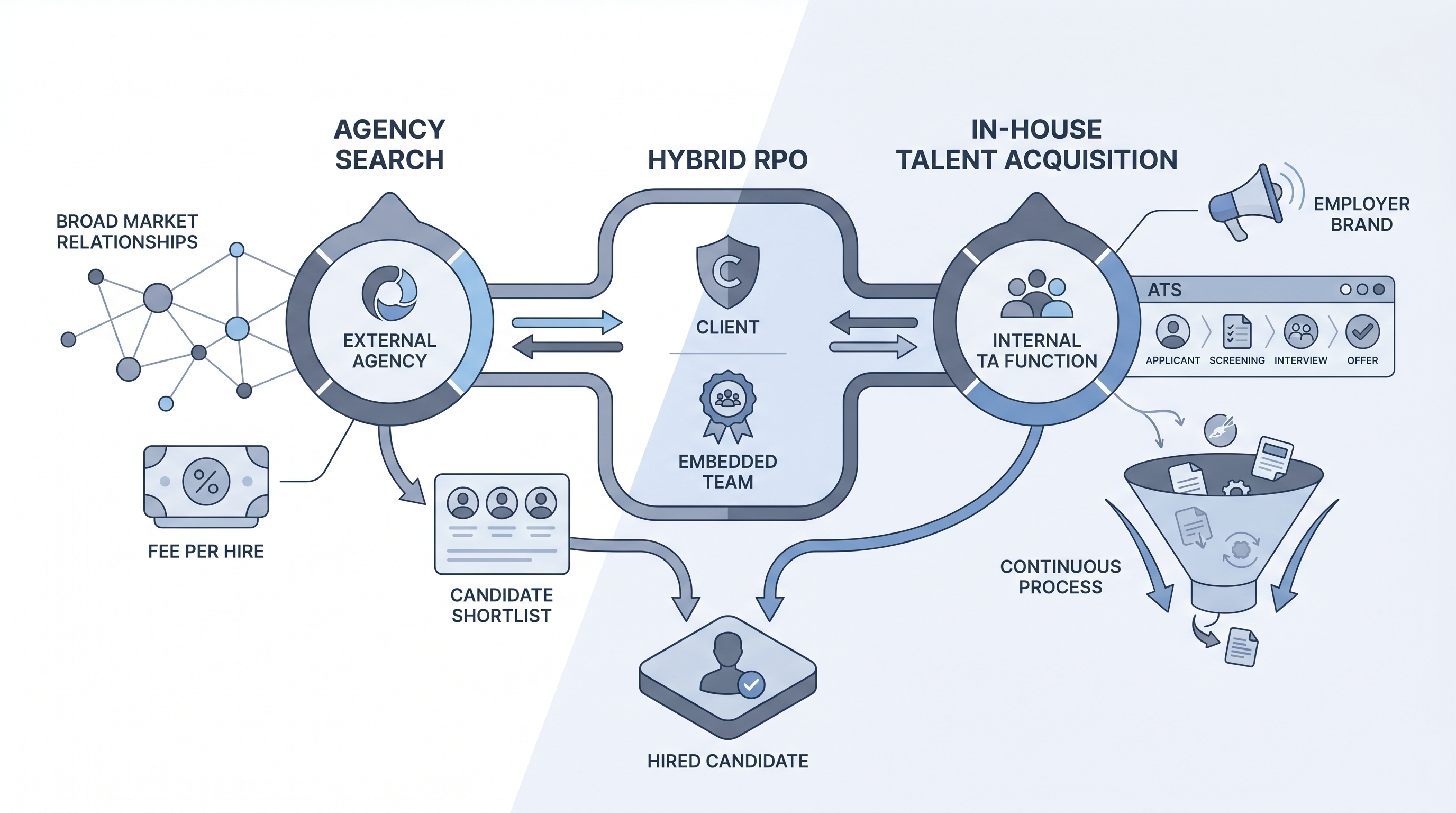
Agency search is a service a company buys from an external recruiting firm, paid on contingency or retainer when a hire is made. In-house talent acquisition is an internal function the company builds and runs itself. The distinction shapes hiring economics, candidate access, brand ownership, and how data privacy obligations are allocated between the company and any external vendor.
Michal Juhas · Last reviewed May 5, 2026
What is the difference between agency search and in-house TA?
Agency search and in-house talent acquisition sit at opposite ends of a build-versus-buy decision in recruiting. An agency is a service you activate when you need it. In-house TA is a function you build, staff, and maintain regardless of current hiring volume.
Both produce hires. The differences are in cost structure, candidate access, accountability, and who owns the candidate relationship and data after the search closes.
Understanding where each model performs well, and where it does not, helps TA leaders, agency principals, and hiring managers make faster decisions about which approach to use for a given role.
In practice
- A TA director at a 200-person SaaS company fills most roles through her internal team but uses a specialist agency for principal engineering and leadership hires, where her team does not have the network depth or time to run a six-week passive sourcing campaign while managing 15 other open reqs.
- An agency recruiter working a series of similar roles for a biotech client sources from the firm's existing candidate relationships rather than advertising publicly, reaching passive candidates who would never apply to a job board posting.
- A manufacturing company's HR director moves to an RPO arrangement after a plant expansion doubles the hiring plan. An RPO provider deploys a team under the company's employer brand using the existing ATS, then scales headcount back down when the surge ends.
Quick read, then how hiring teams use it
This page is for TA leaders deciding how to allocate hiring work between internal teams and external vendors, for agency founders positioning their service, and for hiring managers who want to understand why the search approach matters as much as the job description.
Plain-language summary
- What it means for you: Agency search and in-house TA are not competing models; they are different tools for different situations. Agencies trade cost-per-hire for speed and specialist market access. Internal TA trades per-hire cost for process control and employer brand ownership.
- How you would use it: Map your open roles against two factors: how specialised is the market, and how confidential does the search need to be? Roles that score high on either tend to benefit from an agency. Roles that are high volume and within your team's proven market depth belong in-house.
- How to get started: Pull your last 12 months of placements. Calculate actual cost-per-hire for agency fills versus internal fills by role category. Identify where agency fees consistently exceed the internal cost to run the same search. Those are the roles to bring in-house first.
- When it is a good time: When evaluating a new agency relationship, when reviewing sourcing budget allocation for the next quarter, or when a hiring manager asks why you are not using an agency for a role your team is struggling to fill.
When you are running live reqs and tools
- What it means for you: Agency and in-house sourcing increasingly share the same tools: LinkedIn Recruiter, enrichment providers, AI drafting assistants. The differentiation that remains is market relationship depth and the ability to approach passive candidates through warm introductions that no data provider can replicate.
- When it is a good time: When a req has been open for more than 30 days and in-house sourcing is not converting passive candidates to screening calls. When the role is confidential and cannot be posted. When the TA team has sourcing capacity but lacks market relationships in that specific function.
- How to use it: Build a tiered sourcing policy: define which role categories your team will always source internally, which will always go to agency (confidential or ultra-specialist), and which will be attempted internally for 30 days before agency engagement. Document this so hiring managers understand the process before they ask.
- How to get started: Review your vendor agreements against agency indemnification clauses and agency invoice payment terms. Understand what you owe the agency if the role is filled internally after their candidates are introduced. Many disputes stem from poorly defined exclusivity windows.
- What to watch for: Agencies presenting the same candidates you are already sourcing independently, which adds fee exposure without adding candidate access. Contingency arrangements that create incentives to fill fast rather than fill well. In-house TA teams avoiding agency engagement on hard roles because it feels like an admission of failure rather than a deliberate strategy call.
Where we talk about this
On AI with Michal live sessions, the agency-versus-in-house question comes up across both the AI in recruiting track (where in-house TA teams discuss automation and sourcing strategy) and agency-focused sessions (where founders and ops leads work on positioning and business development). The Sourcing Lab cohort covers how AI tools affect the economics on both sides of this comparison and how to structure client-agency relationships for the current market.
Around the web (opinions and rabbit holes)
Third-party creators cover agency versus in-house recruiting from hiring manager, agency owner, and TA leader perspectives. These are starting points, not endorsements. Verify any cost or fee benchmark with current market data before using it in a client or internal budget conversation.
YouTube
- Agency recruiter vs in-house recruiter: what's the difference? covers the day-to-day experience, incentives, and role scope from practitioners on both sides.
- How to choose between an agency and an internal recruiter walks through the cost and speed trade-offs from a hiring manager perspective.
- RPO explained: recruitment process outsourcing vs agency covers how RPO sits between the two models and when it makes sense.
- Agency vs in-house recruiting in r/recruiting contains practitioner conversations about switching between the two models, including what recruiters prefer about each.
- When to use a recruiting agency in r/humanresources covers HR and TA leader perspectives on agency engagement decisions.
- RPO and agency discussion in r/RecruitmentAgencies explores how agency owners think about RPO competition and positioning.
Quora
- Agency recruiter vs internal recruiter: what are the differences? collects answers from practitioners on both sides covering incentives, candidate experience, and when each model delivers better outcomes.
Agency search vs in-house TA vs RPO: a comparison
| Dimension | Agency (contingency) | Agency (retained) | In-house TA | RPO |
|---|---|---|---|---|
| Fee structure | Per placement, no hire no fee | Upfront plus milestone payments | Fixed headcount cost | Volume-based or per-hire rate |
| Candidate access | Agency network and databases | Agency network, exclusive | Internal pipeline and ATS | Shared internal and vendor tools |
| Confidentiality | Moderate (agency knows client) | High (exclusive engagement) | Low for posted roles | High (works under client brand) |
| Process ownership | Agency manages search | Agency manages search | TA team owns full process | RPO provider owns full process |
| Employer brand | Separate from client brand | Separate from client brand | Fully integrated | Operates under client brand |
| Scales with volume | Yes, by adding more agencies | Per role only | Requires headcount investment | Designed to scale and contract |
Most companies end up in a hybrid: in-house TA for steady-volume roles, contingency or retained for specialist and confidential fills, and RPO for surge capacity.
Related on this site
- Glossary: Talent acquisition, Agency business development, Agency candidate rebate and clawback
- Glossary: Agency indemnification clauses, Agency invoice payment terms, Agency markup and contract staffing
- Glossary: Agency escrow and retainer, Proprietary talent pool, Workflow automation
- Glossary: GDPR and first-touch outreach, Recruitment agency software, AI outreach drafting
- Workshops: Sourcing Lab
- Course: Starting with AI: the foundations in recruiting
- Membership: Become a member