AI-generated interview questions
Interview questions created by an AI assistant from a job description, competency framework, or scorecard. When calibrated and reviewed before use, they give interviewers a consistent, role-relevant question set faster than building one from scratch.
Michal Juhas · Last reviewed June 14, 2026
What are AI-generated interview questions?
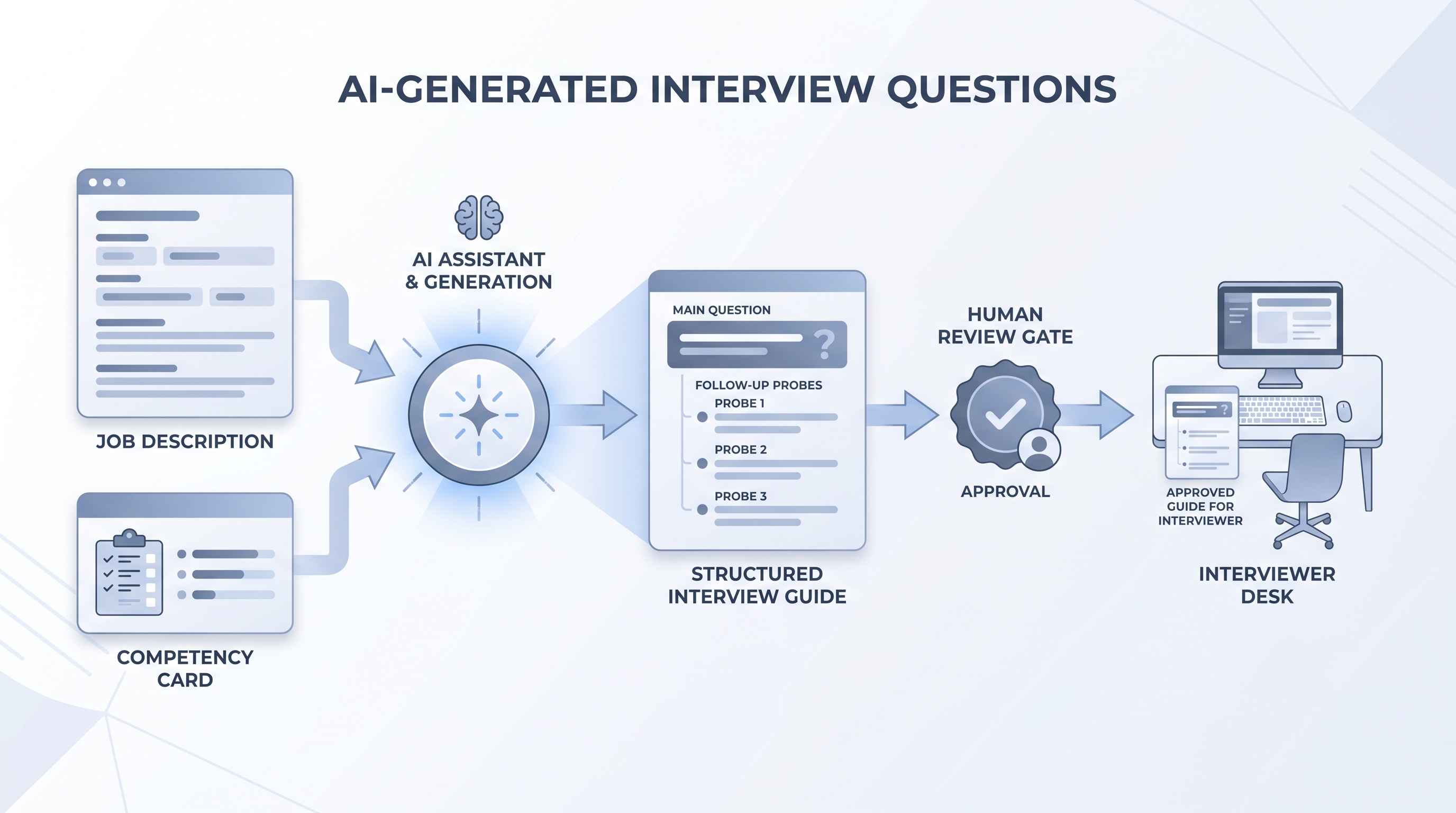
AI-generated interview questions are structured interview prompts drafted by an AI assistant, typically using a job description, scorecard, or competency framework as input. The output can include opening behavioral questions, follow-up probes, and hypothetical scenarios. The efficiency gain is real: a recruiter can have a draft interview guide in minutes. The risk is also real: without a calibration and review step, the questions are generic at best and legally problematic at worst.
In practice
- A recruiter pastes a job description and the three scorecard competencies into a Claude prompt, asking for five behavioral questions per competency with two probing follow-ups each. The output becomes the base interview guide, reviewed by HR before being loaded into the ATS.
- A TA ops lead maintains a shared Notion library of approved AI-generated question cards, organized by competency. Each card shows the question, the expected answer signals, and a "do not ask" list of adjacent topics that could introduce bias.
- An interviewer who has never hired a product manager before uses an AI-generated question set calibrated to the role. Post-debrief, two questions produced no useful signal; the team logs that and updates the prompt for the next round.
Quick read, then how hiring teams use it
This is for recruiters, hiring managers, and TA ops leads who design structured interviews. Skim the first section to understand what AI can and cannot do here. Use the second when you are building a question library or calibrating prompts for a new role family.
Plain-language summary
- What it means for you: You can draft a structured interview guide in minutes instead of hours. The time you save belongs in calibration, not in hoping generic questions surface the right signal.
- How you would use it: Write a specific prompt that names the competency, the level, and one or two context clues about the role. Review the output against your scorecard before sending to interviewers.
- How to get started: Pick the next role where you need an interview guide. Pull the relevant competency from your scorecard. Feed that competency plus the JD into a prompt and ask for five behavioral questions with follow-ups. Review the output for legal risk and relevance.
- When it is a good time: When you are building a new role family template, when a hiring manager complains that interviews feel inconsistent, and when your debrief notes show that different interviewers asked completely different things.
When you are running live reqs and tools
- What it means for you: At scale, inconsistent interviews are a legal and quality risk. AI-generated question sets, reviewed and approved, give every interviewer the same structured starting point regardless of how often they hire.
- When it is a good time: When you have a scorecard and a calibration session already in place. AI question generation accelerates those workflows; it does not replace them.
- How to use it: Wire the question generation step into your intake workflow (see intake to JD AI for the parallel JD workflow). Store approved outputs in your agent knowledge base or ATS-linked doc. Log debrief signal quality to improve prompts over time.
- How to get started: Pick your two highest-volume role families. Generate a question bank for each using a specific competency prompt. Run both through HR review. Load them into the tool interviewers use to prep. Collect signal-quality feedback from the first five debriefs.
- What to watch for: Interview guides that no one actually uses. If interviewers bypass the approved questions, find out why before generating more content. Usually the guide is too long, too formal, or not accessible from where the prep conversation happens.
Where we talk about this
On AI with Michal sessions, AI-generated interview questions come up in the AI in recruiting track as part of the full intake-to-debrief workflow. We build question sets live from real scorecards and debrief which prompts produced more useful output. Start at the AI Sourcing Lab and bring a role where you know the debrief quality has been inconsistent.
Around the web (opinions and rabbit holes)
Third-party creators move fast. Treat these as starting points, not endorsements, and double-check anything before using it with candidates.
YouTube
- How to Use AI to Create Interview Questions (SHRM) walks through practical examples of AI-assisted interview prep for HR professionals.
- Structured Interviews: Why They Work and How to Build Them (Criteria Corp) explains the research behind structured interviews before the AI layer is added.
- Has anyone used ChatGPT to build interview question banks? in r/recruiting is a practical thread on what prompts work and what legal guardrails practitioners are using.
- How do you ensure interview consistency across hiring managers? in r/humanresources includes structured interview frameworks that AI-generated questions can extend.
Quora
- What are the best practices for AI-assisted interview question generation? surfaces both practitioner caution and practical tooling tips.
AI-generated versus manually crafted questions
| Factor | AI-generated | Manually crafted |
|---|---|---|
| Speed | Minutes | Hours |
| Consistency | High if prompt is specific | Variable |
| Legal review needed | Yes, always | Yes, but often skipped |
| Signal quality | Depends on prompt calibration | Depends on interviewer expertise |
| Scalability | High | Low without templates |
Related on this site
- Glossary: Scorecard, Calibration session hiring, Panel debrief alignment, Explainable AI hiring, Agent knowledge base
- Live cohort: AI Recruiting Accelerator
- Course: Starting with AI: the foundations in recruiting
- Membership: Become a member