AI in the hiring process
Using language models, machine learning, and automation tools at each stage of the hiring lifecycle, from writing job descriptions through sourcing, screening, assessments, and interviews to offer acceptance, so decisions move faster, criteria are documented, and repetitive admin leaves more time for the conversations that actually predict hire quality.
Michal Juhas · Last reviewed May 9, 2026
What is AI in the hiring process?
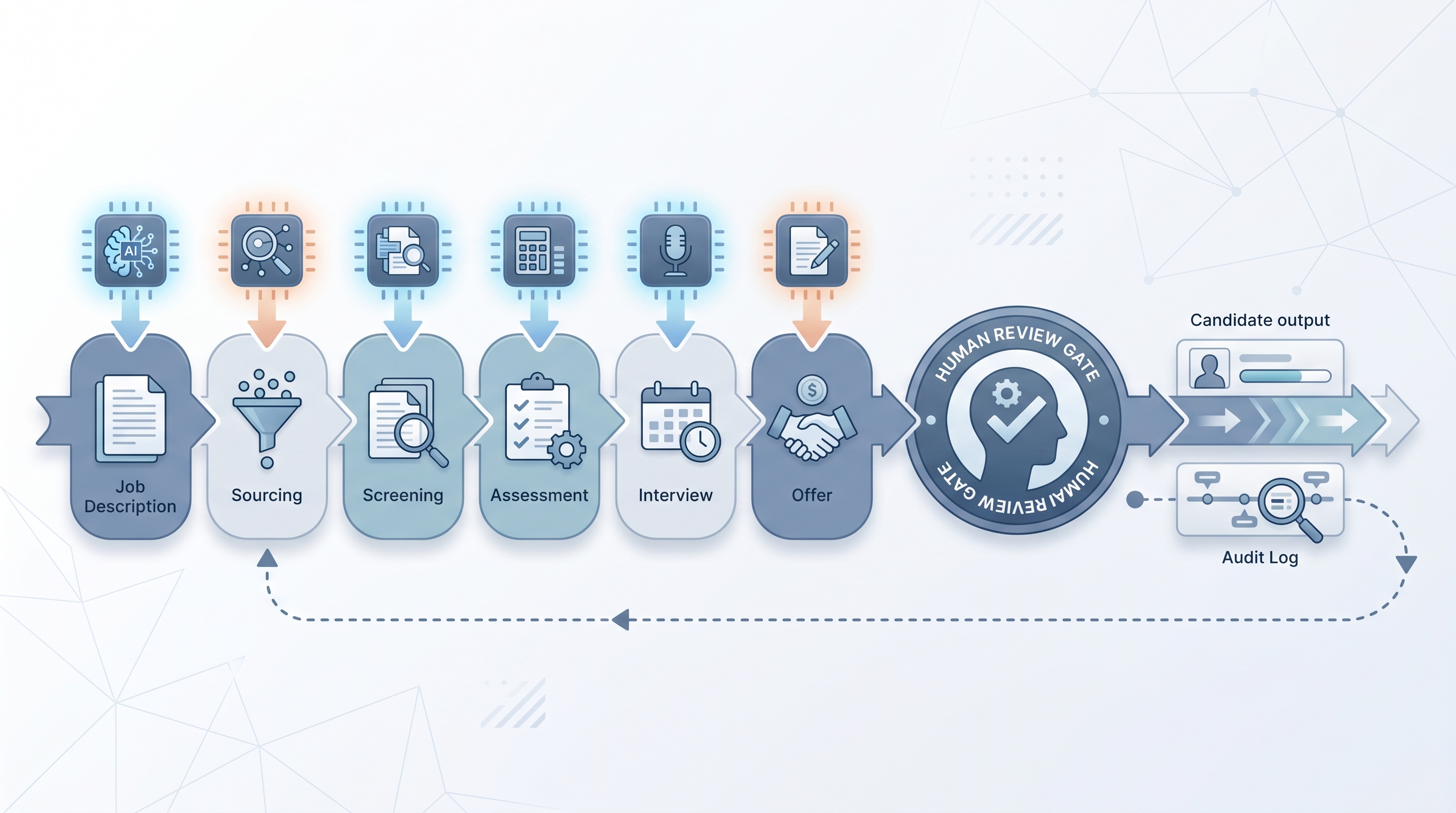
AI in the hiring process means applying language models, machine learning tools, and automation at each procedural stage of hiring: writing the job description, sourcing, screening resumes, running assessments, structuring interview notes, and drafting offers. The goal is faster stage movement, documented decision criteria, and less admin per recruiter so the conversations that actually predict hire quality get more time and attention.
The term is process-first: it asks where AI plugs into each step a candidate moves through, not just which tools a team buys. That makes it narrower than AI in recruiting, which covers strategy and employer brand, but broader than AI in hiring, which focuses specifically on the evaluation and selection stage where compliance risk concentrates.
In practice
- When a TA ops manager builds a Make or Zapier flow that triggers an AI-generated screening summary as soon as a resume lands in the ATS, that is AI in the hiring process at the screening stage.
- "The intake-to-JD tool saves us three rounds of email with the hiring manager" is process-first language: it points at where the time actually went, not at a vendor logo.
- A compliance officer asking "which stages did AI touch for this candidate?" is asking a process question; the answer should come from a decision log, not a vendor dashboard screenshot.
Quick read, then how hiring teams use it
This is for recruiters, sourcers, TA ops, and HR partners who need a shared picture before tooling decisions lock in. Skim the first section for a fast shared vocabulary. Use the second when you are wiring tools to specific stages and need to know what review gates to build.
Plain-language summary
- What it means for you: AI in the hiring process means the routine steps between "job approved" and "offer signed" can get faster and more consistent. Not because a robot makes decisions, but because admin, drafting, and routing get handled so you can focus on the calls and panels that matter.
- How you would use it: Map your current process on paper. Mark the three steps that eat the most recruiter time per week. Identify which involve repetitive input-output work (drafting, extracting, scheduling) rather than judgment. Those are the first candidates for AI assist.
- How to get started: One stage at a time. A prompt chain that turns intake notes into a draft JD, then a second chain that structures interview notes into a scorecard, is a realistic six-week project for a team of three recruiters with a shared playbook.
- When it is a good time: After your process is documented and consistent, not while stages still change week to week. Automating a moving target amplifies inconsistency rather than reducing it.
When you are running live reqs and tools
- What it means for you: Each stage of the hiring process exposes AI errors at a different cost. A poorly worded JD gets edited before anyone is harmed. A biased screening score affects a real candidate. Map risk to stage before connecting tools, and gate the high-risk steps with a human-in-the-loop checkpoint.
- When it is a good time: When the same AI-assisted step fires dozens of times per week, when the happy path is stable, and when you have a named owner for each review gate and a runbook for failures.
- How to use it: Pair no-code automation (Zapier, Make, or n8n) with language model calls at each stage. Keep candidate-facing sends behind a human gate until error rates are boringly low. Log tool name, model version, input, and output for every AI-touched decision so an auditor can reconstruct any record in one pull.
- How to get started: Ship one internal automation first: an AI-generated briefing document that a recruiter edits before the panel sees it. Add more stages only after the first runs cleanly for four to six weeks. Review the AI adoption ladder before committing to a vendor that spans multiple stages.
- What to watch for: Silent partial runs, score drift after a vendor model update, GDPR questions about where AI outputs land, and hiring managers who disable the tool after one bad recommendation. Instrument alerts and run a quarterly audit before problems become patterns.
Where we talk about this
On AI with Michal live sessions we work through the process stage by stage: AI in recruiting blocks map each tool to a step in the pipeline and surface where bias risk concentrates, while sourcing automation blocks go deeper into the first half of the process: search, outreach, and pipeline tracking. If you want the full room conversation with real stack questions and peer pressure-testing of vendor claims, start at Sourcing Lab.
Around the web (opinions and rabbit holes)
Third-party creators move fast. Treat these as starting points, not endorsements, and double-check anything before you wire candidate data.
YouTube
- AI in Recruitment: The Good, The Bad, and The Ugly covers practical limits alongside the benefits, which most promotional content skips.
- How to Automate Your Entire Hiring Process with n8n and Notion (Michele Torti) walks a full hiring-shaped build in public across multiple connected stages.
- n8n Tutorial: Build an AI HR Assistant That Shortlists Candidates shows automation nodes connected to AI scoring in a way recruiters can follow step by step.
- Has anyone automated their hiring process with AI? in r/recruiting is a frank practitioner thread about what actually held up in production versus what looked good in a demo.
- I want to make some recruitment automated workflows but... in r/RecruitmentAgencies covers the "where do I even start" question from people already in the chair.
- Is AI screening actually fair? in r/recruiting covers compliance concerns from practitioners who have run live pilots, not just vendor pilots.
Quora
- How can AI help in the recruitment process? collects practitioner and vendor perspectives across several angles; read critically and verify any tool claims independently before buying.
AI assist versus AI decide
| Stage | AI assist is safe | AI decides is high-risk |
|---|---|---|
| Job description | Draft from intake notes; human edits | Publishing without review |
| Resume screening | Flag matches; human confirms | Auto-reject without human check |
| Assessment scoring | Rank by criteria; recruiter validates | Hard cutoff without human calibration |
| Scorecard | Generate from notes; recruiter edits | Final rating without review |
| Offer | Draft letter; recruiter approves | Sending or negotiating autonomously |
Related on this site
- Glossary: AI in recruiting, AI in hiring, AI hiring, Intake to JD AI, Resume parsing, Scorecard, AI bias audit, Human-in-the-loop, AI adoption ladder, Prompt chain
- Blog: AI sourcing tools for recruiters
- Tools: n8n, ChatGPT
- Live cohort: Sourcing Lab
- Course: Starting with AI: the foundations in recruiting
- Membership: Become a member