AI job screening
Using AI to score and rank job applications against a criteria card, flag missing must-have skills, and surface a shortlist for recruiter review before any advance or decline decision is confirmed.
Michal Juhas · Last reviewed May 10, 2026
What is AI job screening?
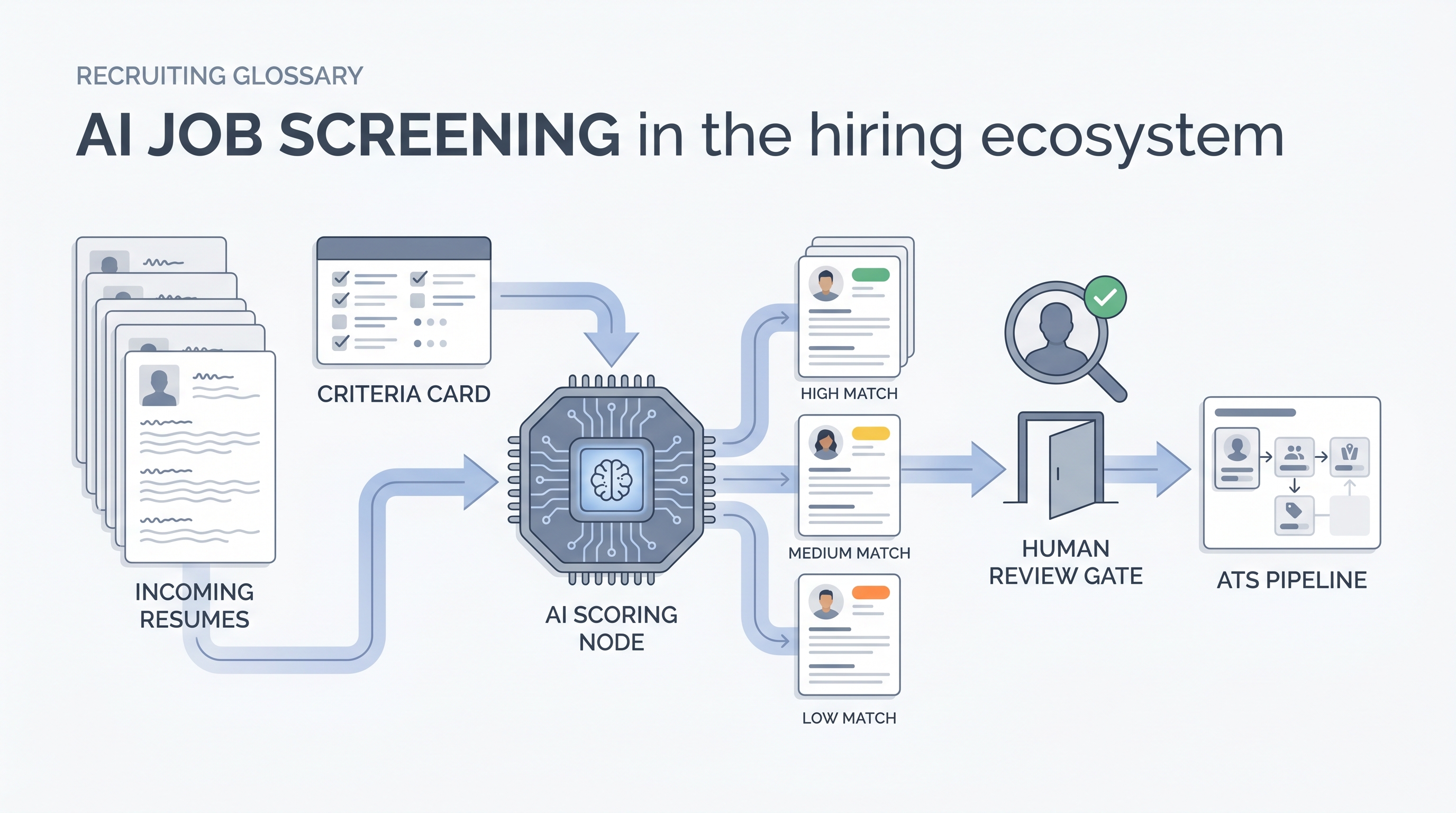
AI job screening applies language models to incoming job applications: the model reads each resume or application form against a criteria card you define, scores each profile on must-have requirements, and returns a ranked shortlist with reasons for each score. A recruiter reviews the output before any profile advances or is declined.
The criteria card is the key variable. Write it from the job requirements, not from memory of the last good hire. Define which skills are must-haves and which are signals, and only automate scoring against must-haves. The model cannot calibrate the hiring manager's unstated preferences; those have to be made explicit before the first resume enters.
In practice
- When a TA ops lead says "we screen with AI," they usually mean resumes are scored against a criteria card and ranked before a recruiter reviews the top tier, not that AI makes the advance decision without a human.
- A sourcer building a screening flow for a high-volume tech role might define "must have Python and AWS" as the scoring criteria and let the model sort five hundred applications into tiers before the recruiter touches a single profile.
- Compliance asks "which AI vendor sees our candidate resumes" because the answer determines the DPA vendor list and the GDPR record of processing entry, not just the tool budget.
Quick read, then how hiring teams use it
This is for recruiters, sourcers, TA, and HR partners who need the same vocabulary in debriefs, vendor calls, and policy reviews. Skim the first section when you need a fast shared picture. Use the second when you are deciding how it shows up in the ATS, sourcing tools, or candidate communications.
Plain-language summary
- What it means for you: An AI reads incoming applications and sorts them by how well they match the job criteria you defined, so you start reviewing a shorter, more relevant list instead of every application in order of arrival.
- How you would use it: Write a criteria card with your hiring manager before the first application enters. The model scores against that card. You review the ranked output and confirm which profiles move forward.
- How to get started: Pick one high-volume role where you currently spend the most time reading applications that do not match the basics. Write the must-haves explicitly. Run a sample screen on ten profiles before you trust the output on hundreds.
- When it is a good time: When the same must-have requirements apply to many applications, when the recruiter is the bottleneck in the screening step, and when you have a named person who will review the AI output before any candidate is declined.
When you are running live reqs and tools
- What it means for you: AI screening is a scoring and ranking layer that plugs into your ATS inbound flow. A webhook or API call fires when a new application arrives, runs the scoring prompt, and writes a score field and reason summary back to the ATS record before the recruiter opens it.
- When it is a good time: After you have a stable criteria card reviewed by the hiring manager, error alerts wired, and a named owner who knows what a wrong score looks like and how to escalate.
- How to use it: Scope the must-have criteria tightly. Exclude demographic proxies from scoring inputs. Log the model version and criteria card version for every batch run. Keep the advance and decline actions behind a human gate. Review a sample of declined profiles every month to catch criteria drift.
- How to get started: Start with a parallel run: score incoming applications with AI while a recruiter also reviews them manually. Compare outputs for two weeks before you remove the manual step. Structured output patterns help when writing back scores and reasons to ATS fields in a consistent format.
- What to watch for: Resume formatting that confuses the parser and causes silent extraction errors. Criteria cards written for one role and reused unchanged for a different one. Batch runs that surface only the top tier and leave strong profiles permanently invisible. Adverse impact monitoring is the governance step that catches the last category before it becomes a pattern.
Where we talk about this
On AI with Michal live sessions we walk through AI job screening end to end: the AI in recruiting track covers criteria card design, prompt structure, how to log outputs for GDPR, and what calibration with a hiring manager looks like in a real session. The sourcing automation track goes deeper on the ATS webhook and API layer. If you want the full room conversation with real stack questions, start at Sourcing Lab and bring your current ATS setup and a job brief you are actively working.
Around the web (opinions and rabbit holes)
Third-party creators move fast. Treat these as starting points, not endorsements, and double-check anything before you wire candidate data.
YouTube
- Search "AI resume screening recruiter" on YouTube filtered to the past year to find practitioners building screening flows in Make, n8n, or direct API integrations that show how criteria cards translate into working prompts. Prefer channels that show the error handling and the calibration step, not only the happy path demo.
- Recruiting Brainfood (Hung Lee) covers AI adoption in screening through practitioner interviews and honest assessments of where automation helps and where the quality story falls apart.
- HR Tech influencer channels increasingly cover AI screening tools with live demos. Watch for whether the demo shows the human review gate or skips straight from AI score to candidate communication.
- r/recruiting has active threads on AI screening tools: what is working in production, what breaks, and what hiring managers actually think when they see AI-sorted shortlists.
- r/humanresources surfaces HRBP and HR leader perspectives on the compliance obligations that come with AI screening, including GDPR, the EU AI Act, and EEOC guidance in the US.
Quora
- Search "AI job screening" or "AI resume screening" on Quora for practitioner answers about implementation experience. Read critically; vendor-authored answers tend to skip the bias and compliance sections.
AI screening versus manual screening
| Dimension | Manual | AI-assisted |
|---|---|---|
| Speed on high volume | Bottleneck | Significant gain |
| Criteria consistency | Varies by reviewer | Consistent if criteria card is stable |
| Bias risk | Implicit | Explicit via criteria card, auditable |
| Compliance documentation | Often informal | Requires DPA, logging, human gate |
Related on this site
- Glossary: Artificial intelligence resume screening, AI-based resume screening, Async screening, Resume parsing, Human-in-the-loop (HITL), AI bias audit, Adverse impact, Scorecard, Structured output
- Blog: AI sourcing tools for recruiters
- Guides: Sourcers
- Live cohort: Sourcing Lab
- Course: Starting with AI: the foundations in recruiting
- Membership: Become a member