Best AI recruiting tools
The AI-powered tools that best reduce recruiter time on repetitive tasks - sourcing, outreach drafting, resume screening, scheduling - while keeping humans accountable for every candidate decision and maintaining audit trails for compliance.
Michal Juhas · Last reviewed May 4, 2026
What are the best AI recruiting tools?
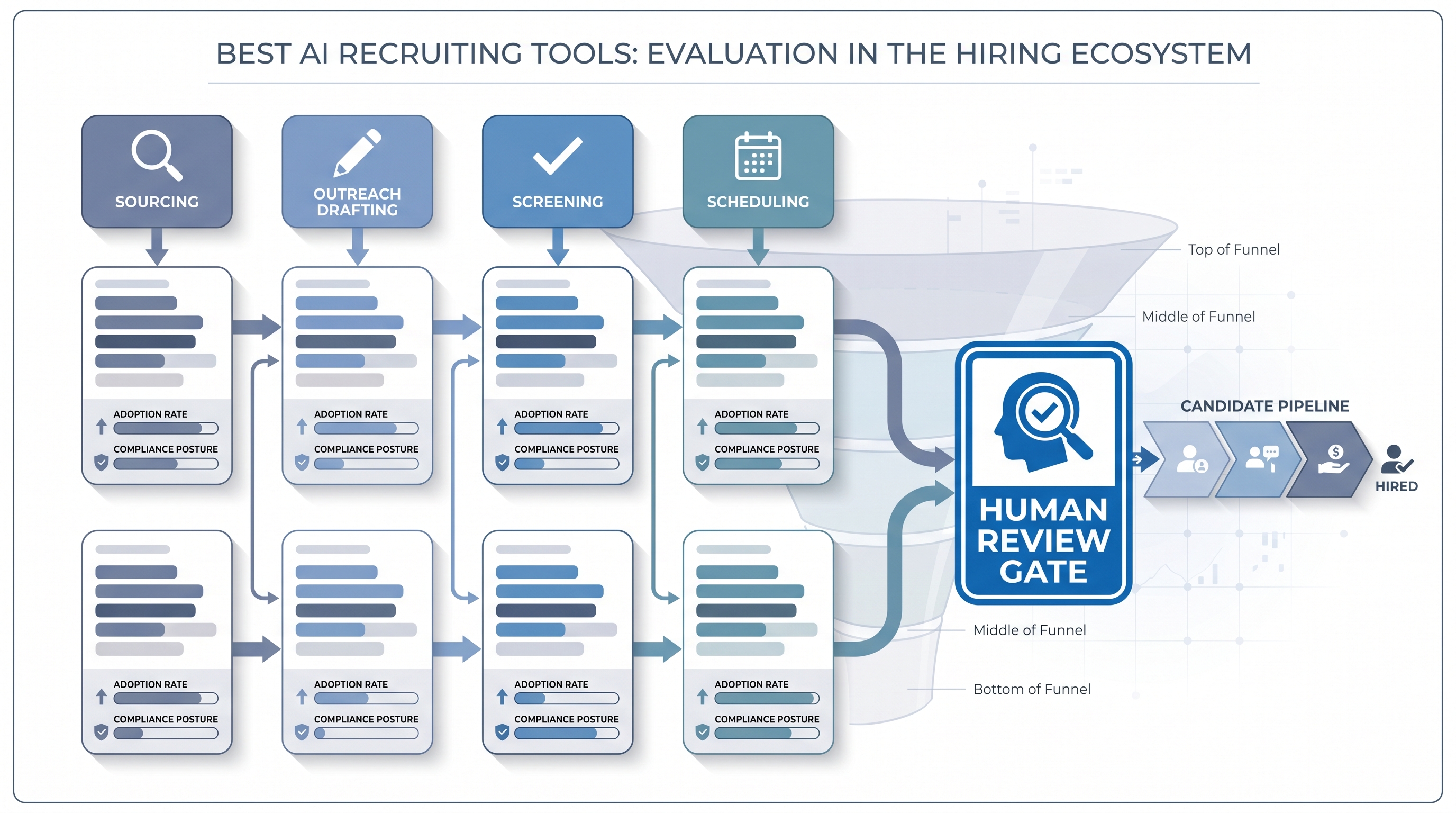
The best AI recruiting tools are the ones that reduce recruiter time on specific bottlenecks - sourcing profile reviews, first-message drafts, CV parsing, interview scheduling - while keeping a human accountable for every candidate decision and maintaining an audit trail for compliance inquiries.
"Best" is always context-dependent: the right tool for a high-volume agency sourcer is not the right tool for a technical in-house recruiter running five executive searches simultaneously. This page focuses on evaluation criteria and category comparisons rather than vendor rankings, because what works depends on your req mix, ATS, and compliance posture.
In practice
- A full-cycle recruiter describes the best AI tool she uses as the one she actually runs on every req, not the one that had the most impressive live demo: a lightweight outreach drafter that saves her 20 minutes per search.
- A TA ops lead says "the best AI recruiting tool is the one with the cleanest audit log" after spending two days reconstructing a candidate screening decision trail for a legal inquiry that should have taken 20 minutes.
- A sourcer who evaluated six AI sourcing tools over three months picks the one with the weakest demo UI but the most stable API, because everything else required manual re-syncing with the ATS every two weeks.
Quick read, then how hiring teams use it
This is for recruiters, sourcers, TA leads, and TA ops practitioners evaluating individual tools, building a team stack, or auditing what is currently live. Skim the first section for shared vocabulary. Use the second when making actual tool decisions.
Plain-language summary
- What it means for you: Best AI recruiting tools means whichever tools solve the biggest time drain your team faces right now, integrate without heroic maintenance, and let you answer a compliance question without a fire drill.
- How you would use it: Pick one bottleneck, trial two tools against it using your own req data, and score them on a rubric before the demo. Do not evaluate six tools at once.
- How to get started: List the three tasks consuming the most recruiter hours per week. Map one tool category to each. Start with the highest-volume, most repetitive task where AI reliability matters more than creativity.
- When it is a good time: Before a headcount surge, when a compliance review flags an AI feature that was never formally evaluated, or when a tool your team relies on changes its pricing or data policy.
When you are running live reqs and tools
- What it means for you: AI recruiting tools make implicit ranking and filtering decisions. Without a documented audit trail, those decisions become liabilities when candidates ask questions or regulators run reviews.
- When it is a good time: When TA is being asked to scale sourcing or screening without proportional headcount, or when leadership asks which tools are driving pipeline quality improvements.
- How to use it: Configure a human-in-the-loop review gate before any AI output reaches a candidate or a hiring manager. Log model version and prompt version alongside each decision. Align IT and legal before any AI feature touches candidate-facing workflows.
- How to get started: Audit your current tool stack and confirm which AI features are actively running. Many teams have AI scoring or enrichment turned on from vendor defaults without realizing it is processing every new application. Find the toggle before an audit does.
- What to watch for: Tools that improve demo performance by loosening privacy or data sharing defaults. Vendor contract terms that grant retraining rights on your candidate data without explicit consent. AI features shipped in quarterly updates without change notifications to your security partner.
Where we talk about this
AI with Michal Sourcing Lab covers AI recruiting tool evaluation in the context of real hiring stacks: which tools hold under ATS load, which features require legal sign-off before enabling, and how to build a vendor scorecard that survives the first year of production. Come with your current shortlist and a compliance question you have not found an honest answer to yet.
Around the web (opinions and rabbit holes)
Third-party creators move fast. Treat these as starting points, not endorsements, and double-check anything before you wire candidate data.
YouTube
- Best AI Tools for Recruiting in 2026 (Recruiting Daily Advisor) walks a practical tool evaluation process for teams without a dedicated TA ops function.
- AI Sourcing and Screening Tools Reviewed (AIHR) compares category leaders on output quality and compliance documentation for HR practitioners.
- What AI Recruiting Tools Actually Work (SHRM) surfaces practitioner perspectives on which tools survive 90 days in production versus which ones looked great in demos.
- Which AI recruiting tools are you actually using? in r/recruiting is one of the most candid threads on production tool usage versus demo-day favorites.
- AI tools that broke after vendor updates in r/RecruitmentAgencies covers post-go-live failures specific to agency and in-house recruiting contexts.
- Compliance concerns with AI screening tools in r/humanresources has practitioner and legal perspectives on automated decision-making obligations.
Quora
- What are the best AI tools for recruiters? collects responses across company sizes and recruiting contexts; read for ICP fit before drawing conclusions.
AI recruiting tool categories quick reference
| Category | Best for | Main compliance watch |
|---|---|---|
| Sourcing AI | Passive candidate discovery at scale | Data residency for enrichment APIs |
| Outreach drafting | Personalized first messages | Human review gate before send |
| Resume parsing | High-volume intake structure | Accuracy on non-standard formats |
| Screening AI | Fit scoring before human review | Bias audit, adverse impact testing |
| Scheduling AI | Interview coordination at volume | Calendar data sharing and retention |
Related on this site
- Glossary: AI recruiting tools, AI recruiting solutions, Human-in-the-loop, AI bias audit, Semantic search
- Blog: AI sourcing tools for recruiters
- Guides: Sourcers, Hiring managers
- Course: Starting with AI: the foundations in recruiting
- Live cohort: Sourcing Lab
- Membership: Become a member