AI recruiting solutions
Integrated combinations of software, workflow design, and AI configurations that address a specific recruiting challenge end-to-end, from sourcing through offer, rather than adding a single feature to an existing stack.
Michal Juhas · Last reviewed May 4, 2026
What are AI recruiting solutions?
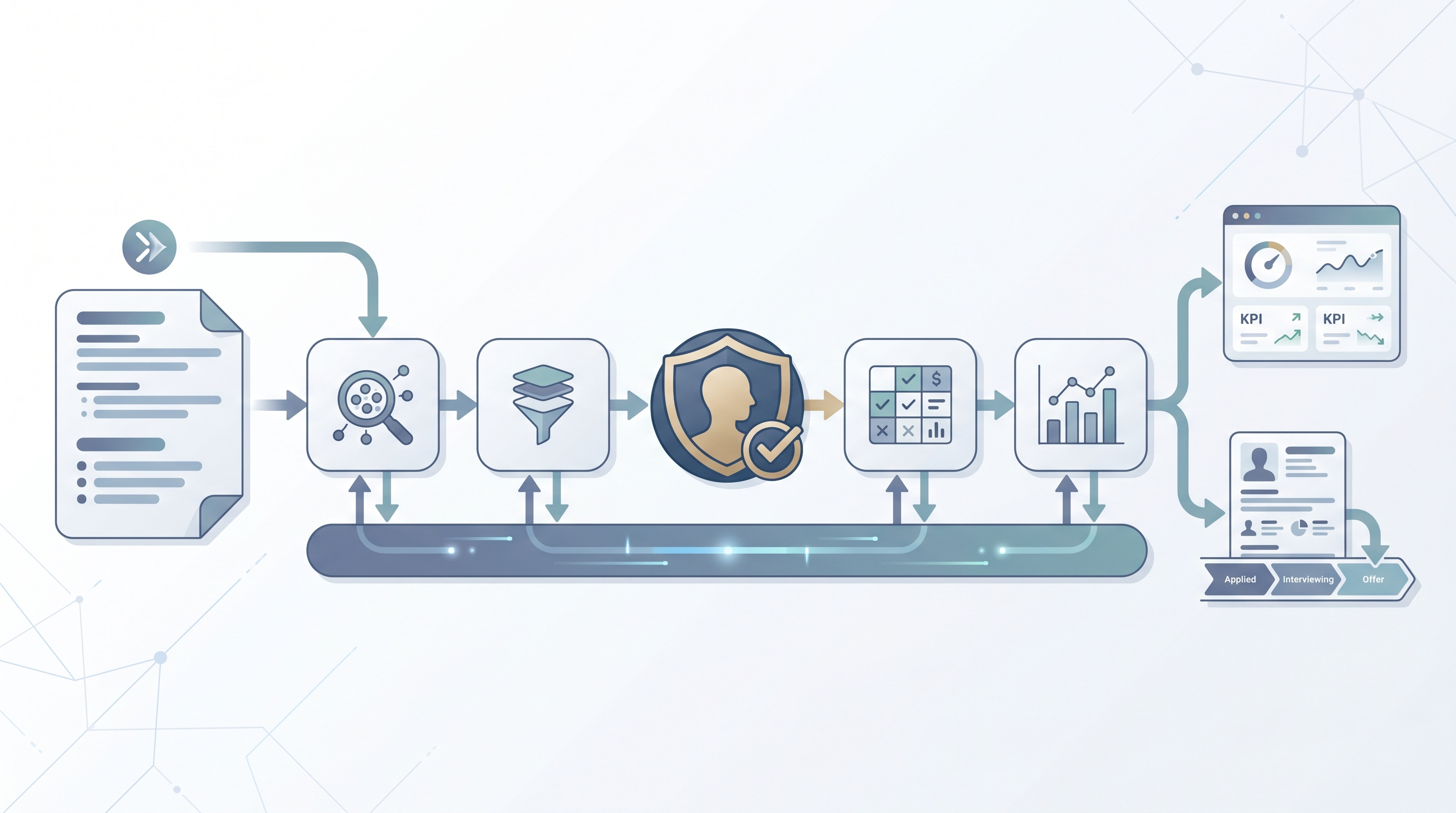
AI recruiting solutions are integrated packages of software, automation, and AI configurations built to address a specific hiring challenge from sourcing through offer. The term covers more than a single AI recruiting tool: a solution typically bundles multiple functions, claims to handle handoffs between stages, and is sold or built as a system rather than a point feature.
The practical difference matters for compliance, cost, and accountability. A solution touches more candidate data, runs more models, and creates more places where a misconfigured step creates risk across the whole funnel. Before evaluating vendors, decide which recruiting problem you are actually solving, because the answer shapes which solution category is even relevant.
In practice
- A TA ops lead who says "we need an end-to-end solution, not another tool" is usually asking for one vendor to own the data handoffs between sourcing, screening, and their ATS, rather than managing four separate API keys.
- When a CHRO asks "what is our AI recruiting solution?" they want to know which vendor or system is making recommendations, where those recommendations go, and who reviews them before a candidate is rejected.
- A recruiter who says "the solution is broken" after a model update stopped scoring CVs correctly is living in the accountability gap that appears when a vendor changes a model version without notifying the team that configured the prompts.
Quick read, then how hiring teams use it
This is for recruiters, TA leads, and HRBPs who need to evaluate vendor proposals, explain AI systems to legal or compliance teams, or decide whether to build versus buy a recruiting solution that uses AI. Skim the first section for a shared picture. Use the second when you are running live reqs and real vendor decisions.
Plain-language summary
- What it means for you: An AI recruiting solution handles multiple steps in your hiring funnel as a connected system, so candidate data moves between sourcing, screening, and review without a manual export at each stage.
- How you would use it: You identify which hand-off in your funnel wastes the most recruiter time, evaluate whether a solution covers that hand-off with a real integration, and pilot it on one role type before committing to a full rollout.
- How to get started: Map the three biggest friction points in your current funnel. Check whether they share a root cause (bad data, missing integration, slow review) before assuming a new solution fixes them.
- When it is a good time: When you have stable scorecards, a documented process, and someone who will own the governance layer, not while the process still changes every week.
When you are running live reqs and tools
- What it means for you: Every AI recommendation in a recruiting solution is a decision with a paper trail obligation: which model, which prompt, which version, who reviewed, and who advanced or rejected each candidate.
- When it is a good time: Before adding any AI solution to early-funnel steps at volume, confirm bias testing, data residency, and GDPR automated decision rules are resolved. Those three converge at the screening stage and are harder to fix after go-live.
- How to use it: Log model versions and output scores alongside candidate records. Keep a human-in-the-loop review gate between any AI recommendation and a candidate-affecting action. Run an AI bias audit on screening or ranking outputs before high-volume deployment.
- How to get started: Map every AI module in your current solution. For each: who owns it, where candidate PII goes, and whether anyone reviewed the bias profile before it went live. Most teams find at least one module nobody audited after the first demo.
- What to watch for: Vendors who rebadge loosely coupled tools as a unified solution without a real shared data model. Scoring outputs that shift after a model update the vendor did not announce. AI recommendations that get applied to candidate decisions without a documented review step.
Where we talk about this
On AI with Michal live sessions AI recruiting solutions come up across both main tracks. The AI in recruiting track covers solution evaluation, where AI feature claims do not match production reality, and where human-in-the-loop gates belong in a real stack. The sourcing automation track goes deeper on how modules hand off data, which integrations break under real load, and what to audit before a vendor goes live on high-volume reqs. Bring your current vendor shortlist and your biggest friction point to Sourcing Lab for a practitioner conversation grounded in real stacks.
Around the web (opinions and rabbit holes)
Third-party creators cover AI recruiting solutions at high speed and mixed depth. Treat these as starting points, not endorsements. Verify compliance postures and integration claims directly with vendors before purchase, and do not wire candidate data to any system before your legal and IT teams sign off.
YouTube
- AI recruiting solutions compared pulls recent practitioner walkthroughs where TA leads ran trials and documented what held up under actual volume rather than curated demos.
- How to build an AI recruiting system covers end-to-end stack builds that show the data handoff problem more honestly than vendor demos.
- AI in talent acquisition full workflow shows sourcing-to-offer AI implementations from teams who ran the whole funnel, not just one stage.
- What AI recruiting solutions are you actually using? in r/recruiting collects candid in-production reports across company sizes and ATS configurations, separate from vendor case studies.
- Has anyone implemented an end-to-end AI hiring solution? in r/recruiting surfaces honest failure stories alongside implementations that survived past the pilot.
- AI tools vs complete solutions for recruiting in r/recruiting has practitioners explaining why they chose point tools over bundled solutions or vice versa, with real reasons.
Quora
- What are the best AI solutions for recruiting? gathers vendor recommendations with varying context; read critically and cross-reference with recent Reddit threads and LinkedIn posts from practitioners who actually ran a pilot.
AI recruiting solutions by scope
| Scope | What it covers | Watch for |
|---|---|---|
| Point tool | One funnel stage | Easy to swap; data handoffs remain manual |
| Integrated platform | Multiple stages, shared data model | Vendor lock-in; check real API support |
| Custom build | Your stack, your prompts | Needs internal ownership; highest flexibility |
| Managed solution | Vendor runs the model + ops | Less visibility; confirm audit log access |
Related on this site
- Glossary: AI recruiting tools, Recruiter AI, AI recruitment platform, Applicant tracking software, Human-in-the-loop, AI bias audit, Adverse impact, Workflow automation, Semantic search
- Blog: AI sourcing tools for recruiters
- Guides: Sourcers
- Workshops: Sourcing Lab
- Membership: Become a member
- Courses: Starting with AI: the foundations in recruiting