Competency framework
A structured set of skills, behaviours, and knowledge areas that define what good looks like at each level of a role, used as the shared reference point for hiring, performance reviews, and development planning.
Michal Juhas · Last reviewed May 23, 2026
What is a competency framework?
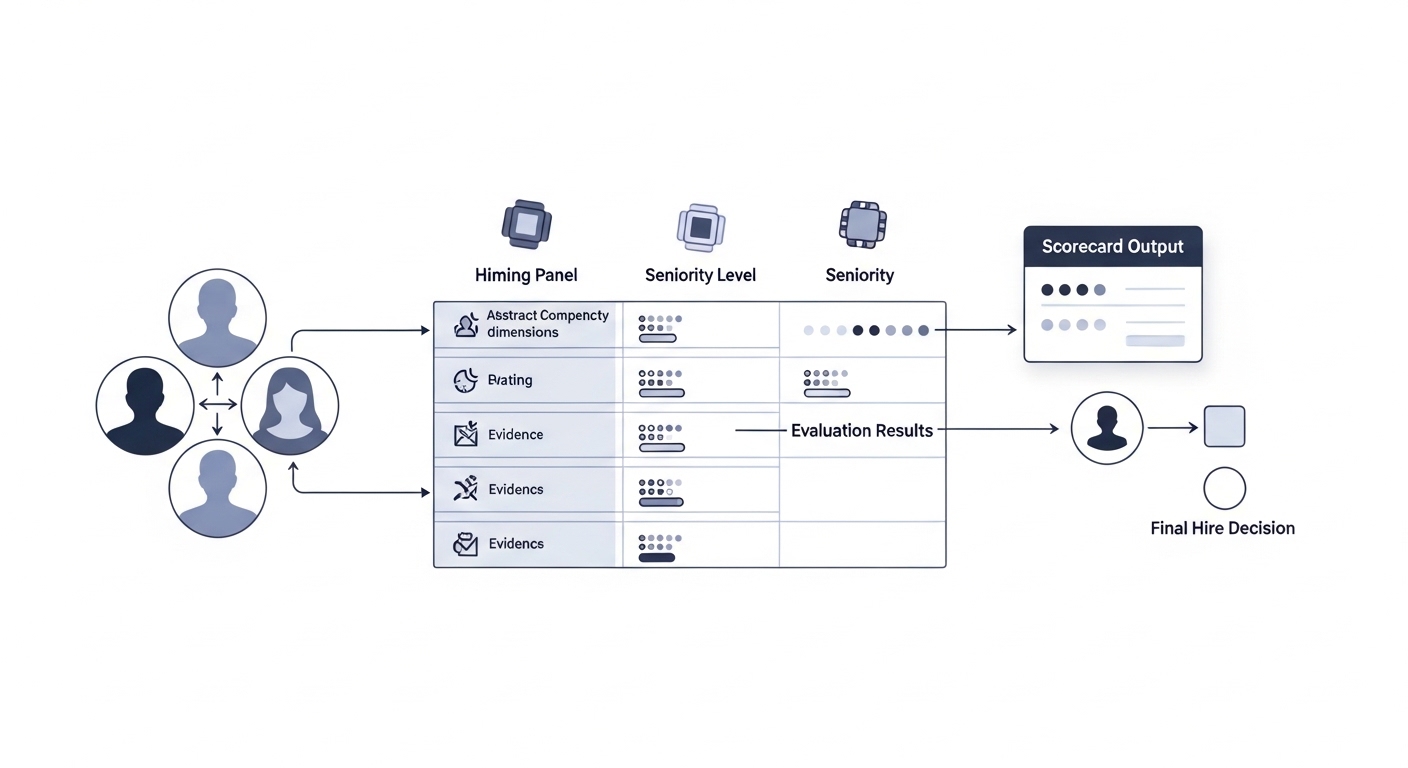
A competency framework is a structured set of skills, behaviours, and knowledge areas that defines what good looks like at each level of a role. It is the shared reference point that turns hiring from a subjective conversation into a comparable, evaluable process. When a panel of interviewers all use the same framework, a candidate's answers map to the same criteria regardless of which interviewer is in the room, and decisions become easier to explain and audit.
In practice
- A hiring panel at a 500-person company rates the same candidate as a "strong yes" and a "pass" in the same round because they are each thinking of a different previous hire when they say "good problem-solver." A competency framework with written behavioural anchors closes that gap.
- A recruiter uses the framework to write structured interview questions before sending a guide to the hiring manager, so every candidate is asked the same questions in the same order.
- A TA ops lead says "we need to update the framework" after noticing that three of the five competency questions in a software engineering scorecard are never answered with high scores by even the strongest hires: a signal the criteria no longer reflect what the role actually needs.
Quick read, then how hiring teams use it
This is for recruiters, sourcers, TA, and HR partners who need the same vocabulary in debriefs, vendor calls, and policy reviews. Skim the first section when you need a fast shared picture. Use the second when you are deciding how it shows up in the ATS, sourcing tools, or candidate evaluation.
Plain-language summary
- What it means for you: A written list of the specific skills and behaviours that define a strong hire for a given role, with descriptions of what each looks like at different levels of seniority.
- How you would use it: Write your interview questions from the framework, train interviewers to map candidate answers to the anchors, and use the scores in your hiring decision debrief.
- How to get started: Pick one role you hire frequently. List the 5 things a great performer in that role does that an average performer does not. Write what each looks like in a behavioural interview answer. That is your draft framework.
- When it is a good time: Any time you have more than one interviewer evaluating candidates for the same role and you want their scores to mean the same thing.
When you are running live reqs and tools
- What it means for you: A competency framework is the input that drives consistent scorecards, structured interview guides, calibration sessions, and eventually defensible pass-rate data if your process is audited for fairness.
- When it is a good time: Before you start interviewing for a new role family, when you are redesigning a hiring process that is producing inconsistent quality, or when pass-rate data shows potential adverse impact that might be driven by inconsistent criteria.
- How to use it: Map each scorecard dimension to a specific competency. Write question and anchor combinations that can be consistently rated by different interviewers without prior calibration. Run a calibration session before each new hire cohort begins.
- How to get started: Pull your five most recent scorecards for one role. Count how many dimensions had written anchors versus free-text notes only. Any dimension with free-text only is a candidate for framework formalisation.
- What to watch for: Frameworks that are so long that interviewers skip questions, competencies that correlate with demographic proxies (cultural fit, communication style as proxies for accent or background), and frameworks that are never updated when the role changes substantially.
Where we talk about this
On AI with Michal live sessions the AI in recruiting track covers how to build scorecards from a competency framework and how AI tools are beginning to assist with behavioural anchor writing. See AI Sourcing Lab.
Around the web (opinions and rabbit holes)
Third-party creators move fast. Treat these as starting points, not endorsements.
YouTube
- Search "competency framework design HR" for practitioner walkthroughs of framework-building workshops used in talent acquisition and performance management.
- Search "structured interview design" for videos that show how competency frameworks translate directly into question and anchor format.
- r/humanresources has threads on building competency frameworks from scratch, including disagreements about whether generic frameworks or role-specific ones produce better outcomes.
- r/recruiting covers the practitioner side: how recruiters actually use frameworks in practice versus how L&D teams design them.
Quora
- How do you create a competency framework for a company? collects answers from HR practitioners on scope, validation, and rollout.
Framework versus job description
| Element | Job description | Competency framework |
|---|---|---|
| Purpose | Attract candidates | Evaluate candidates |
| Audience | Job seekers | Hiring panel |
| Format | Public prose | Internal rubric |
| Updated | Per req | Per role family annually |
Related on this site
- Glossary: scorecard, calibration session (hiring), behavioral interview
- Glossary: structured interview, adverse impact, human-in-the-loop
- Glossary: AI bias audit, talent acquisition metrics
- Live cohort: AI Recruiting Accelerator
- Membership: Become a member