Hiring trigger events
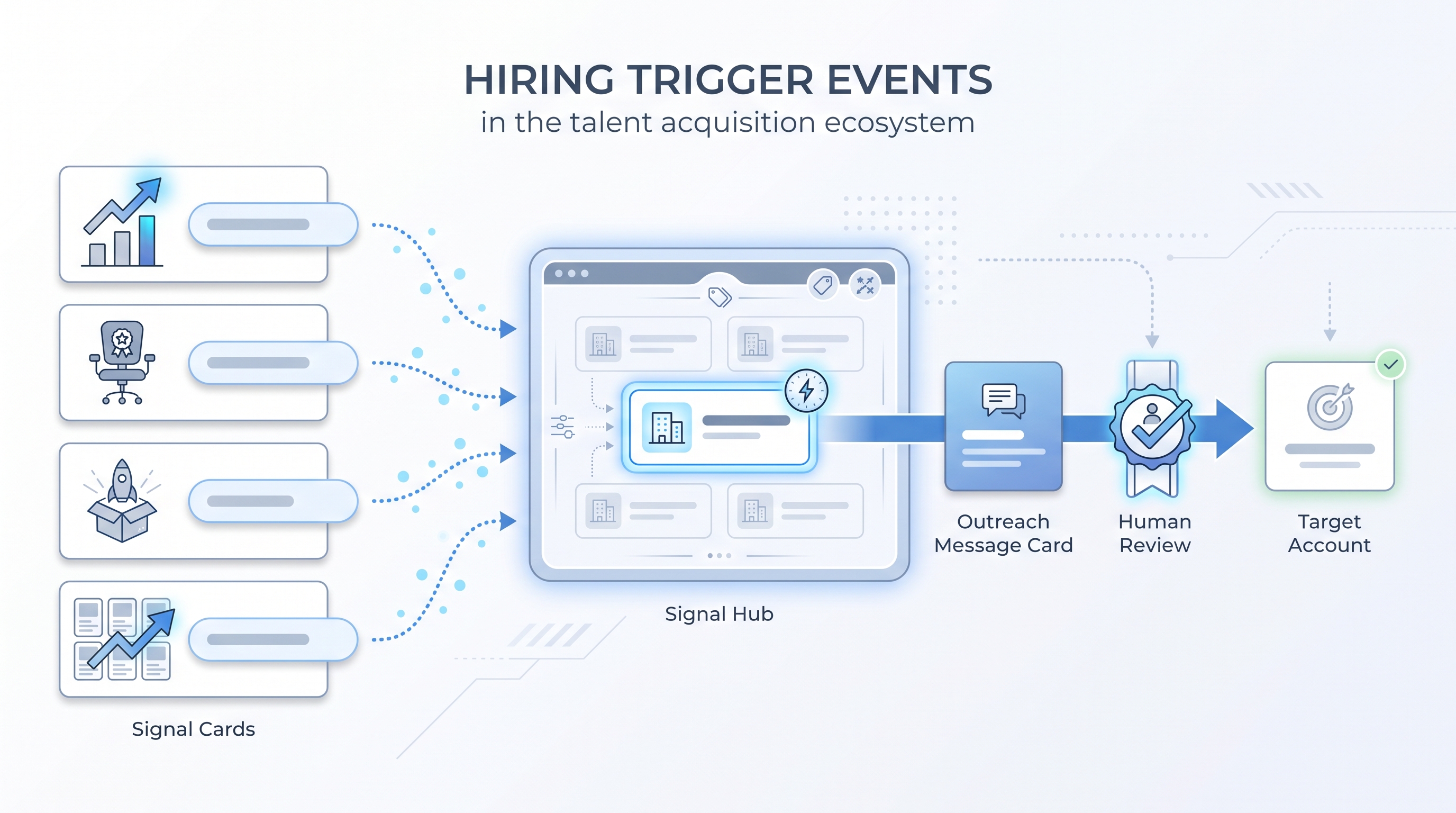
Hiring trigger events are observable signals, such as a funding round, an executive hire, a product launch, an office expansion, or a spike in job postings, that indicate an organization is about to hire or has just started, used by sourcers and agency business development teams to time outreach and prioritize accounts.
Michal Juhas · Last reviewed June 29, 2026
What is a hiring trigger event?
A hiring trigger event is a public or observable signal that an organization is about to hire, or has just started. Hiring almost never happens in isolation: a company raises capital, launches a product, opens a new office, replaces a leader, or wins a large client, and headcount follows. The trigger is that upstream change, spotted early enough to act before the role is broadly advertised.
For sourcers and agency business development, triggers are a timing tool. Reaching a new VP of Engineering the week they join, or a founder days after a Series B, lands very differently from pitching against ten other vendors once the req is live. The signal tells you who to contact, why now, and what to say.
Triggers vary in how much warning they give. Some are leading (funding, a senior hire, an expansion announcement) and buy you weeks or months. Others are lagging (a surge in posted roles) and mean the market already knows. The skill is choosing leading triggers you can act on, and pairing each one with a fast, relevant response.
In practice
- An agency recruiter sets an alert for Series A and B rounds in fintech, then reaches out to each new company's founder within 48 hours with two pre-vetted backend engineers from a warmed pipeline. The relevance of the timing, not the volume of outreach, is what books the intro calls.
- A corporate talent team watches for senior leadership hires at competitors, because a new VP often brings a hiring wave and sometimes makes their old team available. The trigger feeds a task in the talent CRM so a sourcer follows up while the move is fresh.
- A sourcer uses an AI summary to turn a funding announcement into a likely role list (two backend, one product, one finance), then drafts a trigger-specific outreach message that a recruiter reviews and personalizes before sending. Monitoring and drafting are automated, the decision to reach out is not.
Quick read, then how hiring teams use it
This is for sourcers, agency recruiters, and TA leaders who want to reach accounts and candidates at the moment hiring intent is highest, rather than reacting to posted reqs. Skim the first section for the idea. Use the second when you are choosing which triggers to track and building the response workflow.
Plain-language summary
- What it means for you: A trigger event is a public signal (new funding, a leadership change, an expansion) that a company is about to hire. Spot it early and you can reach out before the role is posted and the competition arrives.
- How you would use it: Pick the two or three triggers most predictive for your desk, decide what each one should make you do, and pair it with a relevant pipeline so your outreach is specific, not generic.
- How to get started: Choose one trigger (for many desks, funding rounds work well), set an alert, and commit to a same-week response with a tailored message for the next month.
- When it is a good time: When your pipeline is warm but your outreach is mistimed, or when business development keeps arriving after the req is already with three other vendors.
When you are running live reqs and tools
- What it means for you: Triggers are only as good as the response behind them. The value is not the alert, it is the disciplined, fast, relevant follow-up that the alert prompts.
- When it is a good time: When you can commit an owner and a clear next action to each trigger type. Without that, trigger monitoring becomes a noisy feed nobody acts on.
- How to use it: Route triggers into a talent CRM or talent intelligence platform so each one auto-tags the right account and creates a task. Use AI to summarize the trigger and draft outreach, then keep a human review gate before anything is sent.
- How to get started: Track conversion by trigger type. Keep the signals that produce meetings and placements, drop the ones that only produce opens, and document a lawful basis for any personal data you monitor and store.
- What to watch for: False positives (not every round means your roles), timing errors (some triggers mean you are already late), and GDPR-style limits on monitoring named individuals even from public sources.
Where we talk about this
On AI with Michal live sessions, trigger events come up in sourcing automation blocks when participants build workflows that monitor signals, summarize them with AI, and draft timely, specific outreach. The membership community includes agency and in-house recruiters who run trigger-based business development and compare which signals actually convert.
Leading vs lagging triggers
| Signal | Type | What it tells you |
|---|---|---|
| Funding round, senior hire, expansion | Leading | Hiring is likely soon; you have time to reach out first |
| Product launch, new office, merger | Leading | A team is forming around the change; map the org early |
| Spike in posted roles | Lagging | Hiring is already underway; the market already knows |
| Layoff at an adjacent company | Mixed | Frees candidates now; the hiring company may slow down |
Around the web (opinions and rabbit holes)
Third-party creators move fast. Treat these as starting points, not endorsements.
YouTube
- Searches for "trigger event selling recruiting" and "sales triggers for staffing agency" surface business development tactics on timing outreach around funding and leadership changes.
- r/recruiting has threads on agency business development, where practitioners debate which signals (funding, growth, leadership moves) actually lead to signed roles.
- r/sales covers trigger-event prospecting more broadly, including how to avoid acting on weak signals.
Quora
- Searches for "hiring trigger events sourcing" and "how recruiters use funding announcements" collect practitioner answers on timing and signal selection.
Related on this site
- Glossary: Talent pipeline, Candidate pipeline warming, Talent CRM, Talent intelligence platform, Talent mapping, Sourcing channel attribution
- Lab: AI Sourcing Lab
- Membership: Become a member