Talent CRM
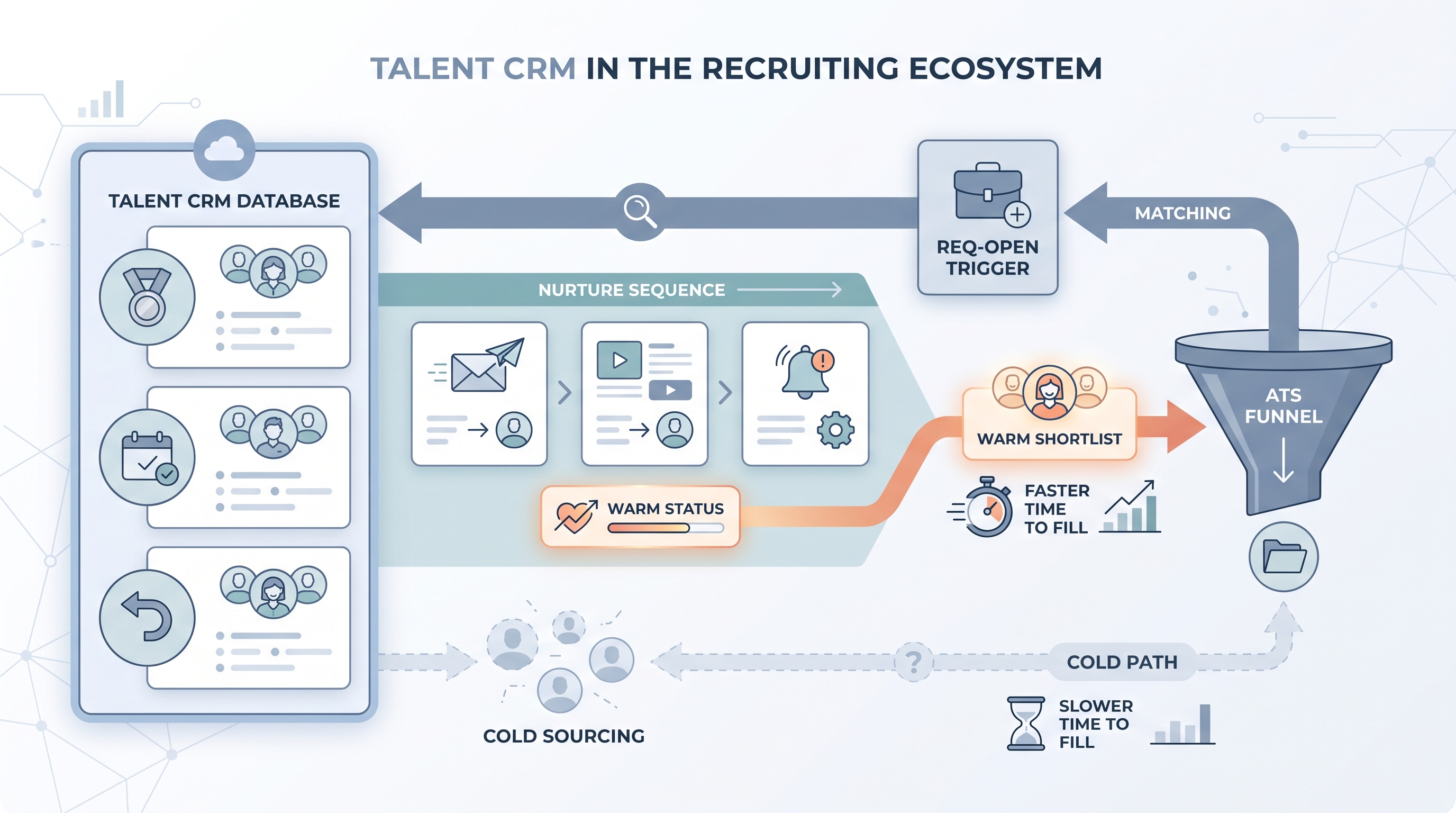
A platform for building, segmenting, and engaging talent communities before active roles open, functioning like a sales CRM but for candidates, so recruiters can warm prospects rather than starting cold each time a req fires.
Michal Juhas · Last reviewed June 21, 2026
What is a talent CRM?
A talent CRM is a platform for managing relationships with candidates before they are in an active application process. It works like a sales CRM: you build a database of contacts, segment them by role family or skill area, send periodic touchpoints to keep them warm, and convert them into applicants when a relevant role opens.
The core insight is that most of your best-fit candidates are passive at any given moment. They are employed, not looking, and will not find your job post. A talent CRM lets you build relationships with them before you need them, so when a req fires you have a warm list to call rather than starting from zero on LinkedIn.
In practice
- A head of talent at a 150-person tech company sets up a silver medalist workflow: every candidate who reaches the final round but does not get the offer is tagged in the talent CRM with role family and reason for not hiring. The sourcer sends a personalised note within a week saying the team would love to stay in touch. Six months later, when a similar role opens, the silver medalists receive the first outreach. Two of the last five hires in that role family came from the silver medalist pool.
- A TA team running a campus recruiting programme adds every student who attended their virtual events to a talent CRM segment tagged by graduation year and skill area. They send four touchpoints over 12 months (a newsletter, a video, an invitation to another event, and a role alert). Their campus-to-hire conversion from the CRM is twice the industry benchmark for cold campus outreach.
- A sourcer inherits a talent CRM with 4,000 contacts and no tagging beyond the source (LinkedIn). She runs a data hygiene sprint: emails 400 contacts to verify current role, removes 600 undeliverable records, and uses an enrichment tool to update job titles for the remainder. The CRM goes from a dump to a searchable pipeline in three weeks.
Quick read, then how hiring teams use it
This is for sourcers, recruiting managers, and TA leaders who own pipeline strategy or are evaluating CRM tools. Skim the first section for the vocabulary. Use the second section when you are building or auditing your talent CRM setup.
Plain-language summary
- What it means for you: A talent CRM converts your past sourcing investment into a reusable asset. Without one, every new req starts from scratch and the sourcing cost resets to zero.
- How you would use it: Tag candidates at entry with role family, skill area, and interaction context. Set re-engagement intervals by segment. When a req opens, run a match query against the relevant segments before doing any new sourcing.
- How to get started: Export every candidate you sourced in the last 12 months who did not convert to a hire. Tag them with role family. Add an opt-in touchpoint. You now have the foundation of a talent pool.
- When it is a good time: When time to fill is consistently too long, when cost per hire is rising, and when you find yourself re-sourcing the same candidate profiles every quarter.
When you are running live reqs and tools
- What it means for you: At scale, a talent CRM only works if it is connected to your ATS, enrichment tools, and outreach platform so data flows without manual re-entry between systems.
- When it is a good time: During ATS selection, when configuring a new sourcing tool that feeds the CRM, and during quarterly data hygiene reviews.
- How to use it: Connect new sourced candidates from LinkedIn, sourcing tools, and events to the CRM automatically. Set a monthly enrichment run to update stale contact data. Build a segment query for each high-priority role family that runs automatically when a req opens in that family.
- How to get started: Audit your CRM contact data for tagging completeness (role family, skill, last interaction date) across a 90-day sample. Fix the three most common tagging gaps first.
- What to watch for: GDPR consent gaps. Every contact in the CRM needs a documented lawful basis and a way to opt out. A talent CRM that has grown without a consent audit is a regulatory liability, not a pipeline asset.
Where we talk about this
On AI with Michal sessions, talent CRMs come up when teams are building proactive sourcing strategies and measuring pipeline self-sufficiency against job board dependency. If you want to map your own sourcing workflow to a CRM model and identify where AI can accelerate re-engagement, join an AI Sourcing Lab.
Around the web (opinions and rabbit holes)
Third-party creators move fast. Treat these as starting points, not endorsements, and do not copy stranger scripts that move candidate data.
YouTube
- Search "talent CRM recruiting" on YouTube for vendor demos from Beamery, Avature, Phenom, and Gem that show how talent pipeline management works in practice inside each platform.
- "Proactive recruiting strategy" talks from TA leaders on YouTube cover the sourcing model shift from reactive job-post-and-wait to proactive pipeline building that a talent CRM enables.
- r/recruiting threads on "talent CRM vs ATS" cover the tooling debate and practitioner experiences choosing between dedicated CRM platforms and ATS-native pipeline features.
- r/humanresources discussions on "passive candidate pipeline" include TA leaders sharing what worked and what failed in building long-term candidate relationship programmes.
Quora
- What is the difference between a talent CRM and an ATS? collects practitioner and vendor answers explaining the functional distinction and when each tool is needed.
Talent CRM vs ATS comparison
| Dimension | Talent CRM | ATS |
|---|---|---|
| Primary use case | Relationship building before a req | Managing applicants through a req |
| Candidate status | Passive, not yet in process | Active applicant |
| Timeline | Months to years | Days to weeks |
| Key activity | Nurture sequences, segmentation, warm outreach | Application tracking, interview scheduling, offer management |
| GDPR complexity | Higher (long-term data retention, opt-in required) | Lower (consent implicit in application) |
| Typical integration | Feeds into ATS when candidate becomes applicant | Receives from CRM; manages from application onward |
Related on this site
- Glossary: Silver medalist candidates, Candidate nurturing, Candidate rediscovery, GDPR and recruiting data, GDPR first-touch outreach, Deduplication and merge rules, Outreach personalisation at scale
- Blog: AI sourcing tools for recruiters
- Live cohort: AI Recruiting Accelerator
- Course: Starting with AI: the foundations in recruiting
- Membership: Become a member