Talent intelligence platform
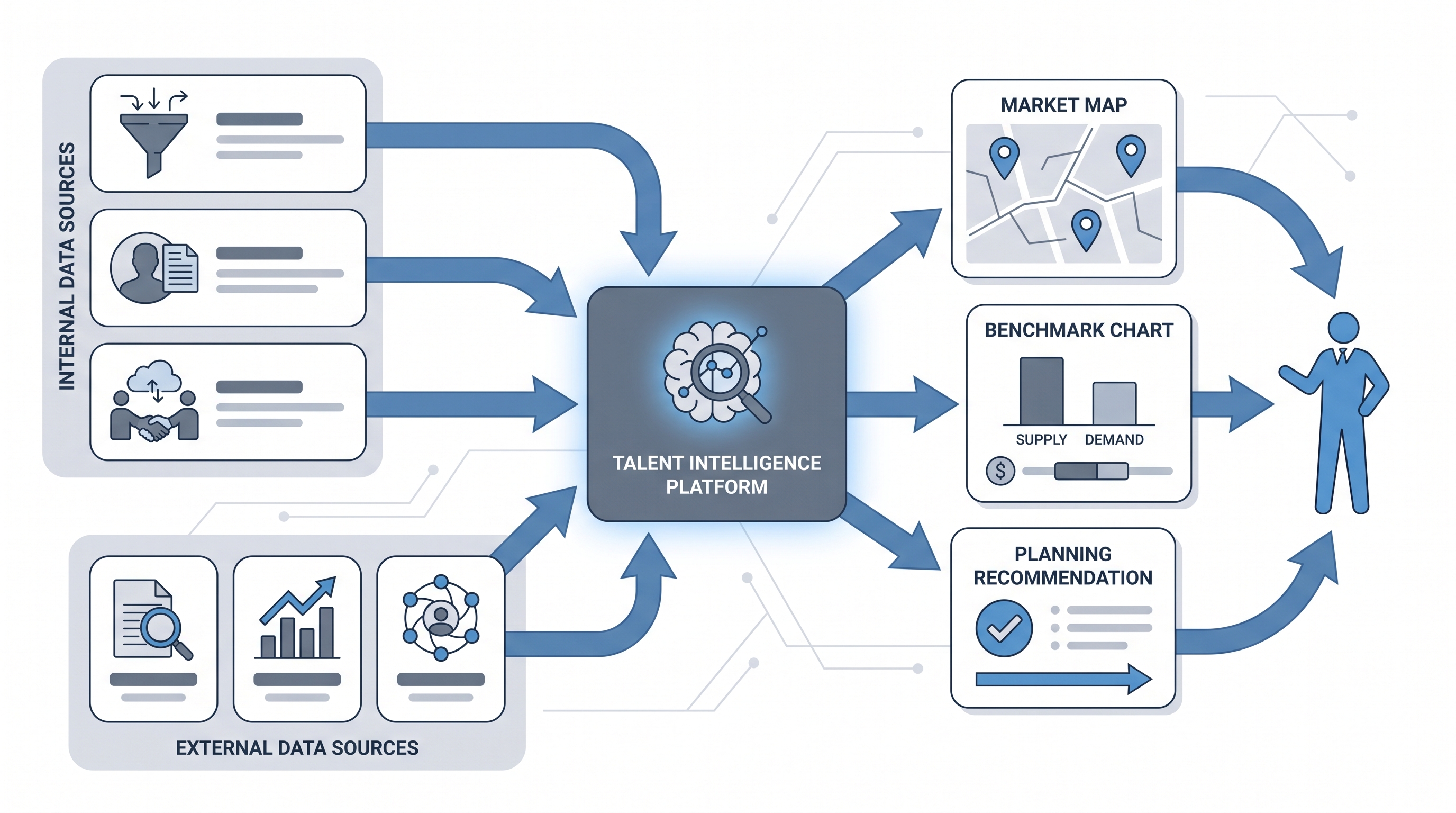
Software that unifies internal people data with external labor-market and candidate data, then applies analytics or AI to answer talent questions: where the skills are, what they cost, who to source, and how to plan. It sits above the ATS and CRM rather than replacing them.
Michal Juhas · Last reviewed June 27, 2026
What is a talent intelligence platform?
A talent intelligence platform is software that unifies internal people data with external labor-market and candidate data, then applies analytics or AI to answer strategic talent questions: where skills are concentrated, what they cost, who to source, and how to plan headcount. It sits above the systems you already run, pulling from the ATS, HRIS, and CRM and combining them with market signals, rather than replacing any of them. The value is decision support: it helps you decide what to source, where, and at what cost before the pipeline work begins. It informs decisions, it does not make hires.
In practice
- A TA leader asks "where should we open our next engineering hub," and uses the platform to compare talent supply, cost, and competitor density across three cities before recommending one.
- A sourcer mapping a scarce role checks supply-and-demand and pay bands by geography first, so outreach targets the markets where the talent actually is.
- An HR business partner feeds skills-supply data into workforce planning and an internal mobility review, rather than treating every gap as an external hire.
Quick read, then how hiring teams use it
This is for recruiters, sourcers, TA, and HR partners who need the same vocabulary in vendor calls, planning sessions, and leadership debriefs. Skim the first section for a fast shared picture. Use the second when you are deciding whether and how it fits your stack.
Plain-language summary
- What it means for you: A talent intelligence platform is a decision layer, not another system of record. It answers market and planning questions your ATS and CRM cannot, by adding external data and analytics on top.
- How you would use it: To map a market, compare locations, check pay, spot competitor moves, and surface internal or past-applicant talent before you commit to external hiring.
- How to get started: Write down two or three strategic questions you keep answering by hand. If the platform answers those well on markets you already understand, it may be worth it.
- When it is a good time: When you are making repeat decisions about where, how, and whether to hire a skill, not when you just want a nicer dashboard.
When you are running live reqs and tools
- What it means for you: The output is directional, not precise. External data is inferred and lagging; internal data is only as clean as your ATS and HRIS. Treat numbers as relative comparisons and trends.
- When it is a good time: After you have a named owner who will convert insights into sourcing and planning actions, and after a data-governance review with your DPO.
- How to use it: Pair it with labor-market intelligence reading habits, validate a slice against a trusted source, and connect it to talent mapping and talent rediscovery workflows so insights reach real pipelines.
- How to get started: Run one real market-mapping question end to end, from data pull to a decision a leader signs off on, before expanding usage across teams.
- What to watch for: Dashboards nobody owns, over-trusting inferred external data, skills matching that depends on a skills ontology your data maps to poorly, and compliance gaps when individual-level profile data is combined across sources.
Where we talk about this
On AI with Michal live sessions, talent intelligence comes up in AI in recruiting tracks and workforce-planning discussions. We walk through how to frame a market-mapping question, read labor-market data without over-trusting it, and connect intelligence to real sourcing and planning moves. Start with the main AI Recruiting Accelerator for the strategy and tooling context, or join Sourcing Lab for the hands-on sourcing side that the intelligence layer feeds.
Around the web (opinions and rabbit holes)
Third-party creators move fast. Treat these as starting points, not endorsements, and verify any process before you wire candidate or employee data across tools.
YouTube
- Search "talent intelligence platform demo" and "labor market analytics recruiting" for recent overviews. Favor analyst breakdowns over vendor demos, and look for ones that discuss data methodology, not just the interface.
- Workforce-planning and people-analytics channels often cover how intelligence data feeds real headcount and location decisions.
- r/recruiting and r/humanresources threads on talent intelligence tools are honest about where the data helps and where it overpromises. Search "talent intelligence" in either subreddit.
- Practitioners often debate build-versus-buy and which vendors have credible data, which is useful before a procurement call.
Quora
- Search "what is a talent intelligence platform" on Quora for answers from analysts, vendors, and practitioners that surface different views on what the category actually delivers.
Talent intelligence platform vs. ATS vs. talent CRM
| Dimension | ATS | Talent CRM | Talent intelligence platform |
|---|---|---|---|
| Primary job | Manage applicants in a process | Nurture candidate relationships | Answer strategic talent questions |
| Data scope | Internal applicants | Internal prospects | Internal plus external market data |
| Role | System of record | System of engagement | System of insight |
| Typical user | Recruiter | Sourcer, recruiter | TA leader, HR strategy, sourcer |
| Output | Pipeline status | Talent pool | Maps, benchmarks, decisions |
Related on this site
- Glossary: Labor market intelligence, Workforce planning, Talent mapping, Talent CRM, Internal mobility, Skills ontology, Talent rediscovery, Candidate data enrichment, Applicant tracking system (ATS)
- Blog: AI sourcing tools for recruiters
- Guides: Sourcers
- Live cohort: Sourcing Lab
- Course: Starting with AI: foundations in recruiting
- Membership: Become a member