Talent pipeline
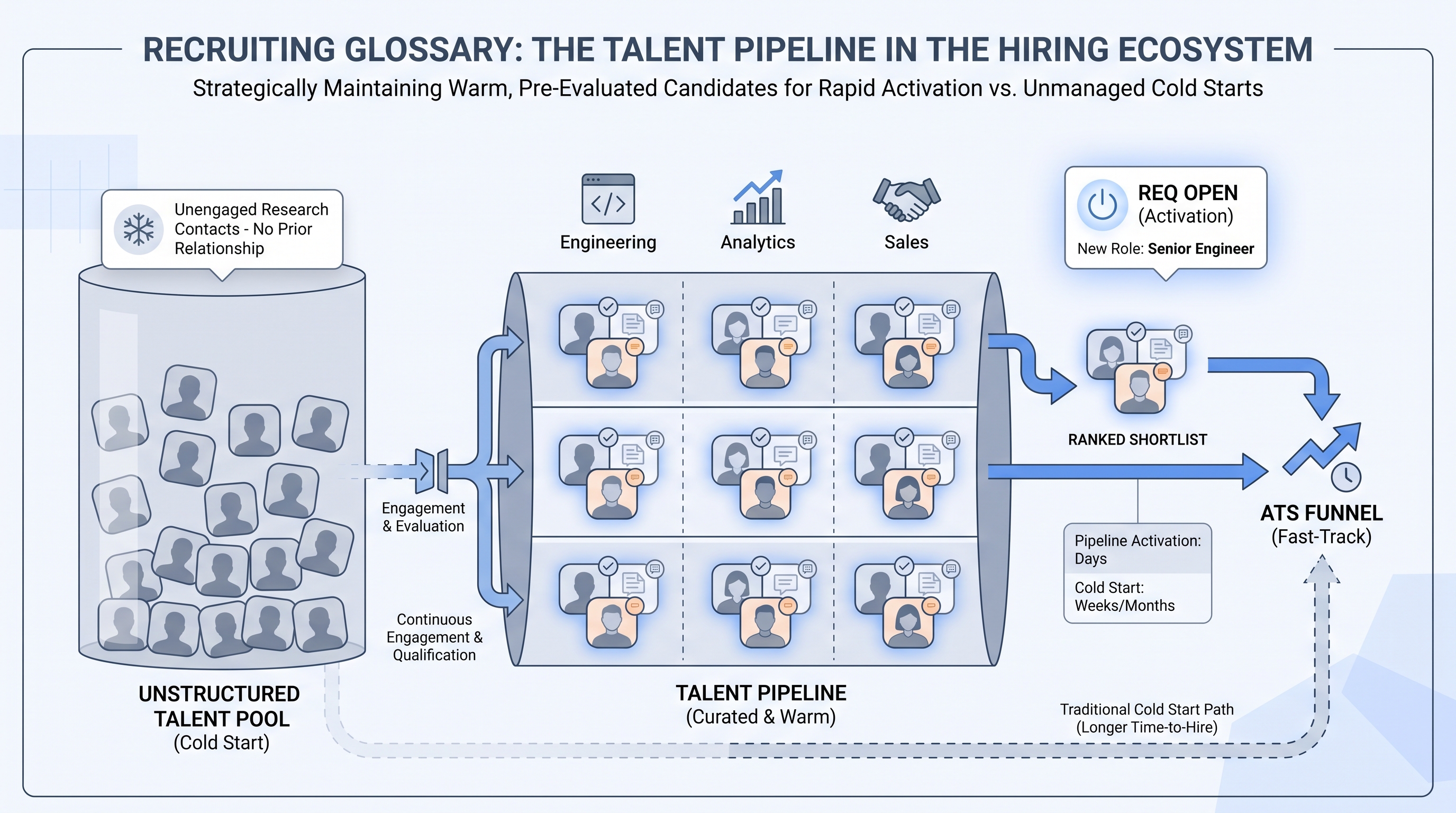
A curated, continuously maintained pool of pre-evaluated candidates who have expressed interest in an organisation and been assessed to some level, ready to be activated quickly when a relevant role opens.
Michal Juhas · Last reviewed June 22, 2026
What is a talent pipeline?
A talent pipeline is a curated pool of candidates who have moved past cold research: they have been sourced, made initial contact, expressed interest at some level, and received a rough qualification assessment. When a req opens, the recruiter activates from the pipeline rather than starting from scratch. A healthy pipeline sits between the unknown market and the active applicant list, covering the role families and geographies that matter most to the business.
In practice
- A sourcer working on a fintech payments team maintains a pipeline of 40 senior engineers who have responded positively to outreach in the last six months. When a req opens, the first message goes to that list, not to cold LinkedIn profiles.
- A TA lead reports pipeline coverage ratio at the weekly ops meeting: three qualified candidates per expected hire for the sales roles, one per expected hire for the data science roles. The difference drives sourcing sprint priorities for the week.
- A recruiter says "they're in the pipeline" to distinguish a candidate who has been engaged and assessed from one who was merely bookmarked in a talent pool.
Quick read, then how hiring teams use it
This is for recruiters, sourcers, TA, and HR partners who need the same vocabulary in debriefs, vendor calls, and policy reviews. Skim the first section when you need a fast shared picture. Use the second when you are deciding how it shows up in the ATS, sourcing tools, or candidate communications.
Plain-language summary
- What it means for you: A talent pipeline is your warm bench: people who already know your company and have shown some level of interest, so you are not starting cold when a role opens.
- How you would use it: Pick two or three high-frequency roles. Build a small curated list of people who have expressed interest, log their qualification notes, and re-engage them with relevant content or a check-in every six to eight weeks.
- How to get started: Export your last six months of sourcing conversations. Tag everyone who replied positively but did not convert to a hire. That is your starter pipeline. Add a re-engagement date to each entry.
- When it is a good time: For roles that open more than twice a year, for hard-to-fill positions where cold start time is costly, and for any function where the market is competitive enough that a warm bench gives a meaningful speed advantage.
When you are running live reqs and tools
- What it means for you: Pipeline coverage ratio is an operational metric: below 2:1 on a high-frequency role means sourcing will be slow and expensive when the next req opens. Building the pipeline is pre-investment in speed.
- When it is a good time: Continuous, not just when a req opens. Pipeline maintenance is a proactive sourcing activity that sits alongside live req work.
- How to use it: Store pipeline records in your CRM or ATS with segmentation by job family, seniority, and geography. Set automated re-engagement reminders. Log every contact and qualification note so the pipeline is useful to any recruiter, not only the one who built it.
- How to get started: Choose the highest-frequency open role family. Run a 30-day sourcing sprint focused entirely on building pipeline, not filling a specific req. Measure how many warm contacts you generate and their initial response rate. That baseline informs future pipeline investment decisions.
- What to watch for: Pipelines go stale quickly. A candidate who was enthusiastic six months ago may have changed roles, changed their mind, or received a competing offer. Build freshness indicators into your CRM and treat any pipeline entry older than six months as requiring re-qualification before presenting to a hiring manager.
Where we talk about this
On AI with Michal live sessions, talent pipeline architecture comes up across the sourcing automation and AI in recruiting tracks. We build real pipeline workflows: segmentation, nurture sequences, engagement tracking, and AI-assisted re-activation. Start at AI Recruiting Accelerator or join membership for office hours where you can bring your current pipeline structure and get grounded feedback from peers who have built and maintained real pipelines at scale.
Around the web (opinions and rabbit holes)
Third-party creators move fast. Treat these as starting points, not endorsements, and double-check anything before you wire candidate data.
YouTube
- Search "talent pipeline recruiting strategy" on YouTube for practitioner walkthroughs of pipeline-building workflows and CRM setup guides from in-house sourcers.
- Recruiting Brainfood streams regularly cover pipeline management strategy, including honest post-mortems of pipelines that looked good on paper but failed in practice.
- r/recruiting has threads on proactive sourcing and pipeline building with candid benchmarks on response rates and coverage ratios from in-house teams.
- r/sourcing covers the sourcing side of pipeline construction in detail, including tool comparisons and engagement cadence discussions.
Quora
- How do you build a talent pipeline for a startup? collects practitioner answers on getting started with limited resources.
Pipeline versus pool versus active applicants
| Category | Evaluation level | Engagement | GDPR note |
|---|---|---|---|
| Talent pool | Identified only | Cold or none | Retention period required |
| Talent pipeline | Qualified, interested | Warm, active | LIA + re-consent schedule |
| Active applicants | Applied, in process | Hot | ATS data, standard retention |
Related on this site
- Glossary: talent mapping, candidate nurturing, proprietary talent pool
- Glossary: candidate rediscovery, passive sourcing, talent CRM
- Glossary: GDPR and recruiting data, time to hire
- Live cohort: AI Sourcing Lab
- Membership: Become a member