Candidate pipeline warming
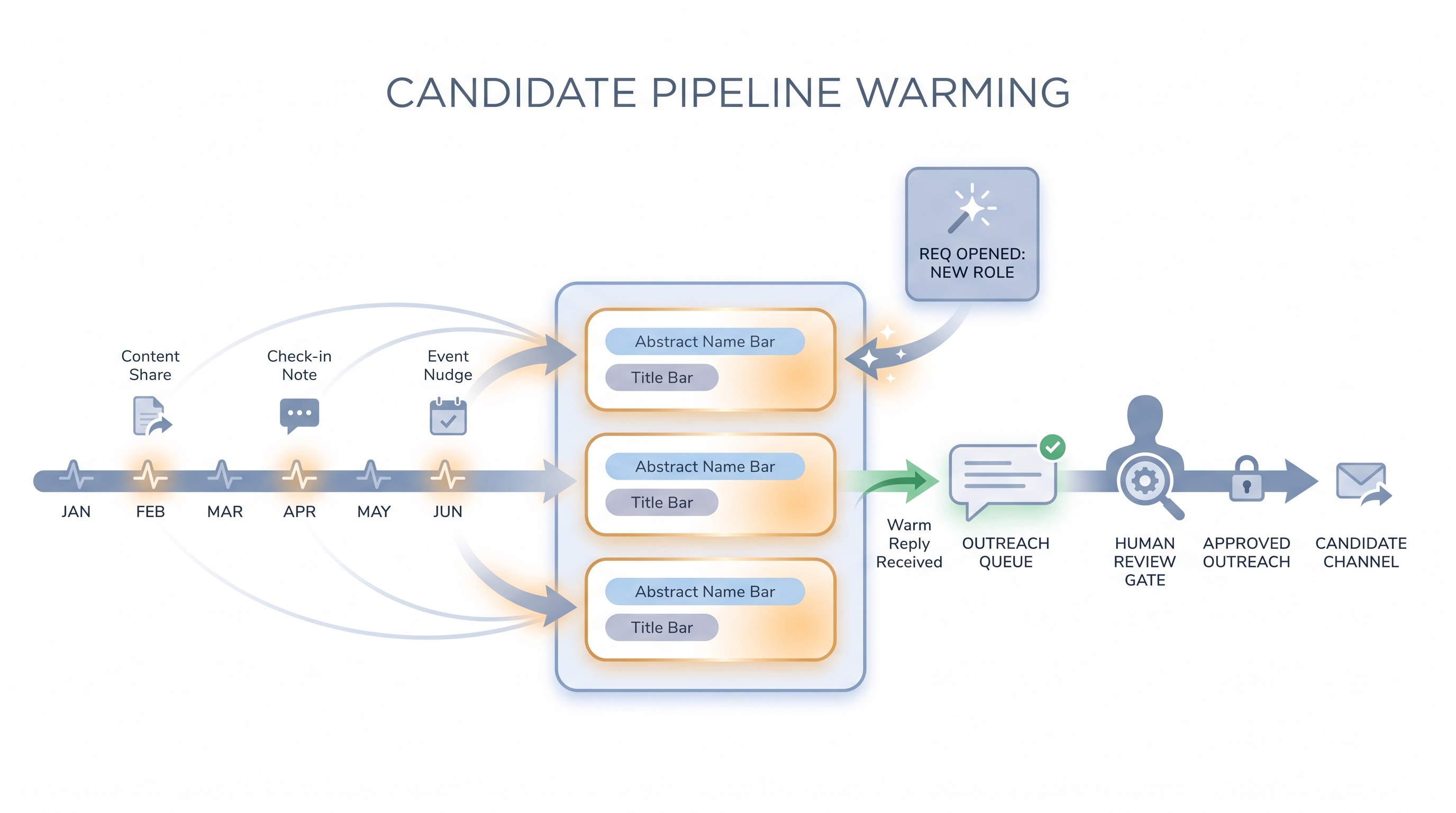
Proactively sharing relevant content and light touchpoints with passive talent over weeks or months, so that when a req opens the first outreach lands on a warm contact instead of a cold list.
Michal Juhas · Last reviewed June 16, 2026
What is candidate pipeline warming?
Candidate pipeline warming is the discipline of keeping passive talent engaged before you need them. Rather than reaching out cold the moment a req opens, sourcers build lightweight, consistent touchpoints over weeks or months: sharing a relevant article, acknowledging a career milestone, or flagging an industry event. When the right role drops, the first message lands with someone who recognises your name.
The practice sits between proprietary talent pool management and active outreach personalization at scale. It requires a CRM or tagging system inside your ATS, a cadence that is consistent enough to be remembered but light enough not to annoy, and a human review layer before anything goes out.
In practice
- A sourcer tags 30 senior data engineers they met at a conference as "warm Q3 pipeline" and schedules a monthly content share in their CRM, sending one link about a relevant open-source project update each month.
- A TA team at a 300-person scale-up keeps a spreadsheet of silver-medal finalists from the last three rounds and sends a "here is what we shipped" email every eight weeks, with no job pitch attached.
- At a debrief on a failed search, the recruiting manager says the role took 80 days to fill because the team had no pre-warmed pipeline; sourcing started cold the day the req opened.
Quick read, then how hiring teams use it
This is for recruiters, sourcers, TA, and HR partners who need the same vocabulary in debriefs, vendor calls, and pipeline reviews. Skim the first section when you need a fast shared picture. Use the second when you are deciding how to build or defend a warm pipeline programme in your current stack.
Plain-language summary
- What it means for you: Warming means staying in light, relevant contact with people you might hire, so they already know you when a role opens.
- How you would use it: Pick 20 to 30 passive candidates per quarter, assign a simple cadence (one touchpoint every four to six weeks), and log each one in your ATS or CRM.
- How to get started: Start with your rejected finalists from the last two searches. They already know your company and cleared your bar. A brief "we are building something you might find interesting" note costs ten minutes.
- When it is a good time: Continuously, not only when a req is urgent. Warming only works if it precedes the ask by at least a few weeks.
When you are running live reqs and tools
- What it means for you: A warm pipeline compresses time to first qualified candidate by days or weeks, because you are not starting from zero when the req drops.
- When it is a good time: When the role is hard to fill, when time-to-hire targets are tight, or when your ATS has a cohort of tagged silver-medalists sitting unused.
- How to use it: Use a CRM segment or ATS custom field to tag warm pipeline candidates by role family and estimated readiness window. Set reminders for touchpoints. Pull the segment when a req opens and add the strongest matches to your outreach queue first.
- How to get started: Connect your outreach personalization tools to your CRM so AI drafts the touchpoint copy and you review before sending. Log every send in the ATS.
- What to watch for: GDPR retention limits, tone drift from AI-generated sequences, and candidate fatigue from sequences that run without a real human reviewing them. Audit the cadence quarterly.
Where we talk about this
On AI with Michal live sessions, sourcing automation blocks spend time on building and maintaining warm pipelines before reqs open. Participants bring their own CRM setup, ATS configuration, and sequence data and work through real examples of what converts. The sourcing lab is the right place to bring your warm pipeline questions alongside your tool stack.
Around the web (opinions and rabbit holes)
Third-party creators move fast. Treat these as starting points, not endorsements, and double-check anything before you wire candidate data.
YouTube
- Searches for "sourcing pipeline nurture" and "passive candidate engagement" on YouTube surface a range of practitioner walkthroughs, from CRM setup to content cadence advice.
- Look for sessions from sourcing practitioners rather than vendor demos to get unvarnished opinions about what actually converts versus what sounds good in a slide deck.
- r/recruiting threads on "passive candidate outreach" and "talent pipeline" contain honest practitioner discussion about cadence, content, and what candidates actually respond to.
- r/RecruitmentAgencies has threads on warm pipeline management from agency sourcers who depend on it as a competitive differentiator.
Quora
- How do you keep candidates warm in your pipeline? collects a range of practitioner answers worth reading critically for what applies to your sector.
Related on this site
- Glossary: Proprietary talent pool, Outreach personalization at scale, AI outreach drafting, Sourcing funnel metrics, Silver medalist candidates, Candidate nurturing
- Blog: AI sourcing tools for recruiters
- Guides: Sourcers
- Live cohort: Sourcing Lab
- Membership: Become a member