Talent mapping
The structured process of documenting the talent landscape for a target role, function, or competitor set before a search formally opens, identifying where qualified people work today and what it would take to engage them.
Michal Juhas · Last reviewed June 22, 2026
What is talent mapping?
Talent mapping is the structured process of documenting who holds a target role or skill set, where they work, how long they have been there, and what their career trajectory looks like. It happens before a search formally opens, so when a req lands you already know the landscape rather than starting from scratch. Executive search firms do this continuously for leadership pools; in-house TA teams do it for roles that recur frequently or are strategically important enough to warrant advance intelligence.
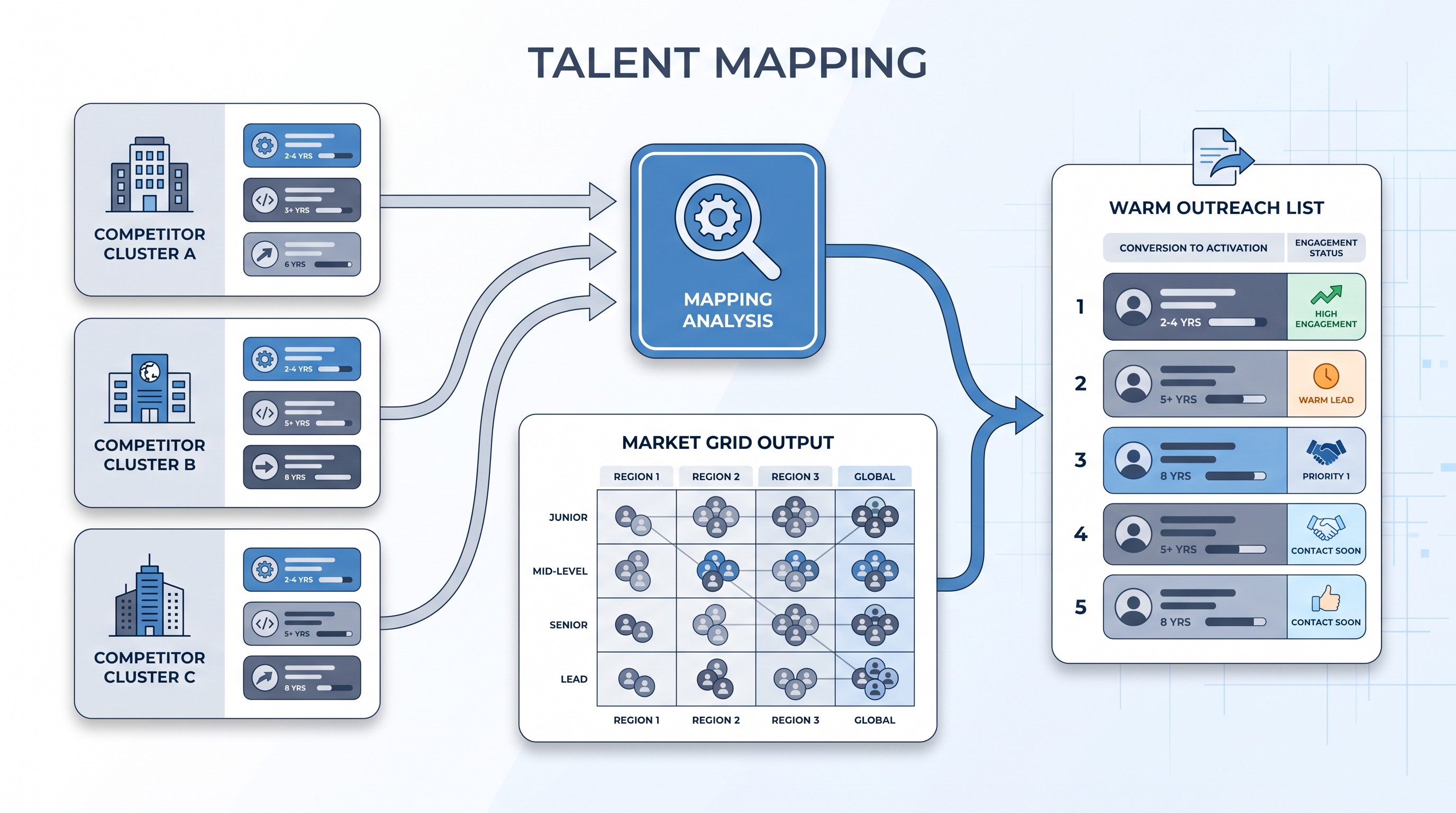
In practice
- A sourcer spends two days mapping senior data engineers at fintech companies in Berlin before the CPO signs off on a new req. When the req opens, the outreach list is already warm.
- A TA leader briefs the team quarterly with a market map showing which competitors are growing their analytics function, so hiring managers calibrate compensation expectations before the search starts.
- In executive search, a recruiter says "the map is done" to signal the research phase is complete and they are ready to move into engagement conversations.
Quick read, then how hiring teams use it
This is for recruiters, sourcers, TA, and HR partners who need the same vocabulary in debriefs, vendor calls, and policy reviews. Skim the first section when you need a fast shared picture. Use the second when you are deciding how it shows up in the ATS, sourcing tools, or candidate communications.
Plain-language summary
- What it means for you: A talent map is a documented picture of where the people you want to hire actually work today, built before you start searching so you are not guessing when the req arrives.
- How you would use it: Pick a target role and three to five key competitors. Document names, titles, and current employers for the top 30 to 50 relevant profiles. Refresh every quarter or when a req opens.
- How to get started: Choose one high-priority role family. Spend two hours doing structured research on a sourcing tool or LinkedIn. Export to a shared spreadsheet with a clear naming convention and access controls.
- When it is a good time: Before recurring roles open, before headcount planning conversations, and whenever a hiring manager asks who is out there in this market.
When you are running live reqs and tools
- What it means for you: Talent maps are the pre-pipeline intelligence layer that reduces cold-start time and sourcing cost per req by converting unknown market terrain into a documented shortlist.
- When it is a good time: For roles that open two or more times per year, for strategic hires where competition is intense, and for functions where real-time market knowledge gives a measurable sourcing edge.
- How to use it: Store maps in your CRM or ATS with clear segmentation, retention dates, and GDPR documentation. Pair with semantic search tools to surface candidates who match a stored persona when a new req opens.
- How to get started: Run a pilot mapping exercise for one job family. Compare outreach response rates on mapped candidates versus cold Boolean searches over 60 days. If mapped outreach converts higher, the case for investing in ongoing mapping is self-funding.
- What to watch for: Maps go stale fast in volatile markets. Build a refresh cadence into the process. Also watch for GDPR exposure if maps are shared widely without access controls or documented retention periods.
Where we talk about this
On AI with Michal live sessions, talent mapping comes up in the sourcing automation track as the strategic intelligence layer before outreach begins. We evaluate AI tools for data coverage and quality, review GDPR documentation requirements, and practice building maps on real target personas. Start at AI Recruiting Accelerator or join membership for ongoing sourcing office hours.
Around the web (opinions and rabbit holes)
Third-party creators move fast. Treat these as starting points, not endorsements, and double-check anything before you wire candidate data.
YouTube
- Search "talent mapping sourcing recruiter" on YouTube for practitioner walkthroughs showing how executive search firms document market landscapes before a search begins.
- Recruiting Brainfood streams occasionally feature strategic sourcing deep-dives where talent mapping is the starting point before any outreach plan is designed.
- r/recruiting has threads on competitive intelligence and market mapping for hard-to-fill roles with honest discussion of what actually works.
- r/sourcing covers sourcing research techniques including talent mapping approaches across different tools and data providers.
Quora
- What is talent mapping in recruiting? collects practitioner answers on use cases, output formats, and tool choices.
Talent mapping versus other sourcing activities
| Activity | Timing | Output | Primary user |
|---|---|---|---|
| Talent mapping | Pre-req, ongoing | Named profiles, employer clusters | Sourcer, executive search |
| Labor market intelligence | Ongoing | Supply/demand trends, comp bands | TA lead, CHRO |
| Live sourcing | Req open | Engaged candidates in pipeline | Recruiter |
Related on this site
- Glossary: labor market intelligence, candidate data enrichment, passive sourcing
- Glossary: semantic search, proprietary talent pool, direct sourcing
- Glossary: GDPR and recruiting data, market mapping (talent)
- Live cohort: AI Sourcing Lab
- Membership: Become a member