HR recruitment system
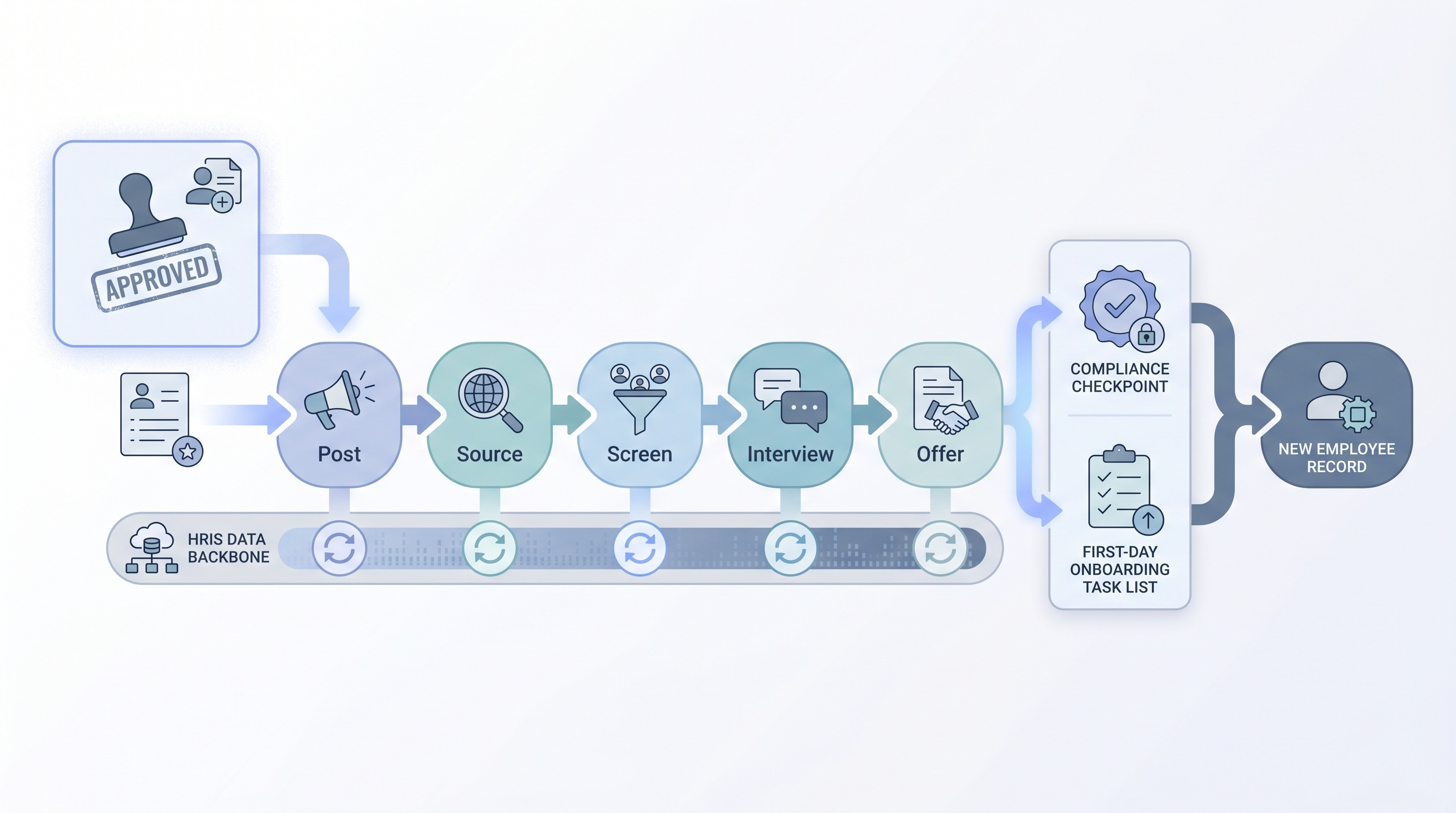
An HR recruitment system is the connected set of tools, processes, and integrations an HR team uses to manage the full hiring lifecycle -- from approved headcount request through sourcing, screening, offer management, and onboarding handoff -- with the HRIS as the central data record.
Michal Juhas · Last reviewed May 9, 2026
What is an HR recruitment system?
An HR recruitment system is the end-to-end infrastructure an HR team uses to take a hire from an approved headcount request to a signed offer and first-day task assignment. In most organisations it centres on an applicant tracking system but extends into requisition approval routing, interview scheduling, offer letter generation, HRIS sync, and EEO compliance documentation.
The "system" framing matters because the value is not in any single tool. It is in whether the handoffs between tools work without manual correction. An ATS that does not sync reliably with the HRIS at offer stage forces the HR team to re-enter the same name in two places. That one gap is what most HR teams mean when they say "our recruitment system is broken."
In practice
- An HR generalist at a 200-person company saying "we need a better recruitment system" typically means a platform that connects headcount approvals, candidate pipeline, interview feedback, and new employee record creation without a spreadsheet running in parallel.
- When an HRBP says "the recruitment system needs to produce an EEO-1 report without a manual extract," they are describing the compliance layer that sits inside or beside the ATS -- one of the non-obvious parts of a full HR recruitment system.
- A TA lead embedded in an HR function joining from a standalone recruiting team will often find that "the system" in their new organisation means one platform where offer templates, onboarding task routing, and candidate stages all live together, with the ATS as one module rather than the entire stack.
Quick read, then how hiring teams use it
This is for HR generalists, HRBPs, TA leads embedded in HR functions, and ops practitioners who need shared vocabulary for vendor evaluations, headcount planning conversations, and compliance reviews. Skim the plain-language section for a fast picture. Use the second when you are auditing, buying, or configuring real tools.
Plain-language summary
- What it means for you: An HR recruitment system is the connected set of tools and processes your HR team uses to move a hire from "approved req" to "first day ready" -- including the ATS, HRIS integration, offer routing, and compliance documentation.
- How you would use it: Open a req, post the job, track applicants through pipeline stages, collect interview scorecards, route the offer through comp approval, sync the new hire record to the HRIS, and hand off onboarding tasks without re-entering data.
- How to get started: Map every manual step in your current hiring process between approved req and first day. Each manual handoff is a gap the system should close.
- When it is a good time: When offer timelines regularly slip because approvals sit in email, when onboarding tasks are still assigned manually after signing, or when EEO reporting requires a manual extract before each quarterly filing.
When you are running live reqs and tools
- What it means for you: An HR recruitment system is where process governance lives: stage permissions, scorecard requirements tied to compensation levels, offer approval chains that mirror your actual finance sign-off workflow, and the API connections that keep ATS, calendar, and HRIS in sync.
- When it is a good time: When the same hiring workflows recur across roles and the cost of inconsistency -- missed offers, dropped candidate dispositions, EEO data gaps -- exceeds the cost of configuring a system that enforces them.
- How to use it: Set approval chains and stage logic before the first real req. Test HRIS sync against live employee records, not dummy data. Wire recruiting email automation only after stage data is trusted and the integration has handled at least one real edge case.
- How to get started: Count the tools in your current stack, then count the manual steps between them. Prioritise the integrations that currently cause offer delays or compliance exposure. Read ATS API integration for what stable API sync looks like in production.
- What to watch for: HRIS connectors that sync once per night in production despite promising real-time in demos, AI scoring features that log nothing about which model version ran on each candidate, and offer approval workflows that bypass comp review for speed. Explainable AI hiring covers the logging obligations when AI features are enabled inside a recruitment system.
Where we talk about this
On AI with Michal live sessions, HR recruitment systems come up across both the AI in recruiting and sourcing automation tracks: the first covers how AI layers sit inside or alongside ATS platforms today, and the second covers the automation triggers that connect hiring milestones to downstream HRIS events. If you want the full practitioner conversation -- including specific ATS-HRIS connector failures and which vendors support real-time sync -- start at Sourcing Lab and bring your stack and the handoffs that currently break.
Around the web (opinions and rabbit holes)
Third-party creators move fast and tooling changes often. Treat these as starting points, not endorsements, and verify anything before you connect candidate data.
YouTube
- Search "HR recruitment system setup" filtering by upload date from the past twelve months for independent walkthroughs that show real configuration steps rather than marketing demos.
- Search "ATS HRIS integration tutorial" for practitioner recordings that show what native versus API integration looks like and where each approach breaks under real hiring volume.
- r/humanresources carries regular threads on ATS and HRIS integration decisions from the HR generalist and HRBP perspective, including candid takes on what vendors promise in demos versus what they deliver after go-live.
- r/recruiting covers the TA side of recruitment systems and is useful for understanding how standalone recruiters and HR-embedded TA teams use the same platforms differently.
Quora
- What is the best HR system for recruiting? collects practitioner answers across company sizes and budget ranges, useful for calibrating which tools HR teams actually reach for before a formal vendor evaluation cycle starts.
HR recruitment system vs related categories
| Category | Primary user | Core focus | HRIS connection |
|---|---|---|---|
| HR recruitment system | HR generalist, HRBP | End-to-end req to offer, people-ops connected | Deep, often native |
| Standalone ATS | Recruiter, TA team | Sourcing pipeline velocity | API or optional |
| Hiring platform | TA ops, HR ops | Unified suite across all hiring stages | Varies by vendor |
| HRIS with hiring module | HR admin | People record accuracy, compliance | Native (same system) |
Related on this site
- Glossary: HR hiring software, HR recruiting software, Applicant tracking software, Hiring management software, Hiring platforms, Hiring software, Employee onboarding software, ATS API integration, Explainable AI hiring, Human-in-the-loop, Time-to-fill, Hiring funnel conversion rates
- Blog: AI sourcing tools for recruiters
- Live cohort: Sourcing Lab
- Membership: Become a member