Hiring software
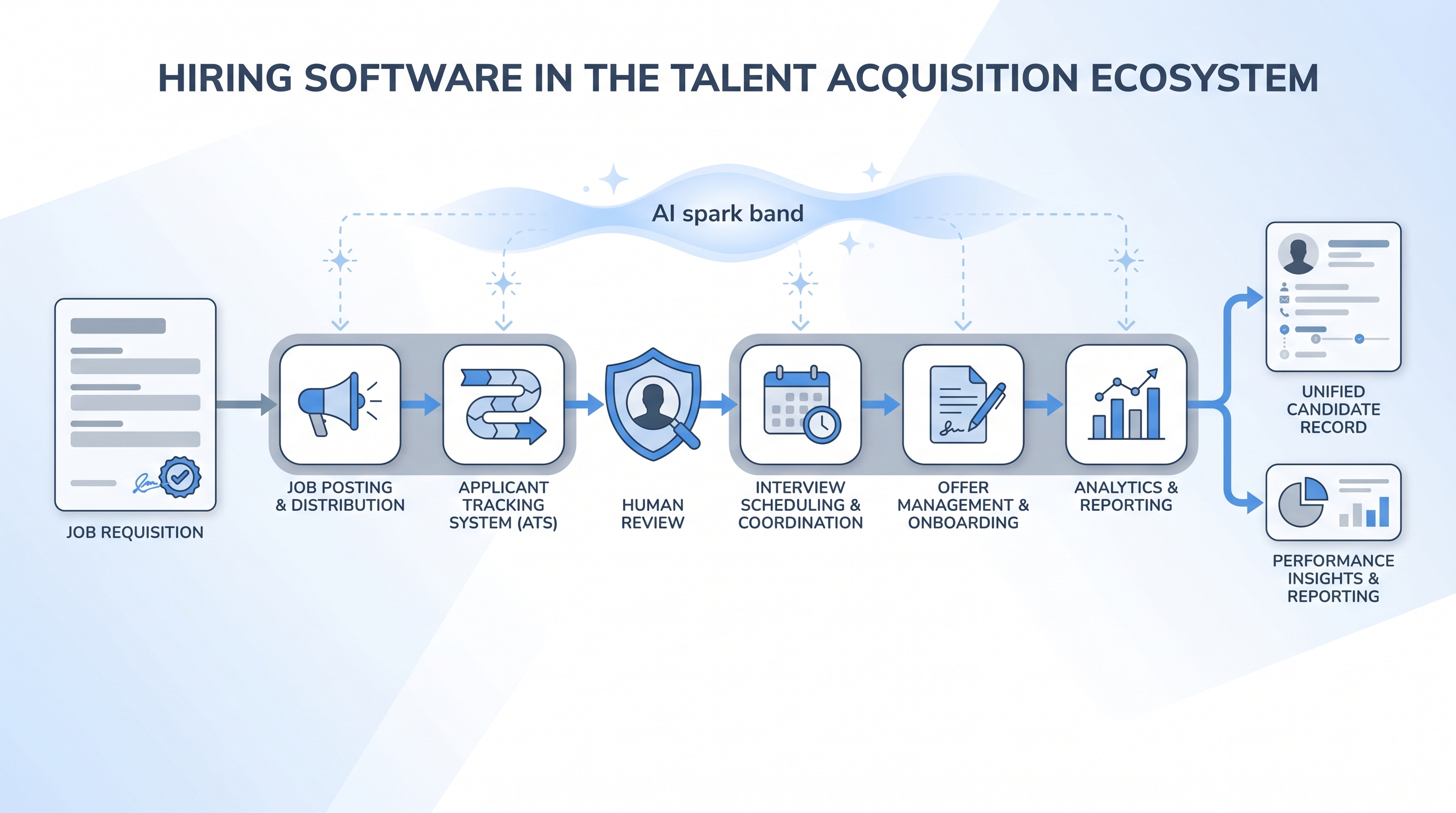
Tools and systems that help organisations manage the hiring process, from job posting and applicant tracking through interviews, offers, and onboarding handoffs, ranging from standalone scheduling tools to integrated platforms covering the full hiring lifecycle.
Michal Juhas · Last reviewed May 8, 2026
What is hiring software?
Hiring software covers tools and systems purpose-built to manage the people, decisions, and data in a hiring cycle. The category is deliberately broad: it includes standalone applicant tracking systems, interview scheduling platforms, offer management tools, sourcing databases, and the integrated suites that combine several of these under one login. Most teams run some version of hiring software from the moment a req is approved through the day a candidate signs an offer and transitions to onboarding.
The term matters in vendor conversations and budget discussions because "hiring software" is often used interchangeably with ATS, HRIS, or recruiting tools, which creates confusion about what is actually being evaluated. Pinning down which part of the hiring cycle is broken, and which category of software closes that gap, is usually worth the fifteen minutes before any demo call.
In practice
- A head of TA talking to the CFO about platform consolidation might say "we are running four pieces of hiring software that do not talk to each other," using the term as a category umbrella that covers everything from the ATS to the scheduling tool to the offer library.
- An agency recruiter describing their desk setup would typically name specific tools by product rather than say "hiring software," but they are describing the same category from a different vantage point.
- When a TA ops lead says "the hiring software broke during the campaign," they usually mean one tool in the stack failed in a way that surfaced to candidates or hiring managers, not that everything collapsed at once.
Quick read, then how hiring teams use it
This section is for recruiters, TA leads, HRBPs, and ops practitioners who need shared vocabulary for vendor evaluations, team onboarding, and tooling discussions. Skim the plain-language section for a fast picture. Use the second when you are auditing, buying, or configuring real tools.
Plain-language summary
- What it means for you: Hiring software is the collective name for the tools that move a candidate from "applied" or "found" to "offer signed" without paper, inboxes, and spreadsheets filling the gaps between steps.
- How you would use it: One req opens, the hiring software tracks every applicant, routes interview feedback, generates the offer, and logs the outcome for reporting. The team does not rekey data between systems.
- How to get started: Map the handoffs in your current hiring process where information currently gets lost or delayed. Those gaps tell you which category of hiring software to buy first and what integration depth actually matters.
- When it is a good time: When hiring volume outpaces what manual tracking supports, when handoffs between teams cause candidate drops, or when a single hiring decision requires more tools to complete than the team can maintain.
When you are running live reqs and tools
- What it means for you: Hiring software is where process governance lives: stage-level permissions, scorecard requirements, approval routing, and the API connections that keep the ATS, calendar, and HRIS in sync without manual intervention.
- When it is a good time: When the same workflows recur across roles and the cost of inconsistency, late hires, missed feedback, unclosed reqs, exceeds the cost of configuring a platform that enforces them.
- How to use it: Set stage permissions and scorecard requirements before launch. Test calendar integrations against edge cases (cancelled panels, rescheduled interviews) before any live req depends on them. Wire recruiting email automation only after stage logic is stable and trusted.
- How to get started: Count the tools in your current stack, then count the manual steps between them. Each manual step is a configuration opportunity. Prioritise the integrations that currently cause candidate delays or data loss.
- What to watch for: Tools that integrate cleanly in demos but sync only once per night in production, AI scoring features that log nothing about which model version ran, and offer workflows that bypass legal or comp review for speed. Read ATS API integration for what stable integration looks like.
Where we talk about this
On AI with Michal live sessions, hiring software shows up across both the AI in recruiting and sourcing automation tracks: the first covers how AI layers sit inside or alongside these platforms, and the second covers automations that connect hiring events to downstream systems. If you want the full room conversation with real stack questions and honest failure stories, start at Sourcing Lab and bring your vendor names and the handoffs that currently break.
Around the web (opinions and rabbit holes)
Third-party creators move fast and tooling changes monthly. Treat these as starting points, not endorsements, and verify anything before you connect candidate data.
YouTube
- Search "hiring software comparison" to find independent TA ops reviews of platform stacks. Filter by upload date: the market moves fast enough that a two-year-old comparison may reference platforms that have since been acquired or repriced.
- Search "ATS vs hiring platform" for practitioner-led walkthroughs comparing point tools with integrated suites and what integration failures look like in production.
- r/recruiting has regular threads on platform switching decisions and what features teams actually use versus what they paid for.
- r/RecruitmentAgencies covers hiring software from the agency side, including what clients expect from the tools agencies bring versus manage internally.
Quora
- What is the best hiring software? collects practitioner answers across different company sizes; useful for calibrating scope expectations before a demo cycle.
Hiring software vs related categories
| Category | Core function | When it is the right choice |
|---|---|---|
| Applicant tracking system | Candidate records and pipeline stages | Primary need is candidate data and stage visibility |
| Hiring management software | Workflow governance across req-to-offer | Approval routing and interview coordination are the pain |
| Hiring platform | All-in-one suite covering most hiring stages | Fragmentation across tools is the primary problem |
| Hiring tools | Point solutions for specific tasks | One step in the funnel is the bottleneck |
Related on this site
- Glossary: Applicant tracking software, Hiring management software, Hiring platforms, Hiring tools, AI hiring software, Best hiring software, ATS API integration, Time-to-fill, AI in recruiting, Scorecard
- Blog: AI sourcing tools for recruiters
- Live cohort: Sourcing Lab
- Membership: Become a member