Intelligent hiring
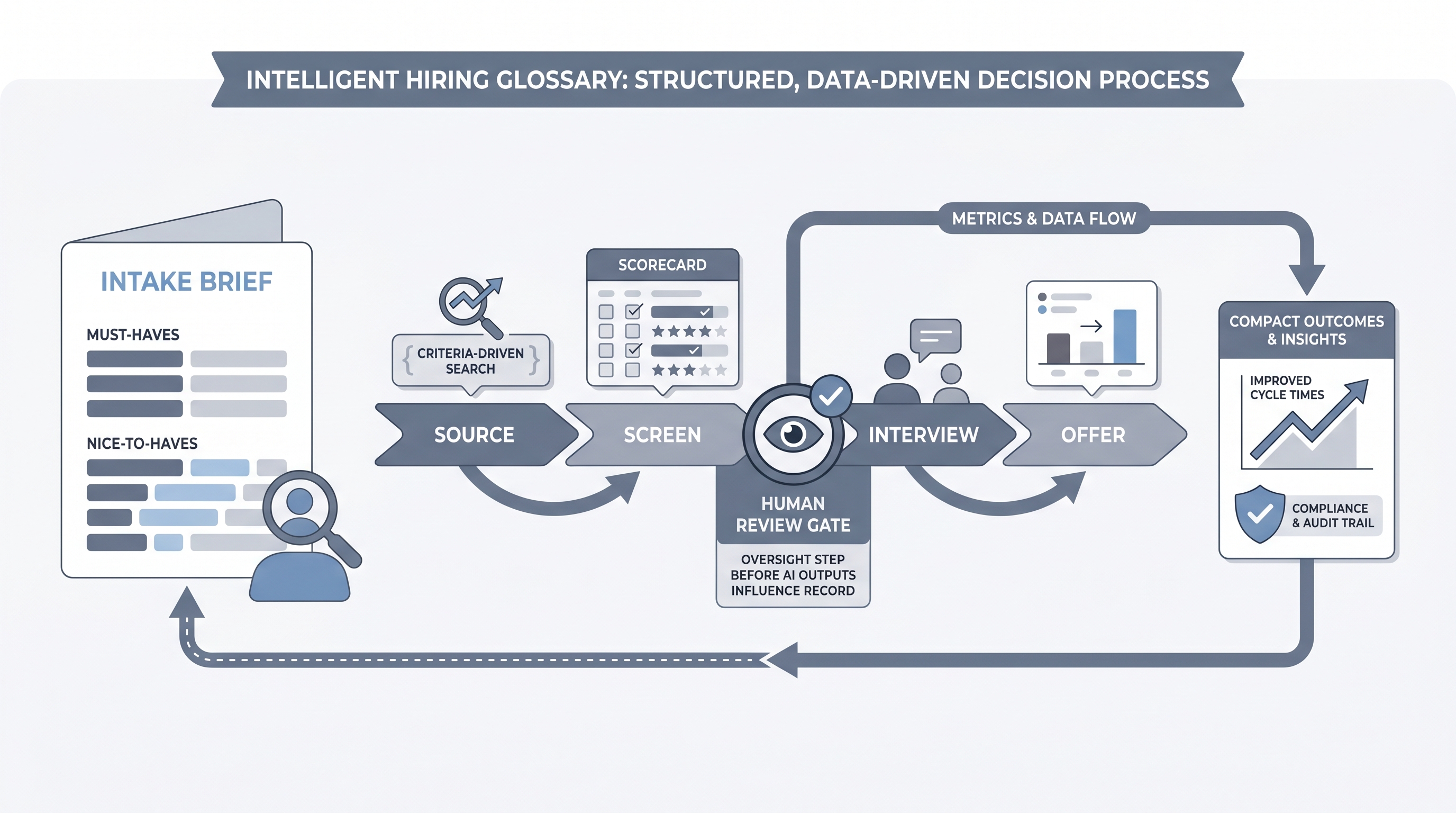
Intelligent hiring is the practice of combining structured intake, consistent evaluation criteria, and data from previous cycles to make hiring decisions that are repeatable, auditable, and less dependent on individual gut feel.
Michal Juhas · Last reviewed May 10, 2026
What is intelligent hiring?
Intelligent hiring is the practice of applying structure, shared criteria, and data from previous cycles to every stage of the hiring process, from intake through offer acceptance. The defining characteristic is that decisions are documented and consistent across reqs: why a candidate was advanced, rejected, or held for a later role can be explained after the fact, not only in the moment.
The term is sometimes used loosely as a synonym for AI in hiring or automated screening. In practice it is broader than both. A team can practice intelligent hiring with a spreadsheet scorecard and a written intake brief. AI and automation accelerate pattern recognition and reduce manual work, but they do not substitute for the governance discipline that makes individual hiring decisions auditable and comparable across quarters.
In practice
- A TA lead at a scale-up noticed they kept hiring the same archetype because no intake brief ever asked what success in the first 90 days would look like. They added a one-line "definition of done" field to every intake: offer acceptance rates held steady while first-year attrition from that source dropped across eight consecutive reqs.
- A sourcer presenting results to a hiring manager says "here are twelve profiles that match the intake criteria" rather than "here are twelve people who looked interesting." That framing shift, criteria-first rather than instinct-first, is the operational difference between an intelligent and an informal sourcing pipeline.
- In vendor demos recruiters often hear "intelligent hiring" used to describe AI-powered ATS or automated screening. On a working team it means something more specific: criteria set before sourcing, scores recorded before the debrief, and outcomes tracked across more than one req.
Quick read, then how hiring teams use it
This is for recruiters, sourcers, TA leads, and HRBPs who want a shared vocabulary for evidence-based hiring that survives handoffs, vendor changes, and hiring manager turnover. Skim the first section for a common definition you can use in a business case or vendor evaluation. Use the second when you are designing or auditing an active process.
Plain-language summary
- What it means for you: Intelligent hiring means agreeing on the rules before sourcing starts, not after the debrief. The team decides what a strong candidate looks like in the intake meeting, not by committee when three finalists are already in play.
- How you would use it: Run the next req with a written criteria card that lists must-haves, nice-to-haves, and what a good first conversation would cover. Score the first ten CVs against it before sharing with the hiring manager.
- How to get started: Ask the hiring manager one question: "If this person fails in the first six months, what is the most likely reason?" The answer is your must-have list. Write it down before you open a sourcing tool.
- When it is a good time: Any req where the hiring manager changed the criteria in the final round, any role you hire more than twice a year, and any position where attrition is a recurring concern worth diagnosing.
When you are running live reqs and tools
- What it means for you: Intelligent hiring creates a data layer across your pipeline that makes sourcing improvements visible and hiring manager calibration measurable, not only felt at the end of a long search.
- When it is a good time: After you have a consistent intake process, consistent scoring, and at least one full cycle with documented outcomes. Measuring before consistency produces noise that misleads rather than informs.
- How to use it: Track time-to-fill and offer acceptance by source and hiring manager. Introduce semantic search and AI screening layers after criteria are stable, not while they are still shifting. Route AI outputs through a human-in-the-loop review gate and log model version alongside the candidate record.
- How to get started: Pick the metric most broken on your current team. If time-to-fill is too long, instrument sourcing-to-screen conversion. If quality of hire is unclear, define it in the intake brief before the next req opens. If hiring managers are unreliable, introduce scorecards on one req first and build from there.
- What to watch for: Criteria drift when the same role opens for the second time; AI screening tools flagging patterns that reflect past bias rather than future fit; and adverse impact emerging at a funnel stage that was never measured before you added AI.
Where we talk about this
On AI with Michal live sessions, intelligent hiring appears in the AI in recruiting and sourcing automation tracks as the governance frame that makes AI-assisted decisions auditable and useful for calibration across cycles. We walk intake design, scorecard structure, and how to log AI tool decisions in a way a compliance team can work with, not just a way that satisfies the vendor checklist. Start at Sourcing Lab and bring your most recent req where the debrief went sideways.
Around the web (opinions and rabbit holes)
Third-party resources shift often. Treat these as starting points, not endorsements. Do not connect candidate data to new tools based on a vendor demo alone.
YouTube
- Search "structured hiring process walkthrough" for practitioner guides on intake meetings, competency-based interviews, and scorecard design that go beyond vendor pitches into what teams actually implement.
- Search "AI recruitment bias audit" for independent reviews of what compliance and legal teams ask before approving AI screening tools in a production hiring workflow.
- r/recruiting threads on "structured interviews" and "hiring process improvement" show what working recruiters find practical versus what requires executive buy-in they cannot easily get.
- r/humanresources carries HRBP discussions on defining quality of hire and building the case for process consistency with hiring managers who prefer informality.
Quora
- What is intelligent hiring? collects definitions from practitioners and vendors; useful for seeing how the term is used commercially versus operationally, and where the two diverge.
Intelligent hiring vs. traditional hiring
| Dimension | Traditional hiring | Intelligent hiring |
|---|---|---|
| Intake | Verbal brief, manager memory | Written criteria card, documented priorities |
| Sourcing logic | Title keyword search | Boolean or semantic criteria tied to intake |
| Screening gate | Recruiter gut feel | Scorecard applied consistently |
| Debrief | First voice sets direction | Panel scores compared before discussion |
| Metrics | Checked occasionally | Tracked by req, source, and hiring manager |
| AI role | Ad hoc, individual use | Governed, logged, human-reviewed |
Related on this site
- Glossary: AI in recruiting, Scorecard, Human-in-the-loop, Talent acquisition metrics, Adverse impact, AI bias audit, Boolean search, Semantic search, Time-to-fill, Workflow automation, Explainable AI hiring, AI recruiting tools
- Blog: AI sourcing tools for recruiters
- Live cohort: Sourcing Lab
- Membership: Become a member
- Course: Starting with AI: foundations in recruiting