Job change signals
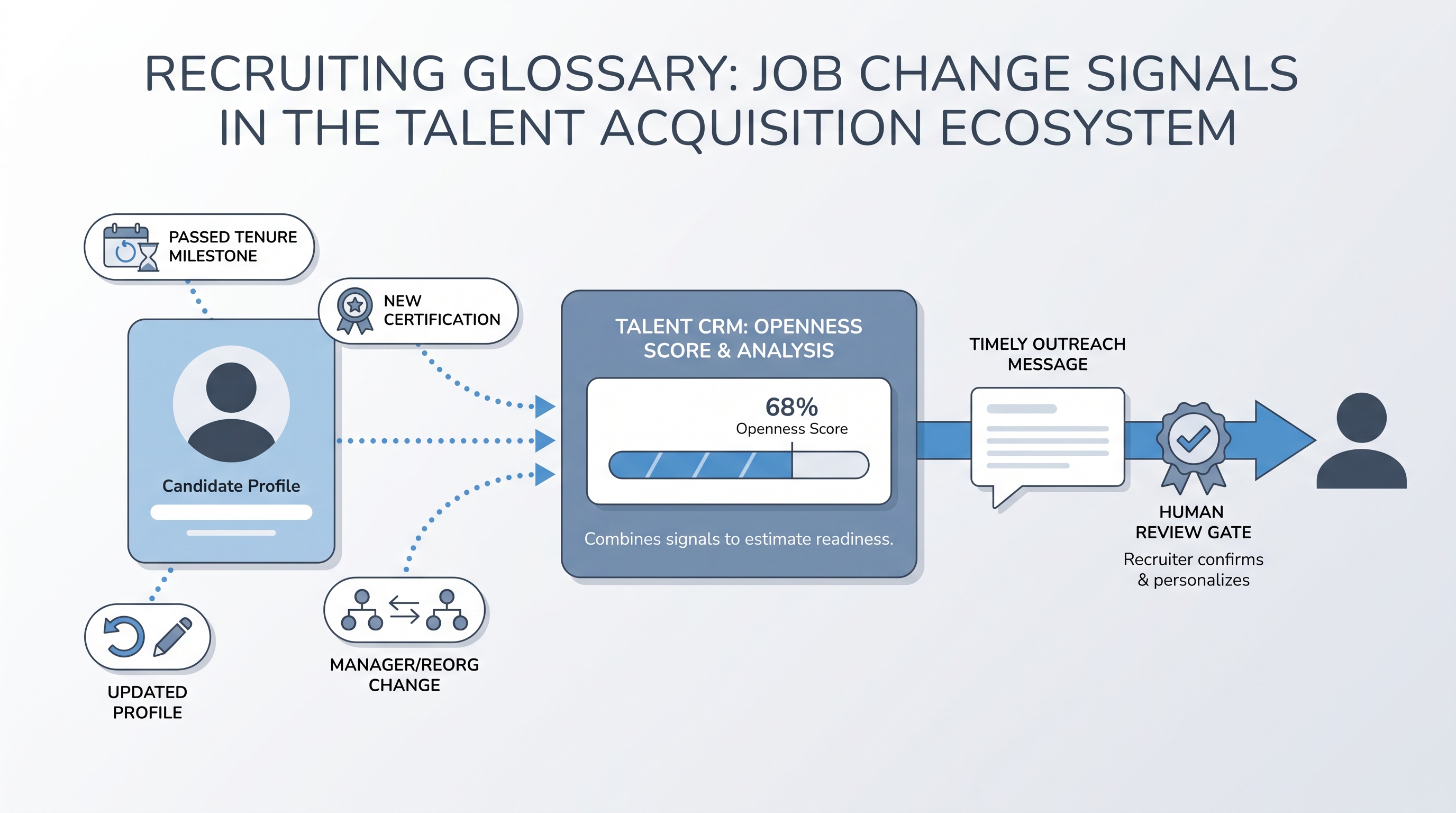
Job change signals are person-level indicators that an individual may be open to or about to change roles, such as a long tenure passing a typical threshold, profile updates, new certifications, reduced engagement at a current employer, or a manager or funding change above them, used by sourcers to time outreach to passive candidates.
Michal Juhas · Last reviewed June 29, 2026
What are job change signals?
Job change signals are clues that a specific person may be ready to move. Where a hiring trigger event tells you a company is about to hire, a job change signal tells you which individual is most likely to say yes if you reach out. They are the candidate-side timing tool in sourcing.
The signals range from simple to structural. A passed tenure milestone (two or three years in a role) is a weak baseline. A refreshed profile, a new headline, an added certification, or an open-to-work indicator reflect intent more directly. The strongest are usually structural: a new manager, a reorganization, a missed promotion, or the employer going through an acquisition, layoff, or funding event. Each one nudges the probability that someone is receptive.
No single signal confirms anything. People stay in roles they updated last week, and people leave roles they never touched online. The skill is to stack a few signals into a prioritization score, then act on the highest-probability people with relevant, well-timed outreach, while respecting that you are inferring openness, not reading minds.
In practice
- A sourcer maintains a saved pool of backend engineers and sets monitoring for profile changes. When one updates their headline and passes a three-year tenure mark in the same month, the system raises their openness score and creates a task. The sourcer reaches out with a specific, relevant role rather than a generic note.
- A talent team notices that a target company was just acquired. They cross-reference their pipeline, surface the people there who also show longer tenure, and prioritize warm, low-pressure outreach acknowledging that acquisitions create uncertainty, without overstepping.
- An AI workflow classifies profile updates across a 2,000-person pool, filtering out cosmetic edits and flagging meaningful changes. A recruiter reviews the shortlist, confirms the signal, and personalizes each message before anything is sent, keeping a human gate between the inference and the outreach.
Quick read, then how hiring teams use it
This is for sourcers, recruiters, and TA leaders who want to reach passive candidates when they are most receptive, instead of messaging at random. Skim the first section for the idea. Use the second when you are building signal monitoring into a sourcing workflow.
Plain-language summary
- What it means for you: A job change signal is a clue that a specific person may be ready to move, like a profile refresh, a new certification, or a manager change. Time your outreach to that moment and it lands far better.
- How you would use it: Maintain a pool of people you would want, watch for a few meaningful signals, and reach out quickly with a relevant opportunity when several stack up.
- How to get started: Pick one strong signal (a refreshed profile or a structural change like a reorg) and one warmed pool. Commit to a same-week, personalized response for a month and measure replies.
- When it is a good time: When your pipeline is full of strong passive candidates but your reply rate is low because outreach is mistimed and generic.
When you are running live reqs and tools
- What it means for you: Signals are a prioritization layer, not proof of intent. The value is in stacking a few weak signals into a score and acting fast with relevance, not in any single data point.
- When it is a good time: When you can route signals into a talent CRM so each one tags the right person and creates a task with an owner. Without a response workflow, monitoring is just noise.
- How to use it: Combine person-level signals with a relevant opportunity (often a live hiring trigger event on the demand side). Use AI to filter and draft, then keep a human review gate before sending.
- How to get started: Track reply and hire rates by signal type. Keep the structural signals that convert, drop the cosmetic ones, and document a lawful basis and retention period for any personal data you monitor.
- What to watch for: Misreading signals (a profile update may be a promotion, not a job search), GDPR-style obligations on tracking named individuals, and outreach that references the signal directly and feels intrusive.
Where we talk about this
On AI with Michal live sessions, job change signals come up in sourcing automation blocks when participants build workflows that monitor a talent pool, score openness, and draft timely, relevant outreach with a human review step. The membership community includes sourcers who run signal-based outreach and compare which signals actually convert to replies and hires.
Strong vs weak signals
| Signal | Strength | Why |
|---|---|---|
| Reorg, new skip-level manager, acquisition | Strong | Structural change often precedes departures |
| Open-to-work indicator, refreshed profile | Strong | Reflects intent, not just time elapsed |
| New certification or course completion | Medium | Suggests growth ambition, not always a move |
| Tenure milestone alone | Weak | Many people stay happily for years |
Around the web (opinions and rabbit holes)
Third-party creators move fast. Treat these as starting points, not endorsements.
YouTube
- Searches for "passive candidate sourcing timing" and "when to reach out to passive candidates" surface practitioner takes on reading openness and timing outreach.
- r/recruiting has threads on passive candidate outreach, what makes people respond, and how to avoid spammy timing-based messaging.
- r/recruitinghell shows the candidate-side reaction to mistimed and signal-mining outreach, a useful reality check.
Quora
- Searches for "how recruiters know you are looking" and "passive candidate signals" collect practitioner and candidate perspectives on what signals reveal and how outreach feels.
Related on this site
- Glossary: Hiring trigger events, Talent pipeline, Candidate pipeline warming, Talent CRM, Talent rediscovery, Talent mapping
- Lab: AI Sourcing Lab
- Membership: Become a member