Talent rediscovery
Using AI or semantic search to resurface previously evaluated candidates from an existing ATS database who match a new open role, converting a passive historical record into an active first-call sourcing channel.
Michal Juhas · Last reviewed June 22, 2026
What is talent rediscovery?
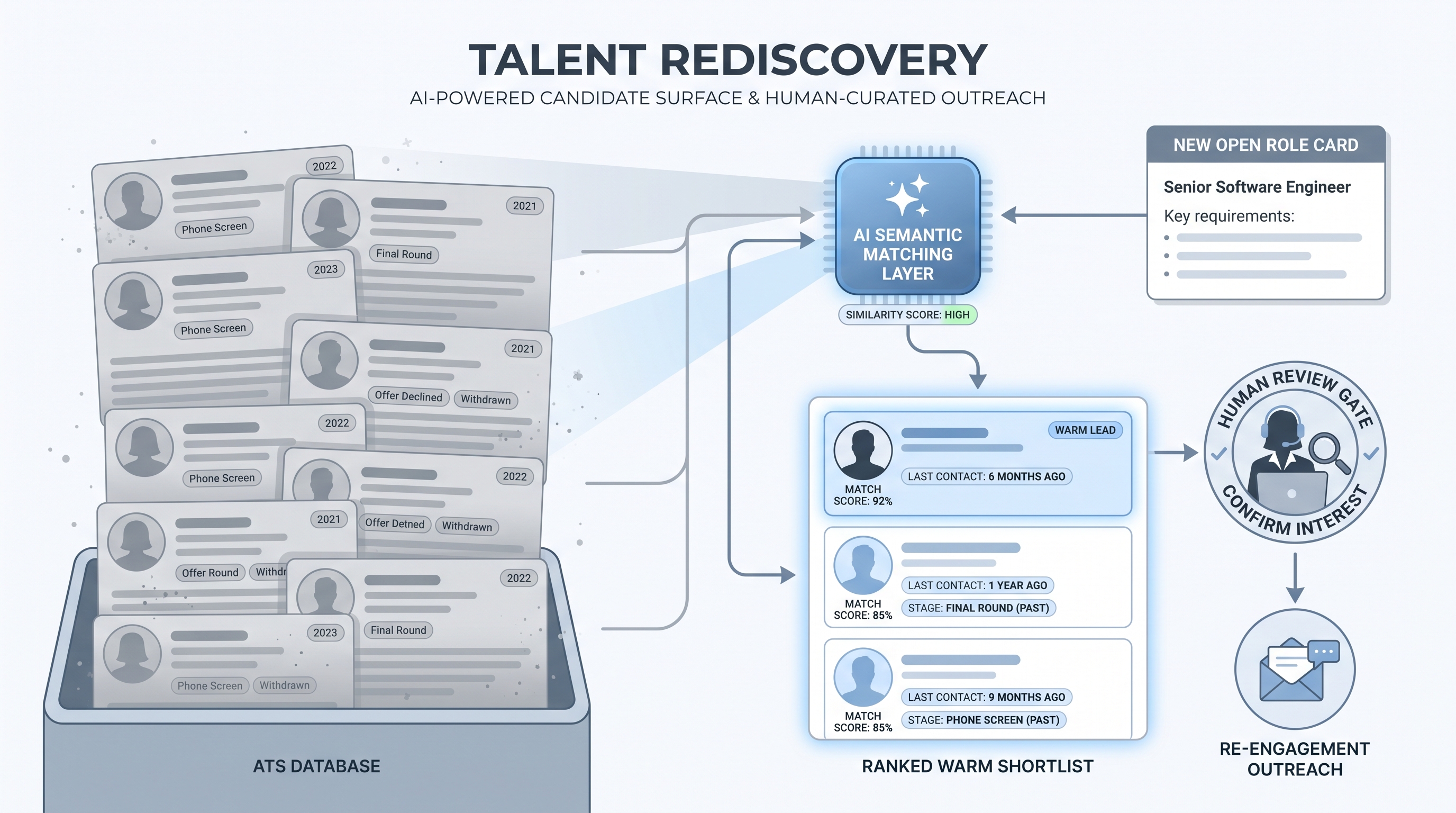
Talent rediscovery uses AI or semantic search to resurface previously evaluated candidates from your ATS database who match a new open role. The idea is simple: your ATS already contains thousands of people who passed a screen, reached a final round, or were silver medalists in an earlier search. Rediscovery tooling turns that passive historical record into an active first-call sourcing channel, so the first question when a req opens is not "who should we source?" but "who do we already know?"
In practice
- A recruiter posts a new senior backend engineering role and runs a rediscovery search before opening LinkedIn Recruiter. The tool surfaces 14 candidates from the last 18 months who matched similar past searches. Three reply within 24 hours. One becomes the hire.
- A TA ops lead runs a monthly ATS health report and finds that 60% of records over two years old have no evaluation notes, meaning rediscovery tooling cannot score them reliably. She adds a data quality remediation sprint to the team's quarterly plan.
- A sourcer uses the phrase "check the ATS first" as shorthand for running a rediscovery search before initiating new outreach, following a process the team adopted after a workshop on ATS utilisation.
Quick read, then how hiring teams use it
This is for recruiters, sourcers, TA, and HR partners who need the same vocabulary in debriefs, vendor calls, and policy reviews. Skim the first section when you need a fast shared picture. Use the second when you are deciding how it shows up in the ATS, sourcing tools, or candidate communications.
Plain-language summary
- What it means for you: You already paid to find and screen many of these candidates. Talent rediscovery tools let you get value from that past work instead of starting every search from scratch.
- How you would use it: When a req opens, run a rediscovery search in your ATS before opening an external sourcing tool. Review the ranked results, identify the ones with strong evaluation notes from past searches, and send a personalised re-engagement message.
- How to get started: Check whether your ATS has a built-in rediscovery feature (most major platforms do). If not, evaluate standalone tools. Run a pilot on one high-frequency role family and measure how many rediscovery contacts convert to screen versus cold outreach.
- When it is a good time: Every time a req opens for a role that has been hired before. The ROI argument is strongest for roles that recur every six to twelve months.
When you are running live reqs and tools
- What it means for you: Talent rediscovery converts your ATS from a graveyard to a sourcing channel. The key metric is past-candidate reactivation rate: how many rediscovery contacts progress to at least a phone screen on the new req.
- When it is a good time: Before every external sourcing sprint. Make "run rediscovery first" a step in your req intake or sourcing kickoff process, not an optional add-on.
- How to use it: Ensure your ATS integration writes structured evaluation data (not just a binary status) so rediscovery tools have enough signal to score accurately. Set re-engagement message templates that reference the prior relationship naturally without being creepy.
- How to get started: Audit your ATS data quality before evaluating tools. A rediscovery tool applied to thin data will surface low-quality matches and damage trust with the hiring team. Fix the data first, then add the tooling.
- What to watch for: GDPR re-contact obligations, stale contact information, and evaluation notes that are too vague to drive meaningful scoring. Also watch for vendor claims of match accuracy on demo data that do not hold on your actual ATS records.
Where we talk about this
On AI with Michal live sessions, talent rediscovery is a recurring topic in the AI in recruiting and sourcing automation tracks. We evaluate rediscovery tools against real ATS data, discuss GDPR re-engagement obligations, and examine what ATS data quality baseline is needed for rediscovery to outperform cold sourcing. Start at AI Sourcing Lab or join membership for sourcing office hours.
Around the web (opinions and rabbit holes)
Third-party creators move fast. Treat these as starting points, not endorsements, and double-check anything before you wire candidate data.
YouTube
- Search "talent rediscovery ATS recruiting AI" on YouTube for vendor demos and practitioner discussions of how rediscovery tools perform on real databases versus demo environments.
- Recruiting Brainfood has covered ATS utilisation and the case for mining existing databases before spending on new sourcing channels.
- r/recruiting has threads on ATS data quality and the gap between rediscovery tool promises and production performance.
- r/sourcing covers sourcing efficiency topics including the "ATS first" approach to proactive pipeline management.
Quora
- How do talent rediscovery tools work? collects technical and practical explanations from recruiters and product managers at HR tech companies.
Talent rediscovery versus cold sourcing
| Approach | Starting point | Typical response rate | GDPR note |
|---|---|---|---|
| Talent rediscovery | Existing ATS records | Higher (prior relationship) | Re-contact lawful basis needed |
| Cold sourcing | No prior relationship | Lower | Legitimate interest basis |
| Silver medalist activation | Final-round past candidates | Highest | Depends on original consent terms |
Related on this site
- Glossary: candidate rediscovery, silver medalist candidates, semantic search
- Glossary: candidate data enrichment, proprietary talent pool, talent pipeline
- Glossary: GDPR and recruiting data, applicant tracking system
- Live cohort: AI Recruiting Accelerator
- Membership: Become a member