Off-limits and non-solicit clauses for agencies
An off-limits clause in a recruitment or staffing agency agreement prohibits the agency from approaching, recruiting, or placing employees of a named client for a defined period. A non-solicitation clause restricts active outreach to those employees. Together they protect clients from having their workforce targeted by the same agency given access to their org chart and talent landscape.
Michal Juhas · Last reviewed May 7, 2026
What are off-limits and non-solicit clauses for agencies?
An off-limits clause in a recruitment or staffing agency agreement prohibits the agency from approaching, recruiting, or placing employees of a named client for a defined period, typically while the engagement is active and for a set number of months after it ends. A non-solicitation clause is a related but narrower provision: it restricts active outreach to the client's employees without necessarily barring the agency from proceeding if an employee makes first contact.
Both clauses exist because the agency relationship creates an information asymmetry. When a client hires an agency, it shares access to its org chart, leadership contacts, compensation structures, and talent pipeline. An off-limits obligation converts that access into a contractual boundary, ensuring the same knowledge used to source talent for the client cannot be turned against the client's own workforce.
For agency owners and operations leads, these clauses are among the most commercially significant in any MSA. A clause that covers the named legal entity is standard and reasonable. A clause that extends to an entire corporate family, all subsidiaries, and all portfolio companies can eliminate a large portion of the agency's addressable candidate market.
In practice
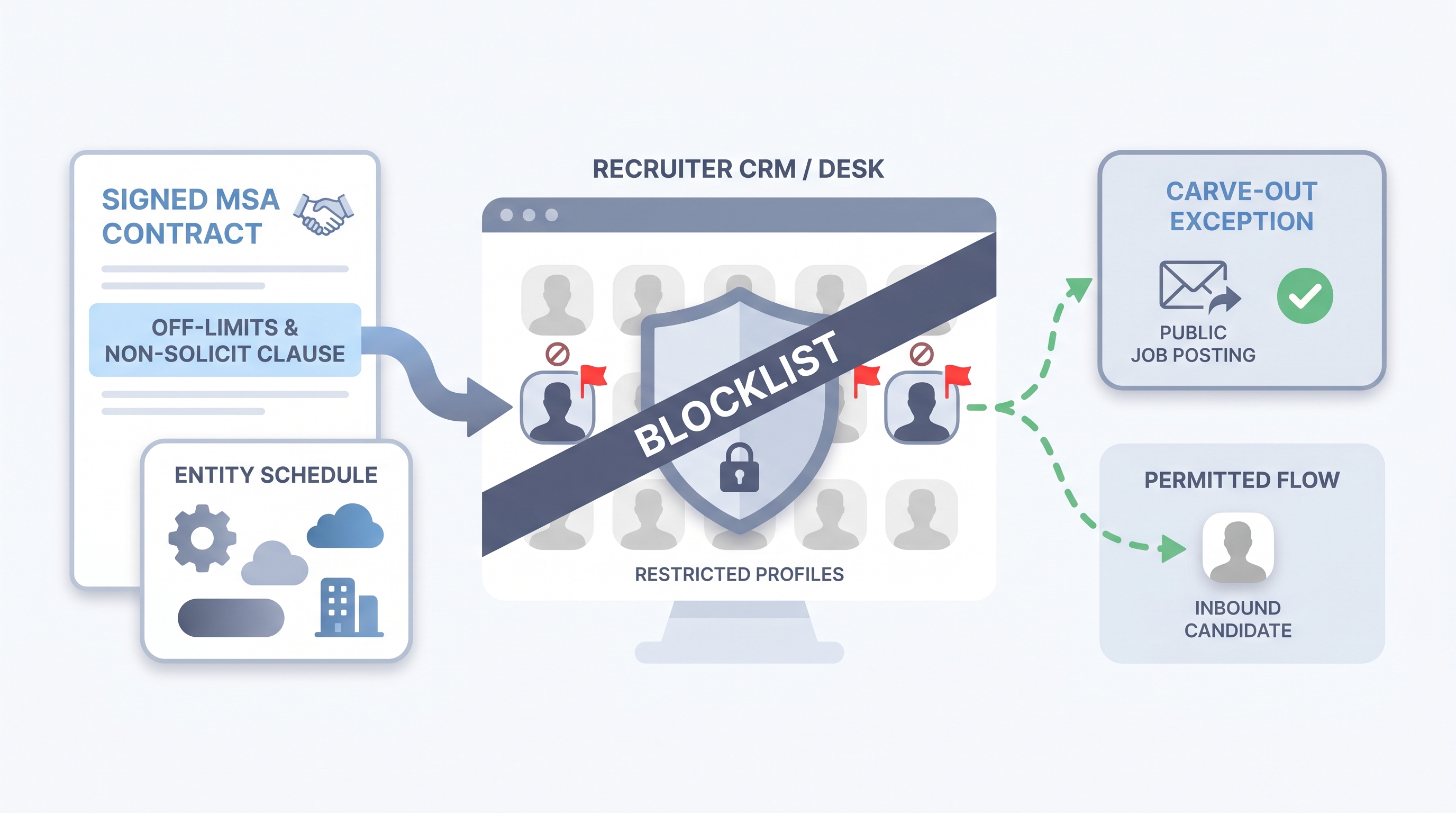
- An agency wins a retained executive search assignment with a large technology company whose MSA contains an off-limits clause covering all subsidiaries globally. The search team discovers that three of the strongest candidates on their longlist are currently employed by a subsidiary listed in the entity schedule. They flag the conflict to the client before any outreach, confirm whether a waiver applies to the placement, and update the CRM blocklist before the assignment goes live.
- A contingency recruiter places a finance manager at a mid-size client. Six months later the same recruiter receives a direct message from a senior analyst at the same company asking for help finding a new role. Before responding, the recruiter checks whether the client MSA contains a non-solicitation or off-limits clause and confirms whether inbound contact from a client employee is covered. The MSA includes a carve-out for employees who initiate contact without the agency's outreach, so the recruiter proceeds, documents the inbound nature of the approach, and notifies the client relationship manager before any submission.
- A staffing agency preparing to sign a new MSA with a private equity-backed portfolio company receives draft off-limits language covering the fund, all portfolio companies, and all future acquisitions during the fund's life. The agency counters with a clause limited to the named entity and its operating subsidiaries, a twelve-month post-engagement duration tied to individual placements, and a carve-out for public job posting respondents. Both parties agree on the scoped version.
Quick read, then how hiring teams use it
This page is for agency owners, operations managers, compliance leads, and in-house TA and procurement leaders who negotiate, sign, or manage recruitment and staffing agreements. Skim the first section for the definition and the core commercial risk. Use the second when you are reviewing an MSA with off-limits language, negotiating scope and duration, or assessing a candidate situation that may touch a restricted employer.
Plain-language summary
- What it means for you: If your agency MSA contains an off-limits or non-solicit clause, approaching employees of the named client or its covered affiliates during the restriction period is a contractual breach with potential legal and commercial consequences. The clause applies even when a candidate reaches out first, unless you have negotiated a clear inbound carve-out.
- How you would use it: Before any outreach to a candidate currently employed at a named entity, check your CRM blocklist. Before signing a new client agreement, read the off-limits clause carefully: confirm the scope, the covered entities, the duration, and what constitutes a trigger event.
- How to get started: Pull your three highest-revenue client MSAs and check whether they contain an off-limits or non-solicitation clause. If they do, confirm the entity schedule is current and that your CRM has a do-not-contact flag for covered employees.
- When it is a good time: Before any outreach to candidates at major client accounts, before signing a new agency agreement with off-limits language, and at every MSA renewal where the client group has changed due to acquisitions or restructures.
When you are running live reqs and tools
- What it means for you: Every off-limits clause is a live constraint on your candidate addressable market. The practical risk is not legal action on day one: it is the inadvertent approach that surfaces in a client review, damages trust, and loses the relationship before any formal claim is made.
- When it is a good time: Before sourcing for any role at a client whose agreement contains an off-limits clause, confirm the entity list is loaded into your ATS or CRM. Before presenting a candidate who has recently left a restricted employer, check whether the post-exit period has elapsed.
- How to use it: Tag every client in your CRM with the off-limits status, the list of covered entities, and the expiry date for each placed candidate. Route any inbound approach from a client employee through your relationship manager before responding.
- How to get started: Create a simple MSA compliance log: client name, off-limits scope (entity list), duration, post-placement trigger, and carve-outs agreed. Review this log with your team at the start of each sourcing assignment.
- What to watch for: Clauses with no entity schedule (scope is left as "the client and its affiliates"), no duration cap, no carve-outs for public postings, and automatic extension clauses that reset the period every time a new placement is made. These are the configurations most likely to create inadvertent breaches on a busy desk.
Where we talk about this
On AI with Michal live sessions, agency contract structure, including off-limits obligations, non-solicit scope negotiation, and MSA compliance, comes up in the AI in recruiting track when agency principals and in-house TA leaders discuss sustainable agency relationships and governance frameworks. The Sourcing Lab cohort covers both agency and in-house perspectives so participants understand what is being agreed to before signature and how to structure relationships that protect both sides.
Around the web (opinions and rabbit holes)
Off-limits and non-solicitation clause commentary in the staffing and recruitment context is spread across employment law blogs, staffing industry association resources, and commercial contract negotiation guides. These are starting points, not endorsements. Verify any legal or contractual position with counsel before relying on it in a live MSA negotiation.
YouTube
- Non-solicitation clauses in employment and vendor contracts explained covers the mechanics of non-solicit obligations in commercial agreements, including how scope is defined and what triggers a breach.
- Staffing agency MSA negotiation: off-limits and non-compete clauses walks through practical approaches to limiting off-limits scope in agency agreements.
- How to negotiate vendor contract restrictions in recruiting explains how both agencies and clients approach scope, carve-outs, and duration in practice.
- Non-solicitation clauses in agency contracts in r/RecruitmentAgencies includes agency owner perspectives on how off-limits obligations affect candidate pipelines and client relationships.
- MSA negotiation tips for staffing firms in r/staffing covers practical strategies for managing restrictive contract clauses on high-volume desks.
- Contract clause negotiation in r/legaladvice offers general perspectives on scope limits, carve-outs, and enforceability of non-solicit provisions.
Quora
- What is an off-limits clause in a staffing agreement and how does it work? collects practitioner perspectives on how off-limits obligations are defined, negotiated, and enforced in agency contracts.
Off-limits clause design and commercial risk
| Clause design | Covered scope | Duration | Agency risk | Recommended position |
|---|---|---|---|---|
| Broad: all affiliates, no schedule | Entire corporate family plus future acquisitions | Unlimited or auto-renewing | Very high | Reject; insist on a named entity schedule with a scope cap |
| Entity-scoped: named legal entity and direct subsidiaries | Specified in a signed schedule | 12-24 months post-placement | Manageable | Accept with public-post and inbound carve-outs |
| Placement-triggered: duration runs per hire | Scoped to direct employer of placed candidate | 12 months from start date | Low | Preferred structure; limits exposure to actual placements |
| Reciprocal: client also cannot hire agency staff directly | Mutual obligations on both parties | Matched duration | Balanced | Negotiate for any broad-scope clause as a counterweight |
Related on this site
- Glossary: Master services agreement for agency services, Agency indemnification clauses
- Glossary: Candidate right to represent, Client exclusivity in agency agreements
- Glossary: Joint employment liability for staffing placements, Co-employment in contract staffing
- Glossary: Most favored nation (MFN) pricing in agency contracts, Agency invoice and payment terms
- Workshops: Sourcing Lab
- Course: Starting with AI: the foundations in recruiting
- Membership: Become a member