Open source recruitment software
Hiring software where the source code is publicly available, self-hostable, and modifiable by your team, letting companies run their ATS, job board, or workflow layer on their own infrastructure without vendor lock-in.
Michal Juhas · Last reviewed May 15, 2026
What is open source recruitment software?
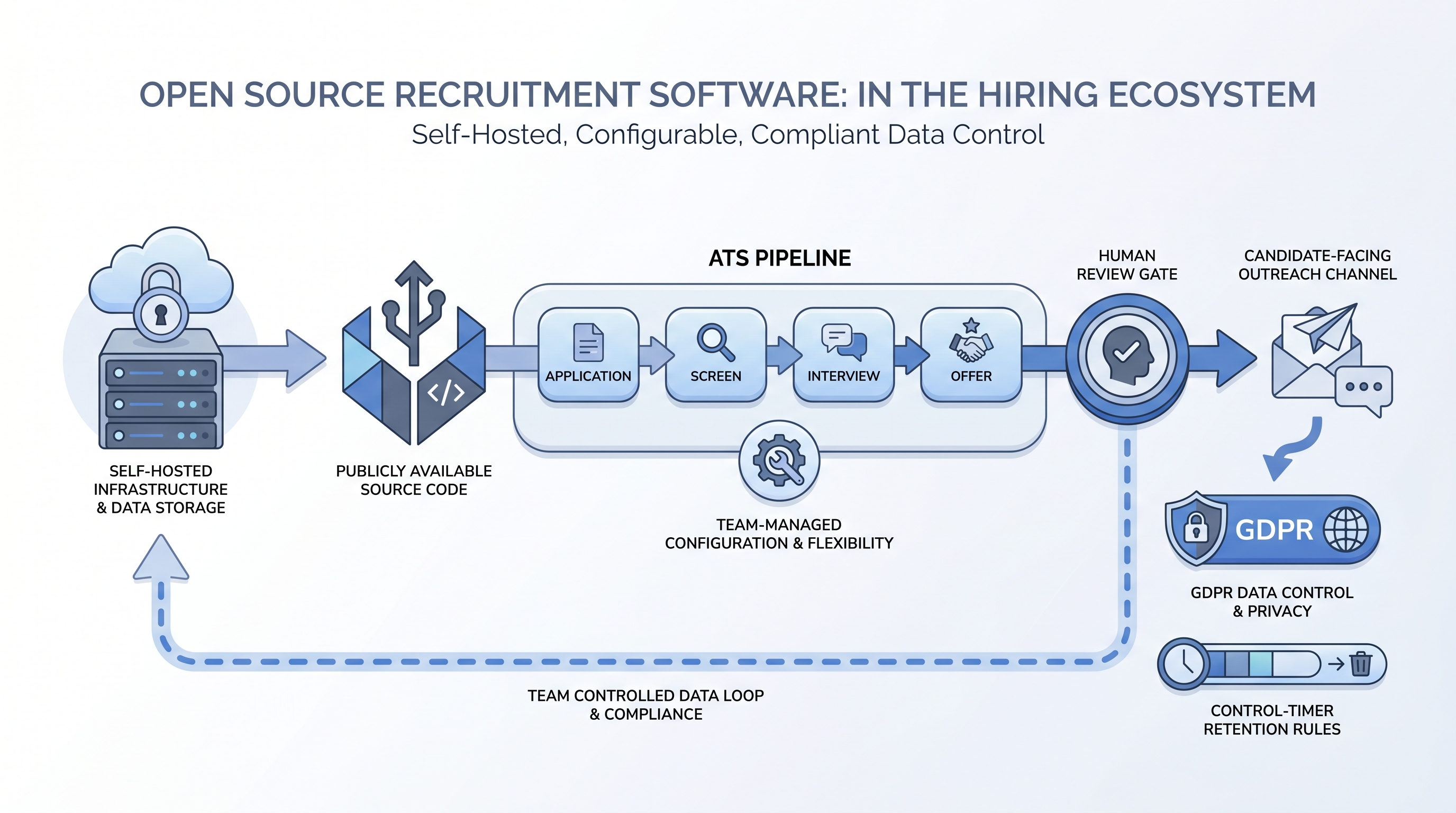
Open source recruitment software covers hiring tools where the source code is publicly available under a licence that allows self-hosting, modification, and redistribution. The most common category is the open source ATS, where companies run their own applicant tracking system on private infrastructure rather than on a vendor-managed cloud.
The practical appeal is direct: candidate personal data stays on servers your team controls, retention and deletion rules are yours to set, and there is no vendor relationship to migrate away from if pricing changes. The practical cost is that your team absorbs the patching, upgrading, and compliance work that a SaaS vendor handles in exchange for the subscription fee.
In practice
- A 50-person company processing candidates from several EU countries might self-host an open source ATS on EU infrastructure because no commercial vendor offers the required data residency terms at a price point that fits the stage.
- A TA ops lead who says "we built it ourselves on n8n" is describing a custom workflow automation layer on top of open source tooling, not a purpose-built ATS. The two use cases look similar from the outside but have very different maintenance obligations.
- Sourcers and recruiters rarely choose open source software directly. The decision usually comes from engineering or ops leadership, which means the people responsible for day-to-day hiring often have limited input into what gets deployed.
Quick read, then how hiring teams use it
This is for recruiters, TA leaders, and HR partners who need shared vocabulary in vendor reviews, tool audits, and compliance conversations. Skim the first section for a fast shared picture. Use the second when deciding whether to self-host a tool, build a custom workflow layer, or assess whether the engineering overhead justifies the data control gain.
Plain-language summary
- What it means for you: Open source recruitment software is a hiring tool your company installs and runs on its own infrastructure. Your team controls the data, sets the rules, and maintains the system rather than paying a vendor to do it.
- How you would use it: You log in to the same kind of pipeline view as a commercial ATS: stages, candidate records, job postings, and interview notes. What differs is who owns uptime, security, and updates.
- How to get started: Map the hiring step causing the most manual work or compliance complexity. Check whether an open source tool addresses it directly, then assess whether your team has the engineering capacity to run it. If capacity is the constraint, a lightweight commercial tool is usually the more realistic path.
- When it is a good time: When data residency requirements, budget constraints, or customisation needs exceed what commercial vendors offer, and when your company has the engineering resources to own the maintenance cycle.
When you are running live reqs and tools
- What it means for you: Open source recruiting tools change the risk allocation. Data breaches, late security patches, and GDPR deletion failures become your incidents rather than your vendor's. That trade-off only makes sense when the control gain outweighs the support cost.
- When it is a good time: When your legal or IT team requires full data sovereignty, when commercial vendor pricing is unsustainable at your candidate volume, or when you need a workflow layer no commercial product covers.
- How to use it: Treat the open source ATS as the system of record: named stage owners, scorecard templates per role, audit logs for every stage move. Pair it with commercial tools for functions like candidate data enrichment where open source alternatives lag. Keep a runbook that documents who patches the system and how quickly.
- How to get started: Before committing, run a 30-day proof of concept with one job family and a test candidate pool. Measure actual recruiter time against setup and maintenance cost. Most teams discover the support overhead during the pilot rather than in production.
- What to watch for: Unpatched security vulnerabilities are the most common failure mode. GDPR deletion requests that require custom scripts are the most common compliance failure. Model drift in any AI features bolted on via API. And the original engineer who set the system up leaving the company before anyone else understands it.
Where we talk about this
On AI with Michal live sessions, open source recruitment software comes up most often in the sourcing automation track, where teams want to build custom pipelines without vendor lock-in. The conversation covers when to use a self-hosted workflow layer like n8n, when a commercial ATS is the right baseline, and how to structure data governance for self-hosted candidate records. If you want the full room conversation on custom versus commercial stacks, start at Sourcing Lab and bring your IT constraints and data residency requirements.
Around the web (opinions and rabbit holes)
Third-party creators move fast. Treat these as starting points, not endorsements, and double-check anything before you wire candidate data through a self-hosted system.
YouTube
- OpenCATS tutorial: setting up your open source ATS covers installation, job posting configuration, and basic pipeline setup for teams evaluating OpenCATS.
- n8n for HR automation: building recruiting workflows shows how teams use the open source workflow tool to build sourcing sequences, application routing, and ATS integrations.
- Self-hosted vs SaaS recruitment software walks through the compliance and cost trade-off between running your own stack and paying for a managed service.
- Anyone running an open source ATS in production? in r/recruiting has honest practitioner threads on what works, what breaks, and what the documentation does not mention.
- Open source ATS for a small team in r/humanresources covers the real support burden of self-hosted systems from a small-team perspective.
- Building recruiting automation with n8n in r/n8n has community threads from practitioners who have built custom hiring workflows and describe where failure modes appear.
Quora
- What are the best free and open source ATS? collects practitioner opinions across company sizes (read critically, weight recent answers more heavily).
Open source versus SaaS recruitment software
| Dimension | Open source / self-hosted | SaaS ATS |
|---|---|---|
| Data residency | Your infrastructure | Vendor infrastructure |
| GDPR DPA | You are the data controller | Vendor absorbs DPA obligations |
| Setup cost | Engineering time upfront | Subscribe and configure |
| Ongoing maintenance | Your team owns patches | Vendor handles updates |
| Customisation depth | Full: modify the source code | Limited to vendor feature set |
| Support when it breaks | Community forums, your team | Vendor SLA |
Related on this site
- Glossary: Workflow automation, Applicant tracking software, ATS API integration, Human-in-the-loop (HITL), Candidate data enrichment, Recruitment management software, Scorecard
- Tools: n8n
- Blog: AI sourcing tools for recruiters
- Live cohort: Sourcing Lab
- Course: Starting with AI: the foundations in recruiting
- Membership: Become a member