Recruitment management software
A system or integrated set of tools that manages the full hiring lifecycle, from job requisition through offer acceptance and HRIS handoff, giving TA teams a shared pipeline, role-based access, and reporting that spans sourcing, applicant tracking, and hiring decisions.
Michal Juhas · Last reviewed May 9, 2026
What is recruitment management software?
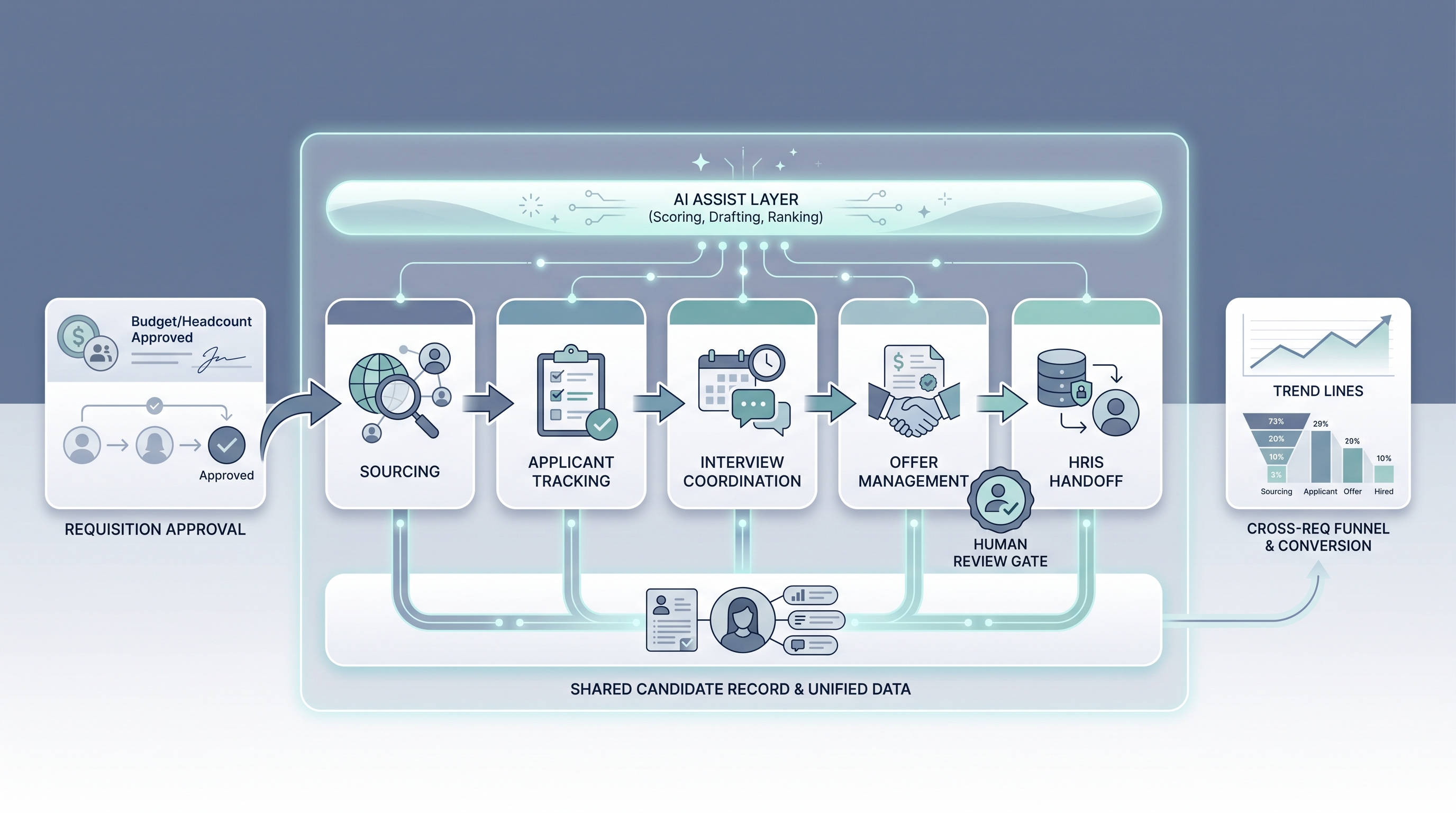
Recruitment management software is a system, or an integrated set of tools, that covers the full hiring lifecycle: from the moment a headcount request is approved through sourcing, application tracking, interview coordination, offer management, and the handoff to an HRIS when a candidate accepts.
The term is often used interchangeably with ATS, but the distinction matters in practice. An ATS primarily tracks where candidates are in the pipeline and stores their documents. Recruitment management software is a broader category that also handles requisition approval workflows, budget authorization, cross-requisition reporting, and structured connections to workforce planning. Many vendors start as ATS products and gradually add RMS features; the label changes when reporting spans the full hire cycle, not just candidate stages.
For TA leaders, the practical difference is whether the system can answer operational questions, such as average time-to-fill by department, offer acceptance rate by source, and how many reqs each recruiter currently owns, without exporting data to a spreadsheet.
In practice
- When a hiring manager submits a headcount request and it routes through a finance approval chain before the job is posted, that is the requisition management layer that most TA ops teams associate with RMS rather than a basic ATS.
- In AI Sourcing Lab sessions, the question "does your ATS do that?" often refers to time-in-stage alerts or cross-req pipeline visibility. These are RMS-level features, not just candidate database functions.
- A TA leader at a 500-person company described their RMS migration as "the moment we stopped exporting every metric to Google Sheets and could finally see offer acceptance rate by department inside the tool itself."
Quick read, then how hiring teams use it
This is for recruiters, sourcers, TA, and HR partners who need the same vocabulary in vendor calls, leadership reviews, and implementation decisions. Skim the first section for a shared picture. Use the second when you are evaluating, configuring, or troubleshooting your current system.
Plain-language summary
- What it means for you: Recruitment management software is the system that holds the full record of your hiring process, from the approved headcount number through the signed offer letter, so every stakeholder (recruiter, hiring manager, TA leader, finance) sees the same pipeline.
- How you would use it: You open reqs through it, move candidates through stages, schedule interviews from it, collect feedback inside it, issue offers through it, and pull reports when leadership asks how many hires are on track this quarter.
- How to get started: Audit your current process and count how many tools, spreadsheets, and manual handoffs sit between a req opening and a hire being recorded. Each gap is a configuration opportunity in an RMS.
- When it is a good time: Before a headcount scale-up, when onboarding coordinators who cannot navigate a fragmented stack, or after a quarter where a mis-hire traced back to feedback that never made it into the system.
When you are running live reqs and tools
- What it means for you: The RMS is where process governance lives: who can advance a candidate to offer, who must sign off before a req opens, which panels get which scorecards, and which events trigger the HRIS sync.
- When it is a good time: When the same workflow runs across multiple roles and the cost of inconsistency (late hires, missed feedback, unclosed reqs) exceeds the cost of configuring a platform properly.
- How to use it: Set up stage-by-stage permission rules before launch. Test edge cases (cancelled interviews, rescheduled panels, offer revisions) in a sandbox before any live req depends on the integration. Confirm that AI-assisted features log model version and criteria so a compliance question has a one-page answer.
- How to get started: Demo the system with your actual job types and a real sample pipeline. Map the five or six handoffs where information currently gets lost, and verify the RMS closes those gaps without manual re-entry. See ATS API integration for what stable integration actually looks like.
- What to watch for: Data migration gaps that break source-of-hire reporting for months after go-live, permission creep that puts candidate data in front of the wrong hiring managers, AI ranking features with no audit trail, and offer approval flows that bypass legal or comp review.
Where we talk about this
On AI with Michal live sessions, recruitment management software shows up in both the AI in recruiting and sourcing automation tracks: the first covers how AI layers sit inside or alongside these platforms, the second covers how automations connect hiring events to downstream systems without creating data gaps. Start at Sourcing Lab and bring your vendor name, your integration list, and the top two reporting questions you cannot currently answer without a spreadsheet.
Around the web (opinions and rabbit holes)
Third-party creators move fast and tooling changes monthly. Treat these as starting points, not endorsements, and check anything before you connect candidate data.
YouTube
- Search "recruitment management software vs ATS" to find vendor explainers and practitioner walkthroughs from TA ops leads comparing platforms in public. Filter by upload date: this space moves fast enough that a two-year-old review may describe a product that has since been acquired or repriced.
- Search "ATS evaluation TA ops" for practitioner-led stack reviews. Posts from independent recruiters and TA ops roles tend to be more candid about integration failures than vendor-produced content.
- r/recruiting has recurring threads on ATS and hiring software decisions, often surfacing real configuration pain points and contract surprises vendors do not mention in demos.
- r/TalentAcquisition includes TA leader conversations about platform migrations, reporting limitations, and what teams wish they had tested before signing.
Quora
- What is the best recruitment management software? collects practitioner answers across different company sizes; the implementation time estimates are often more realistic than vendor documentation.
Recruitment management software vs ATS vs HRIS
| Capability | ATS | Recruitment management software | HRIS |
|---|---|---|---|
| Candidate pipeline and stage tracking | Core | Included | Not typical |
| Requisition approval workflow | Often basic | Usually full | Sometimes |
| Offer management and e-signature | Varies by vendor | Usually included | Sometimes |
| Cross-requisition analytics | Limited | Usually included | Workforce-level only |
| AI-assisted ranking or drafting | Varies | Increasingly embedded | Not typical |
| HRIS handoff at hire | Integration-dependent | Often native | Core |
Related on this site
- Glossary: Applicant tracking software, Hiring management software, Hiring platforms, Hiring software, ATS hiring software, AI in recruiting, Time-to-fill, Human-in-the-loop (HITL), Pipeline coverage reporting, Recruitment analytics software
- Blog: AI sourcing tools for recruiters
- Live cohort: Sourcing Lab
- Membership: Become a member