Passive sourcing
Proactively reaching professionals who are not actively job searching, using profile signals, referral networks, and targeted outreach to convert passive interest into pipeline before a role competes on open-market job boards.
Michal Juhas · Last reviewed June 8, 2026
What is passive sourcing?
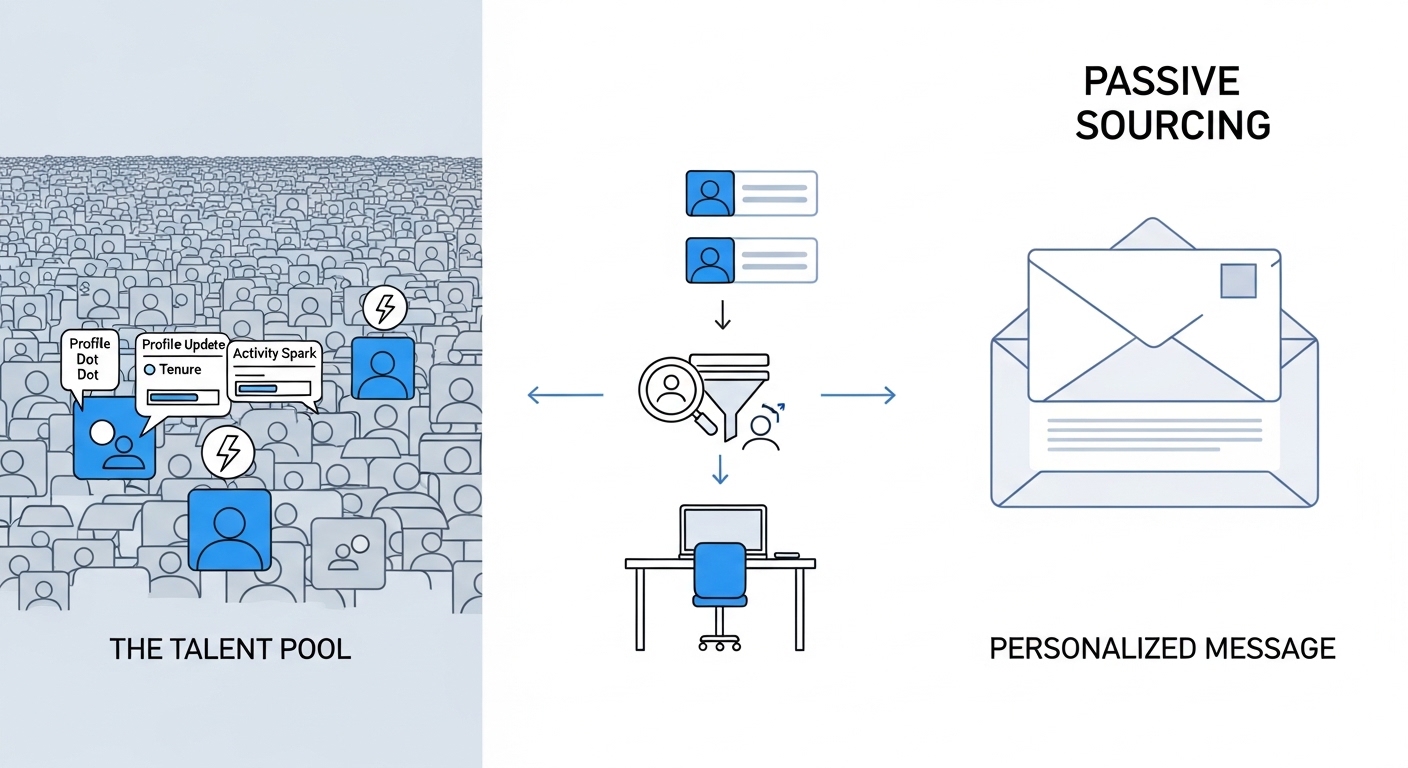
Passive sourcing means proactively reaching professionals who are not applying anywhere right now. You identify them through profile signals, referral networks, and targeted search, qualify them against the role, and reach out before they ever see a job post.
In practice
- A sourcer builds a Boolean search on LinkedIn Recruiter, filters by tenure signal and recent profile updates, and sends a tailored InMail campaign. The pipeline starts before the job post goes live.
- A sourcing automation team hooks candidate data enrichment into a weekly alert that flags when a target profile updates their headline, triggering a warm outreach sequence.
- A hiring manager might say "let's source this one" when they know the right person is unlikely to be scrolling job boards, signalling the team should build a list rather than run ads.
Quick read, then how hiring teams use it
This is for sourcers, recruiters, and TA leaders who need to fill roles where the best candidates are not raising their hands. Skim the first section for a shared definition. Use the second when you are building a sourcing campaign or deciding when passive sourcing earns its cost.
Plain-language summary
- What it means for you: You go and find the candidates rather than waiting for them to apply. This takes more sourcer time but typically produces higher-quality shortlists for hard-to-fill or confidential roles.
- How you would use it: Build a target profile, run searches across LinkedIn, GitHub, or community databases, qualify profiles, personalise messages, and follow up at least twice before retiring the sequence.
- How to get started: Pick one role where inbound applicants have consistently missed the mark. Define three to five criteria you would use to qualify someone before reaching out. Run a Boolean search and build a list of 20 to 30 names before you send a single message.
- When it is a good time: Senior, niche, or confidential roles. Any role where your last three hires came from sources other than job boards.
When you are running live reqs and tools
- What it means for you: Passive sourcing generates structured data (profile quality, reply rates, conversion at each stage) that feeds sourcing funnel metrics and informs where to adjust the search criteria or the message.
- When it is a good time: When source-of-hire data shows job boards underperform. When the role requires confidentiality. When building a niche talent pool for recurrent openings.
- How to use it: Use AI sourcing tools to accelerate list building, but keep a human eye on every message before it sends. Log each contact with a lawful basis and opt-out status per GDPR. Track reply rate and stage conversion per campaign to know what is working.
- How to get started: Read outbound talent sourcing for the operational playbook, then run one campaign in parallel with your job post for the same role and compare the quality of shortlists after two weeks.
- What to watch for: Personalisation hooks that reference inaccurate data. Messages that inadvertently encode protected-characteristic assumptions. Campaigns that burn a talent pool by over-contacting the same short list of people across multiple roles.
Where we talk about this
On AI with Michal live sessions, passive sourcing is central to both the sourcing automation and AI in recruiting tracks. We walk real list-building, message drafting, and GDPR workflows with actual ATS and sourcing tool stacks. Start at AI Recruiting Accelerator or Sourcing Lab and bring your current conversion data.
Around the web (opinions and rabbit holes)
Third-party creators move fast. Treat these as starting points, not endorsements.
YouTube
- Search "passive candidate outreach" on YouTube for sourcer walkthroughs; the SourceCon and Talent42 archives have practitioner talks on building and qualifying passive lists with real reply-rate data.
- The "Sourcing School" YouTube channel covers LinkedIn search operator updates and message frameworks with honest performance numbers.
- r/recruiting threads on passive sourcing cover InMail reply rates, tool comparisons, and messaging experiments from people doing it day to day.
- r/RecruitmentAgencies has honest discussions on when passive sourcing earns its cost and when job boards still win.
Quora
- What is the difference between active and passive recruiting? collects practitioner perspectives worth reading critically alongside your own data.
Active versus passive sourcing
| Dimension | Active sourcing | Passive sourcing |
|---|---|---|
| Candidate pool | Job-seekers (~25%) | Employed and not looking (~75%) |
| Time per hire | Lower | Higher |
| Cost per hire | Lower | Higher |
| Quality for niche roles | Variable | Generally higher |
Related on this site
- Glossary: Outbound talent sourcing, AI sourcing tools, Candidate data enrichment, Proprietary talent pool, GDPR first-touch outreach
- Blog: AI sourcing tools for recruiters
- Guides: Sourcers
- Live cohort: Sourcing Lab
- Membership: Become a member