People graph in recruiting
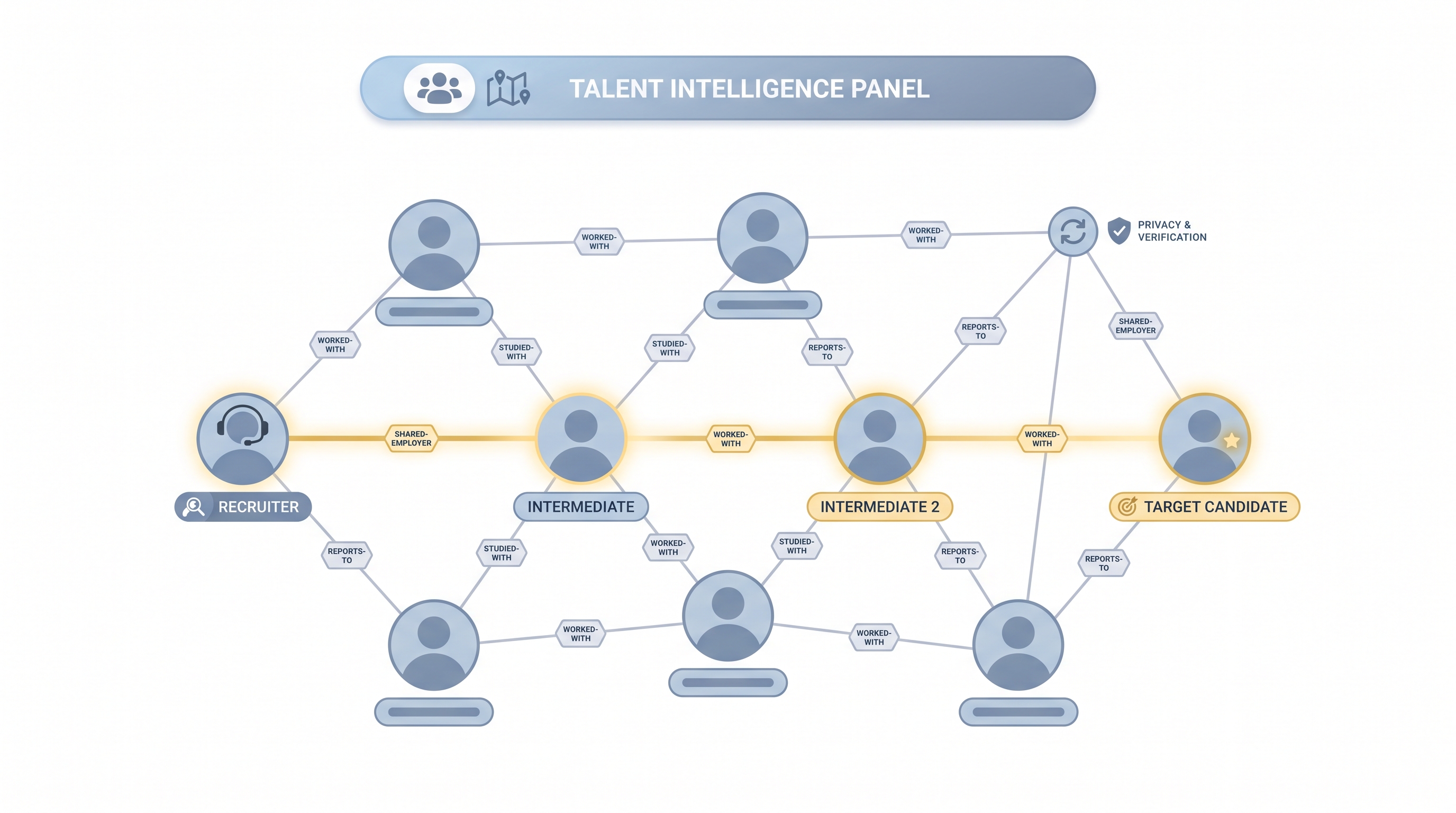
A people graph in recruiting is a data model that represents people as nodes and their attributes and relationships, such as who they worked with, where they studied, their skills, and their employers, as connected edges, so a recruiter can query relationships and paths between people rather than just matching isolated records.
Michal Juhas · Last reviewed June 29, 2026
What is a people graph in recruiting?
A people graph in recruiting stores information about people as a network instead of a flat list. Each person is a node, and the things that connect them, shared employers, schools, projects, skills, managers, and referrals, are edges. Where a spreadsheet or talent CRM treats each candidate as an isolated record, the graph treats the connections between candidates as data in their own right.
That difference matters because the most valuable sourcing questions are about relationships. Who do we already know who could introduce us to this person. Who worked with this hiring manager before. Who else came from the team that just got acquired. These are multi-hop questions, and a graph is built to traverse them quickly, while a row-and-column database has to grind through expensive joins to answer the same thing.
People graphs usually live underneath a product rather than in a recruiter's hands directly. They power the warm-path, similar-people, and team-mapping features of many talent intelligence platforms and sourcing tools. Their power depends entirely on data quality: a graph built on stale edges and bad entity resolution produces confident, wrong connections, so accuracy and refresh discipline matter as much as the structure itself.
In practice
- A recruiter searching for a hard-to-reach executive uses a tool's people-graph feature to find a warm path: a current employee worked with the target two companies ago. The intro request goes through that connection instead of a cold message, and the response rate is far higher.
- A sourcing team maps a competitor's engineering org through collaboration and reporting edges, identifying not just individuals but the clusters of people who tend to move together after a reorganization.
- A platform uses AI to keep the graph fresh, extracting new roles and relationships from updated profiles and resolving duplicate records. A recruiter still treats a suggested connection as a lead to confirm, because a stale edge can imply a relationship that no longer holds.
Quick read, then how hiring teams use it
This is for sourcers, recruiters, and TA leaders evaluating relationship-based tooling, who want to know what a people graph adds and where it can mislead. Skim the first section for the idea. Use the second when you are weighing graph features in a platform.
Plain-language summary
- What it means for you: A people graph stores candidates as connected nodes, capturing who worked with whom and shared employers, schools, and skills, so you can find warm paths and hidden connections a flat list would miss.
- How you would use it: Through a tool's features, find an introduction path to a target, surface people similar by background, or map a team, rather than building a graph yourself.
- How to get started: When trialling a sourcing or intelligence tool, test its warm-path and similar-people features on roles you know well, and check whether the connections are accurate and current.
- When it is a good time: When relationships drive your hiring, such as executive search, referrals, or mapping teams that move together, more than keyword matching does.
When you are running live reqs and tools
- What it means for you: The graph's value is the connections, and its risk is bad connections. Treat suggested relationships as leads to verify, not facts, because entity-resolution errors and stale edges are common.
- When it is a good time: When the tool keeps its graph fresh and you can pair it with a vector database for semantic matching and your talent CRM as the system of record.
- How to use it: Use the graph for proximity and intro paths, semantic search for relevance, and the CRM for status and outreach. Confirm a warm path with the connector before relying on it.
- How to get started: Log which graph-sourced introductions actually convert, so you learn where relationship data earns its place versus where plain search is enough.
- What to watch for: Stale edges, wrong record merges, GDPR obligations on storing rich relationship data, and inferred connections that feel intrusive if surfaced bluntly.
Where we talk about this
On AI with Michal live sessions, people graphs come up when participants compare relationship-based sourcing with semantic search and discuss where connection data adds real signal, such as referrals and executive search. The membership community shares experience with graph-backed tools and where their suggested connections hold up or break down.
People graph vs CRM vs vector search
| Layer | Answers | Best for |
|---|---|---|
| People graph | How is this person connected to others | Warm intros, team mapping, referrals |
| Talent CRM | What do we know and where are they in the process | System of record, outreach, status |
| Vector search | Who is semantically similar to this person | Relevance matching across different wording |
Around the web (opinions and rabbit holes)
Third-party creators move fast. Treat these as starting points, not endorsements.
YouTube
- Searches for "talent graph sourcing" and "relationship based recruiting" surface explainers on graph-backed tools and warm-introduction sourcing.
- r/recruiting has threads on referral and relationship sourcing and on the tools that claim to surface connections.
- r/datascience discusses graph databases and entity resolution, the technical backbone of any people graph.
Quora
- Searches for "what is a people graph" and "graph database for recruiting" collect explanations of the model and how it differs from a relational database.
Related on this site
- Glossary: Talent intelligence platform, Talent CRM, Vector database (TA), Talent mapping, Contact enrichment (sourcing), Talent rediscovery
- Lab: AI Sourcing Lab
- Membership: Become a member