Vector database (talent data)
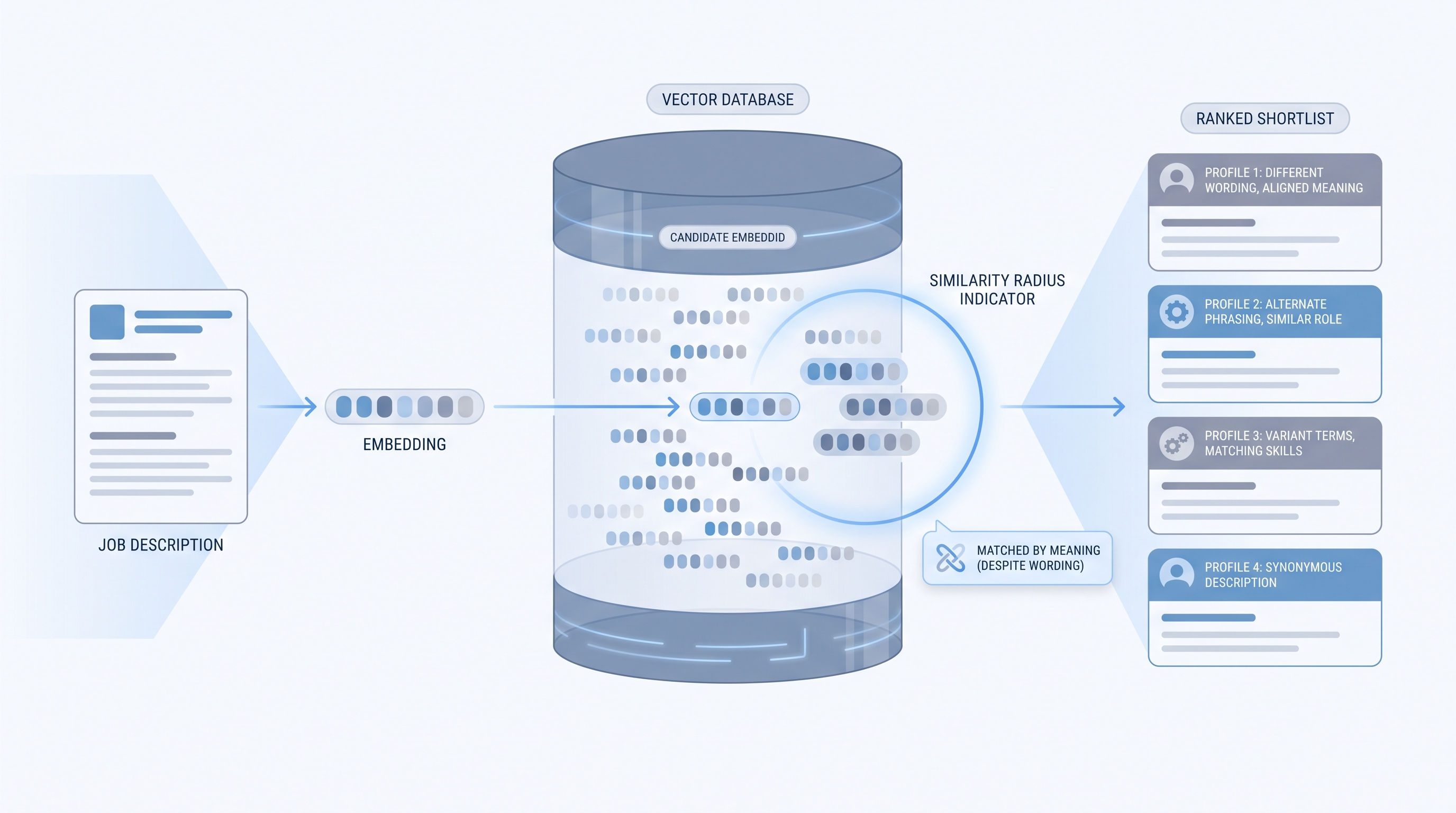
A database that stores candidates and job descriptions as numerical embeddings, enabling similarity search that finds relevant profiles even when the wording in the query differs from the wording in the resume.
Michal Juhas · Last reviewed June 26, 2026
What is a vector database in talent data?
A vector database stores text as embeddings, which are numerical representations of meaning rather than exact words. When a recruiter searches for a job description or candidate profile, the database finds items whose meaning is closest to the query, even if the exact words do not match.
This is the technical layer under most modern AI sourcing tools and talent search products. When a tool surfaces a profile for "site reliability engineering" in response to a query about "platform operations," a vector database is what made that connection possible.
For recruiting teams, this has a practical implication: the quality of the candidate matching depends heavily on the embedding model the vendor is using, not just the size of their database. Understanding the concept helps you ask better questions during procurement and debug unexpected search results.
Vector databases are closely related to semantic search and RAG setups, both of which appear frequently in advanced recruiting AI builds.
In practice
- A sourcing platform uses a vector database to match candidates to job descriptions semantically. A sourcer notices that profiles for "growth engineer" are surfacing for a "data engineering" role. Investigation reveals the embedding model conflates the two because both appear frequently together in startup job ads in the training corpus.
- A TA ops team builds an internal talent pool using an embedding model and a vector database. They can now query "experienced partner-facing recruiter for a fintech expansion" and surface historical candidates who match the intent, not only those who used those exact words in their profiles.
- During a vendor evaluation, a talent data aggregator cannot name the embedding model they use or confirm whether candidate embeddings are stored or generated on-the-fly. The team escalates a GDPR question to legal before signing the contract.
Quick read, then how hiring teams use it
This is for sourcers, TA ops practitioners, and TA leaders who need vocabulary to evaluate AI sourcing tools without getting lost in technical jargon. Skim the first section for the concept. Use the second when you are in a vendor evaluation or debugging why a semantic search is not returning the profiles you expect.
Plain-language summary
- What it means for you: A vector database is how AI sourcing tools find candidates that match the meaning of a job description, not just the exact keywords. It is the mechanism behind "AI candidate matching."
- How you would use it: You query a tool that runs on a vector database the same way you would any search. The difference is you can write the job description as natural language rather than a Boolean string.
- How to get started: Check whether your current ATS or sourcing tool uses semantic search. If it does, try querying with a paragraph describing the role rather than a keyword list and compare the results.
- When it is a good time: Useful whenever keyword-based search is returning too-narrow results or when you are searching across multilingual profiles.
When you are running live reqs and tools
- What it means for you: The embedding model powering a vendor's vector database is a key quality variable. Different models encode technical skills, seniority signals, and non-English text differently.
- When it is a good time: Evaluate this during any new tool procurement and during annual vendor reviews where match quality has degraded.
- How to use it: Ask vendors which embedding model they use, how often embeddings are regenerated (staleness matters for active candidates), and whether GDPR controls exist for stored embeddings.
- How to get started: Run a parallel test: the same search query in your current keyword-based tool versus the semantic tool. Compare precision and recall on profiles you already know are good fits.
- What to watch for: Embedding models that underrepresent non-English text, privacy obligations around stored embeddings under GDPR, and semantic matching being presented as a hiring decision rather than a sourcing shortlist.
Where we talk about this
On AI with Michal live sessions, vector databases and semantic search come up in sourcing automation blocks when participants are evaluating AI matching tools or building their own talent pools. If you want to see how embedding-based search is practically implemented and tested, start at Sourcing Lab.
Around the web (opinions and rabbit holes)
Third-party creators move fast. Treat these as starting points, not endorsements.
YouTube
- Searches for "vector database recruiting" and "embeddings for HR tech" surface developer-oriented tutorials and TA tech explainers on how semantic search works under the hood.
- r/MachineLearning and r/recruiting have intersecting threads on embedding quality, vector search precision, and where the technology breaks down in production pipelines.
Quora
- Searches for "how does AI candidate matching work" and "vector search recruiting tools" collect practitioner answers on the mechanics and limitations of semantic talent search.
Related on this site
- Glossary: Semantic search, RAG, Candidate data enrichment, Proprietary talent pool, AI candidate sourcing
- Lab: AI Sourcing Lab
- Membership: Become a member