Proctoring (online assessments)
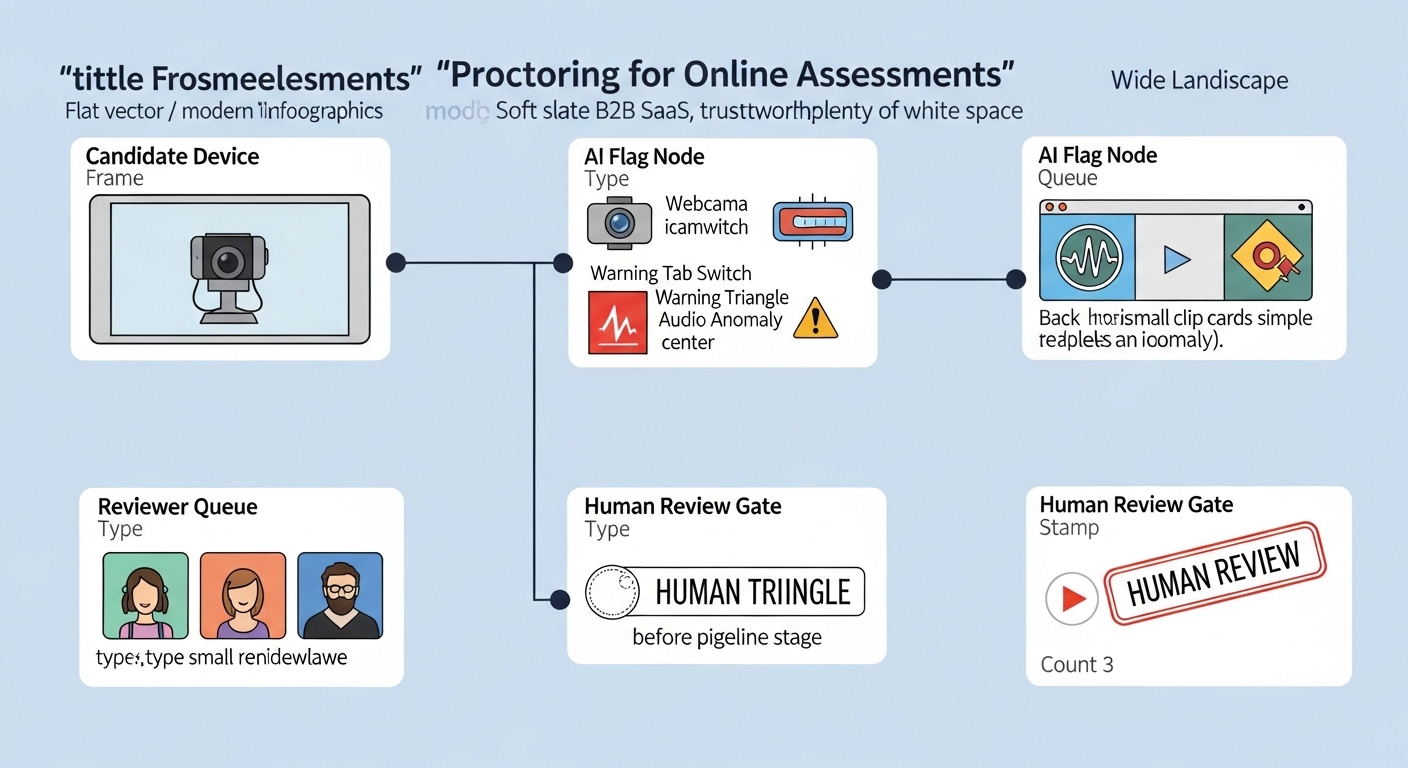
Technology and procedures that verify candidate identity and monitor behaviour during remote hiring assessments, ranging from record-then-review webcam capture to AI-flagged live monitoring.
Michal Juhas · Last reviewed June 8, 2026
What is proctoring (online assessments)?
Proctoring in hiring means using technology to verify who is taking a remote assessment and whether they are taking it without prohibited help. It ranges from passive webcam recording reviewed by a human later to live AI monitoring that can pause or fail a test in real time.
In practice
- A graduate hiring team enables record-and-review on their coding assessment. A human ops coordinator spot-checks flagged sessions before any candidate is disqualified.
- An executive search firm uses a live proctor via video call for a senior leadership psychometric, citing the high cost of a bad hire at VP level.
- A TA leader might say "we turned off AI proctoring" after seeing drop-off rates rise 40 percent on the proctored version of the same test, deciding that candidate completion was more valuable than automated monitoring.
Quick read, then how hiring teams use it
This is for TA leaders, recruiters, and assessment vendors who need to understand the integrity, privacy, and candidate-experience trade-offs before enabling or recommending proctoring. Skim the first section for a shared picture. Use the second when designing an assessment process.
Plain-language summary
- What it means for you: Proctoring records or monitors candidates during an online test to check they are taking it themselves and without prohibited aids. It adds a privacy obligation and can reduce completion rates.
- How you would use it: Enable record-and-review for roles where test integrity matters significantly. Always require a human review of AI flags before any hiring consequence fires.
- How to get started: Check your assessment vendor's proctoring options, confirm they are GDPR-compliant for your jurisdictions, add proctoring disclosure to the candidate pre-assessment notice, and establish who reviews flagged sessions.
- When it is a good time: High-volume roles where the assessment result carries significant weight, certification-adjacent roles, or when past data shows test-sharing is affecting score distributions.
When you are running live reqs and tools
- What it means for you: Proctored test data is personal data under most privacy frameworks, including special-category data if biometric processing is involved. You need a retention schedule, processor agreements, and a deletion workflow as part of your ATS compliance setup.
- When it is a good time: When the assessment result is a primary screening gate. When the role has a genuine test-sharing risk (certifications, high-volume entry roles with widely shared content).
- How to use it: Set record-and-review as the default. Reserve AI-automated flags for human triage, not automatic disqualification. Audit flag rates by candidate group for adverse impact before deployment. Document the lawful basis and retention period in your candidate privacy notice.
- How to get started: Run one month with and without proctoring on the same assessment and compare completion rates, flag rates, and downstream quality at the interview stage.
- What to watch for: Completion rate drops that disproportionately affect candidates with caregiving responsibilities or shared living spaces. AI flag tools that produce inconsistent results across lighting conditions or for neurodivergent candidates. Recordings stored indefinitely without a deletion workflow tied to your data retention schedule.
Where we talk about this
On AI with Michal sessions, proctoring comes up in the AI in recruiting track when discussing how assessment tools integrate with ATS pipelines and what GDPR obligations attach to each step. See AI Recruiting Accelerator for the next live session.
Around the web (opinions and rabbit holes)
Third-party creators move fast. Treat these as starting points, not endorsements.
YouTube
- Search "remote proctoring hiring" for vendor demo comparisons and TA leader commentary; look for practitioner-led reviews rather than vendor marketing where possible.
- The "Talent Acquisition Leaders" podcast (episodes on assessment and fairness) is a useful counterweight to vendor content on proctoring claims.
- r/recruitinghell has extensive candidate feedback on proctored assessments that is useful for understanding how intrusive processes feel from the other side.
- r/humanresources threads on pre-employment testing cover proctoring trade-offs from the practitioner view.
Quora
- Is online proctoring for job assessments effective? collects a range of practitioner and candidate views worth reading before choosing a configuration.
Proctoring options compared
| Type | Intrusiveness | False-positive risk | Candidate experience |
|---|---|---|---|
| Record and review | Low | Low | Acceptable |
| AI-automated flags | Medium | High | Friction |
| Live proctor | High | Low | Highest friction |
Related on this site
- Glossary: Async screening, Adverse impact, Pre-employment assessment test, EU AI Act hiring, GDPR recruiting data
- Guides: Sourcers
- Live cohort: AI Sourcing Lab
- Membership: Become a member