Recruiter capacity planning
Matching recruiter headcount and req load to forecast hiring demand, so no one runs an unsustainable number of open roles while the business misses its hiring plan.
Michal Juhas · Last reviewed June 16, 2026
What is recruiter capacity planning?
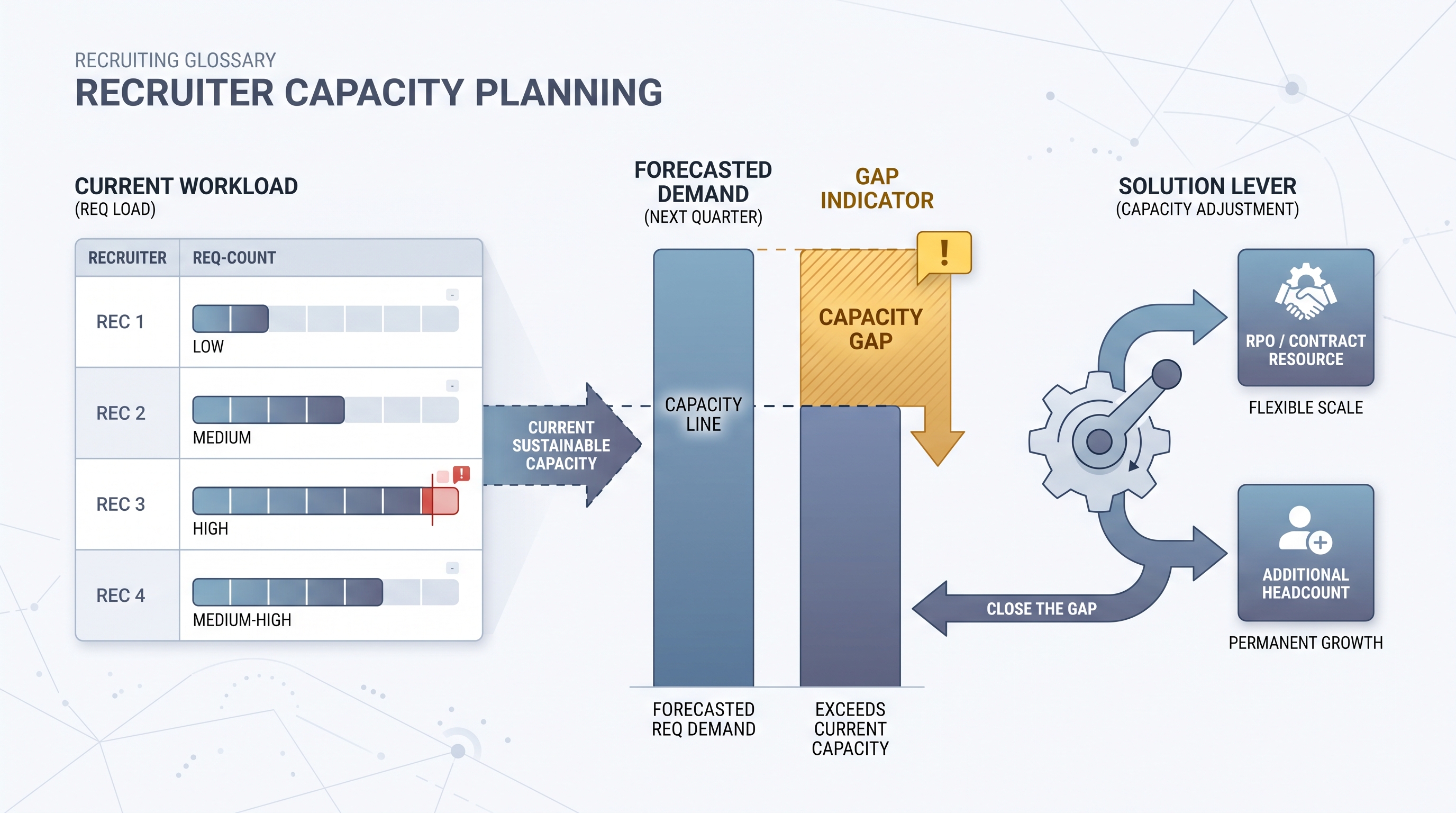
Recruiter capacity planning is the process of matching the number of open requisitions to the recruiter bandwidth available to work them. When done well, it prevents individual recruiters from carrying unsustainable loads, surfaces staffing gaps before they become a hiring plan miss, and gives TA leaders the data to make a headcount case to finance rather than asking for help after the crisis.
The core variables are req volume, role complexity, and the tools available to each recruiter. A sourcer working a high-volume inbound pipeline can handle more reqs than a full-cycle recruiter doing executive searches. AI tooling changes the equation further, though the impact is real only when the tools are implemented well.
Capacity planning sits at the intersection of headcount planning (what the business needs to hire) and recruiting operations (how TA is structured to deliver it).
In practice
- A TA leader runs a quarterly model in a spreadsheet: each recruiter's current req count, average days-to-close, and next quarter's forecasted new reqs. The model shows three recruiters are already at 90 percent of sustainable load before any new reqs drop.
- After implementing AI-assisted outreach drafting and screening note summarisation, a team of five recruiters handles 12 percent more reqs per quarter with the same headcount and similar time-to-fill numbers.
- At a QBR, a recruiting manager cannot explain why two senior engineering reqs have been open for 90 days. A capacity audit reveals both were assigned to the recruiter with the highest req load on the team, who had been in reactive mode for two months.
Quick read, then how hiring teams use it
This is for TA leaders, recruiting managers, and ops partners who need a shared framework for req load, headcount, and sustainable hiring throughput. Skim the first section when you need a fast shared definition. Use the second when you are building a model, presenting to finance, or diagnosing why the team is stretched.
Plain-language summary
- What it means for you: Capacity planning is how you make the case for more recruiter headcount, or prove that AI tools are buying back time, or explain why a hiring target is not realistic at current staffing.
- How you would use it: Track req count per recruiter every week. Compare to a target ratio for each role type. Flag when anyone consistently exceeds the target for more than two weeks.
- How to get started: Build a simple spreadsheet: recruiter name, open req count, role type mix, average days-to-close. Update it weekly. Present it at your team meeting so the whole group can see load distribution.
- When it is a good time: Before every headcount planning cycle, and whenever a recruiter flags that they are overwhelmed.
When you are running live reqs and tools
- What it means for you: A capacity model connects your current req load to your hiring forecast, so you know three months in advance whether you need additional resources.
- When it is a good time: Build and run the model quarterly. Review it monthly. Update it immediately when a large new req batch drops or when a recruiter leaves.
- How to use it: Segment reqs by role family and complexity level. Set sustainable ratio targets for each segment (for example, five to eight technical reqs per recruiter, twelve to fifteen operations reqs). Calculate the required FTE given next quarter's forecast and compare to current FTE. Use the gap as your budget ask.
- How to get started: Pull the last quarter's req and days-to-close data from your ATS. Calculate each recruiter's average load. That baseline is more defensible in a finance conversation than an industry benchmark you found online.
- What to watch for: Req hoarding (recruiters who keep reqs assigned to them even when inactive), role complexity being undercounted in the model, and AI tool adoption being assumed rather than measured.
Where we talk about this
On AI with Michal live sessions, recruiter capacity and the impact of AI on recruiter throughput comes up in AI in recruiting blocks when participants are measuring ROI on tools and building the case for their TA budget. The membership community includes TA ops practitioners who have shared real capacity models for benchmarking.
Around the web (opinions and rabbit holes)
Third-party creators move fast. Treat these as starting points, not endorsements.
YouTube
- Searches for "recruiter req load" and "TA capacity planning" on YouTube surface a mix of vendor webinars and practitioner talks on how teams model recruiter bandwidth.
- r/recruiting has candid threads on req load pressure, what sustainable looks like by role type, and how recruiters advocate for themselves when overloaded.
- r/TA includes TA ops practitioners sharing spreadsheet models and discussing how to present capacity data to finance.
Quora
- Searches for "how many reqs should a recruiter have" on Quora collect a range of practitioner answers worth filtering by industry and role type before drawing conclusions.
Related on this site
- Glossary: Headcount planning, Recruiting operations, Recruiter activity reporting, Weekly hiring funnel report, Talent acquisition metrics, RPO
- Lab: AI Sourcing Lab
- Membership: Become a member