Recruitment process outsourcing (RPO)
A model where an external provider takes over part or all of a company's recruitment function, providing people, process, and technology under a service level agreement, typically on a cost-per-hire or retained basis.
Michal Juhas · Last reviewed June 13, 2026
What is recruitment process outsourcing (RPO)?
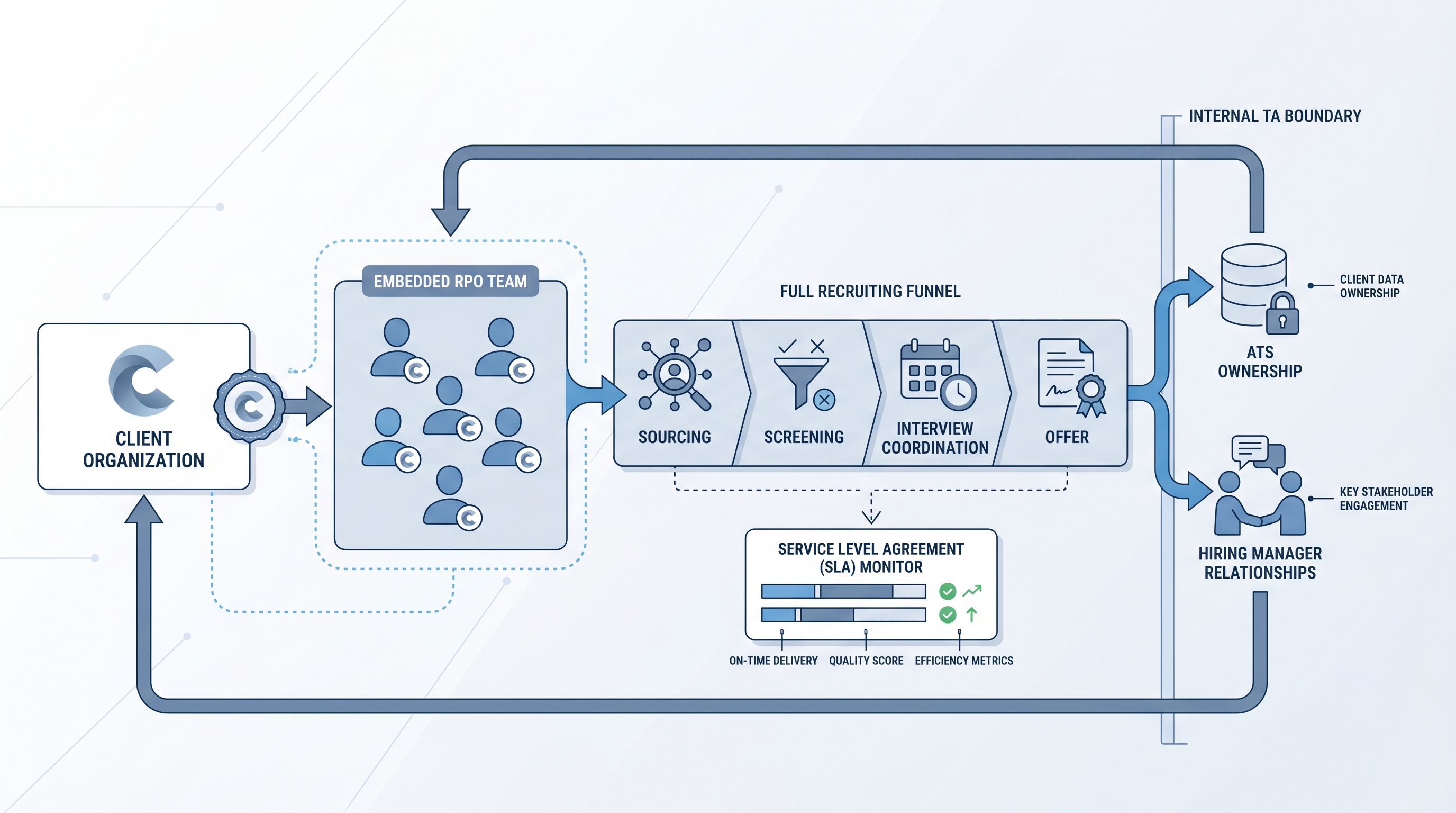
Recruitment process outsourcing is when a company contracts an external provider to operate some or all of its hiring function. The provider uses the company's brand, ATS, and process, and is paid under a service agreement rather than per-placement. They act as an extension of your talent acquisition team, not as a vendor filling one-off roles.
In practice
- A fintech scale-up growing from 80 to 300 employees in 18 months brings in an RPO provider to own sourcing, screening, and interview coordination across all technical and commercial roles while two internal recruiters focus on executive and culture-sensitive hires.
- A retailer with seasonal hiring spikes uses a selective RPO arrangement to outsource high-volume store associate recruiting between March and August, then ramps the provider back down when the season ends.
- A CPO might say "we are running an RPO motion" to mean the company is using outsourced recruiters under their brand rather than posting roles on job boards or using contingency agencies.
Quick read, then how hiring teams use it
This is for HR leaders, CPOs, and TA leaders evaluating whether to outsource part or all of their recruitment function. Skim the first section for a shared definition. Use the second when evaluating provider options or structuring a contract.
Plain-language summary
- What it means for you: An external team runs your hiring process under your brand and SLA. You pay for capacity and outcomes, not headcount.
- How you would use it: Define which roles or stages to outsource, agree an SLA with measurable output targets, retain ATS ownership and data portability rights, and keep an internal owner for hiring manager relationships.
- How to get started: Calculate your current cost-per-hire and time-to-fill by role type. Request proposals from two or three RPO providers for the same scope. Compare against the all-in cost of the equivalent internal team including benefits, tools, and management overhead.
- When it is a good time: High-volume growth phases, geographic expansion, or a restructure that requires rapid TA scale-up or scale-down.
When you are running live reqs and tools
- What it means for you: RPO affects your ATS configuration, sourcing tool access, interview coordination workflows, and employer brand. The provider needs system access and process documentation to be effective; without those, you pay for a team that spends its first month rebuilding institutional knowledge.
- When it is a good time: After internal process documentation is solid. If your ATS workflow is undocumented and your JDs are inconsistent, RPO onboarding takes longer and produces worse results than if you hand over a clean operating model.
- How to use it: Define who owns each decision point in the hiring process (hiring manager, RPO recruiter, internal TA lead). Agree escalation paths for offers above a certain level or roles with sensitive scope. Run a weekly scorecard review against SLA metrics rather than waiting for monthly reports.
- How to get started: Pilot with one role type or one geography before committing to full RPO. Define your success metrics for the pilot, run it for 90 days, and use the data to decide whether to expand or adjust.
- What to watch for: Provider recruiters who do not know enough about your culture or product to represent the employer brand convincingly. SLAs that focus on activity metrics (CVs submitted) rather than outcome metrics (offers accepted). Contracts with no data portability clause.
Where we talk about this
On AI with Michal sessions, RPO comes up in the AI in recruiting track when discussing how workflow automation and AI tools change what an RPO provider can deliver efficiently, and how to evaluate whether provider-managed sourcing is producing pipeline that feeds your ATS effectively. See AI Sourcing Lab for the next live session.
Around the web (opinions and rabbit holes)
Third-party creators move fast. Treat these as starting points, not endorsements.
YouTube
- Search "recruitment process outsourcing explained" for overview content; the RPOA (Recruitment Process Outsourcing Association) publishes vendor-neutral educational material worth starting with.
- Podcast episodes from HR Leaders and Talent Acquisition Leaders on YouTube cover RPO buyer-side perspectives worth watching before you draft an RFP.
- r/humanresources has honest threads on RPO experiences including failed engagements, which are more useful than vendor case studies.
- r/recruiting includes recruiter perspectives on working for RPO providers, helpful context for understanding provider team dynamics.
Quora
- What is the difference between RPO and a staffing agency? collects practitioner answers worth reading before framing your own evaluation.
RPO model comparison
| Model | Scope | Cost structure | Internal control |
|---|---|---|---|
| Full RPO | End-to-end TA | Retainer or cost-per-hire | Low |
| Selective RPO | One stage or role type | Volume-banded | Medium |
| Staffing agency | Single role | Per-placement fee | High |
| Contract recruiter | Embedded individual | Day rate | High |
Related on this site
- Glossary: Workflow automation, Talent acquisition, Headcount planning, MSP workforce, Quality of hire
- Blog: AI sourcing tools for recruiters
- Guides: Sourcers
- Live cohort: AI Recruiting Accelerator
- Membership: Become a member