Quality of hire
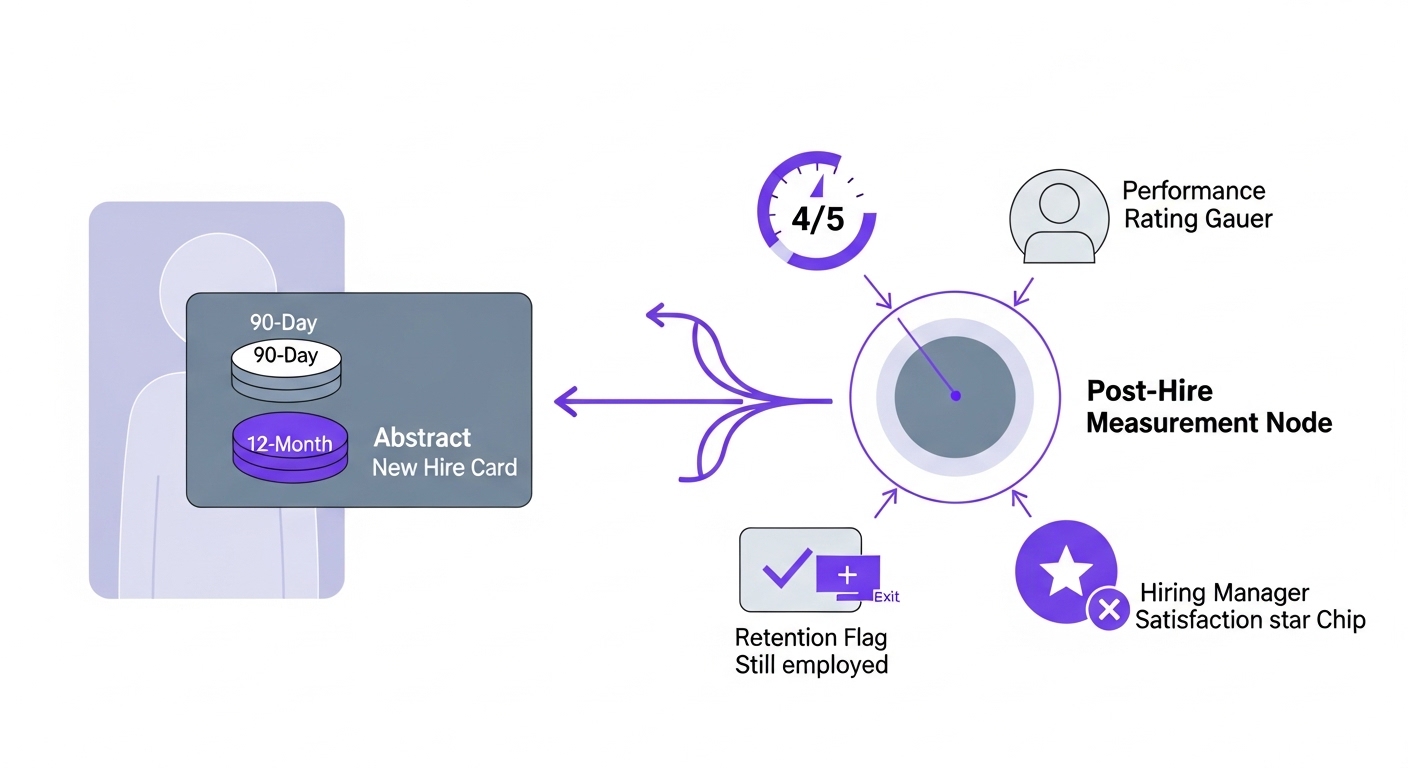
A composite metric measuring how well new employees perform and fit relative to expectations set during the recruiting process, typically combining performance ratings, retention, and hiring manager satisfaction at 90 days and one year.
Michal Juhas · Last reviewed May 31, 2026
What is quality of hire?
Quality of hire measures how well the people you hire actually perform and stay, relative to what you said you were hiring for. It is a composite score, not a single number, and the most common version combines performance rating at 90 days or one year, retention at 12 months, and hiring manager satisfaction shortly after start. The formula only means something if you agreed on it before the search began.
In practice
- A TA director at a 500-person SaaS company ran a quality of hire analysis for the first time and found that engineering hires sourced through employee referrals had 90-day performance ratings 14 percentage points higher than hires from job boards. They shifted sourcing budget toward referral activation and saw the gap narrow.
- A recruiter who tracks quality of hire describes the 90-day check-in as "the fastest feedback loop I have." Asking the HM: "On the criteria we defined together, how is she tracking?" takes five minutes and tells the recruiter more than any metric dashboard.
- In live sessions, the common blocker is data access: TA owns the ATS but not the HRIS where performance ratings live. Building a quality of hire metric requires a conversation with HR data or People Analytics that most recruiting teams have never had.
Quick read, then how hiring teams use it
This is for recruiters, sourcers, TA, and HR partners who need the same vocabulary in debriefs, vendor calls, and leadership reporting. Skim the first section when you need a fast shared picture. Use the second when you are deciding how to build quality of hire measurement for your team.
Plain-language summary
- What it means for you: Quality of hire answers the question: were the people we hired good? Not "did we fill the req" or "were they available," but "did they perform, stay, and meet what the role needed?"
- How you would use it: Pick three criteria that define success in a specific role before you open it. Ask the HM to rate the new hire against those criteria at 90 days. Log the score. That is your starting data set.
- How to get started: Do not wait for a perfect data infrastructure. Start with a simple 1-to-5 rating on three pre-agreed criteria, collected from hiring managers at 90 days via a short survey. Five hires is enough to start seeing patterns.
- When it is a good time: After any higher-volume hiring sprint, when you have enough data to compare channels and sourcing approaches against outcomes, not during active sourcing.
When you are running live reqs and tools
- What it means for you: Quality of hire is the metric that converts recruiting from a cost centre to a value conversation with finance and HR leadership. When you can show which sourcing channels produce hires who stay and perform, you can defend sourcing budget with data rather than instinct.
- When it is a good time: Build the measurement infrastructure during a slower period, not during a hiring sprint. The data collection is upstream: you need to define success criteria before the search, not after the hire starts.
- How to use it: Connect your ATS offer stage to a post-hire survey trigger at 90 days. Route the results to a shared tracker. Segment by source, role type, and recruiting team. Review quarterly. See talent acquisition metrics for the broader dashboard context.
- How to get started: Build a one-page data brief for your HR data or People Analytics partner explaining what you need: new hire ID, start date, 90-day performance rating, 12-month retention. Most HRIS systems can produce this. The conversation to have it shared is the first step.
- What to watch for: Defining quality of hire retrospectively after a bad hire. Using it as a recruiter performance metric without accounting for factors outside the recruiter's control (manager quality, onboarding, team stability). Comparing quality of hire across role types without adjusting for different success definitions.
Where we talk about this
On AI with Michal live sessions, quality of hire comes up in the metrics blocks of the AI in recruiting track, where teams connect recruiting decisions to post-hire outcomes using structured data from the ATS and HRIS. If you want to build a quality of hire dashboard for your team and need to know which data sources to connect and how to present it, start at AI Sourcing Lab.
Around the web (opinions and rabbit holes)
Third-party creators move fast. Treat these as starting points, not endorsements, and double-check anything before you wire candidate data.
YouTube
- Search "quality of hire recruiting metrics" on YouTube for TA thought leaders and HR analytics practitioners who walk through formula design and data collection approaches for teams without dedicated analytics support.
- LinkedIn Talent Solutions' official channel has published content on quality of hire measurement that covers the three-component model and common mistakes in formula design.
- r/humanresources threads on quality of hire reveal how differently companies define and weight the components, useful for calibrating your own formula.
- r/recruiting has practitioner threads on the data access problem (TA versus HRIS) and how recruiters have resolved it in different company sizes.
Quora
- Searching "how to measure quality of hire" on Quora surfaces answers from practitioners and consultants covering both simple and sophisticated approaches, with specific formula examples.
Related on this site
- Glossary: Talent acquisition metrics, Scorecard, Calibration session, Time to fill, Structured output, Hiring funnel conversion rates
- Blog: AI sourcing tools for recruiters
- Guides: Sourcers
- Live cohort: AI Recruiting Accelerator
- Membership: Become a member