Skills gap analysis in recruiting
Comparing the skills a team currently holds against those a role or business roadmap requires, then using that gap to prioritize sourcing, training investment, or organizational design decisions.
Michal Juhas · Last reviewed May 29, 2026
What is skills gap analysis in recruiting?
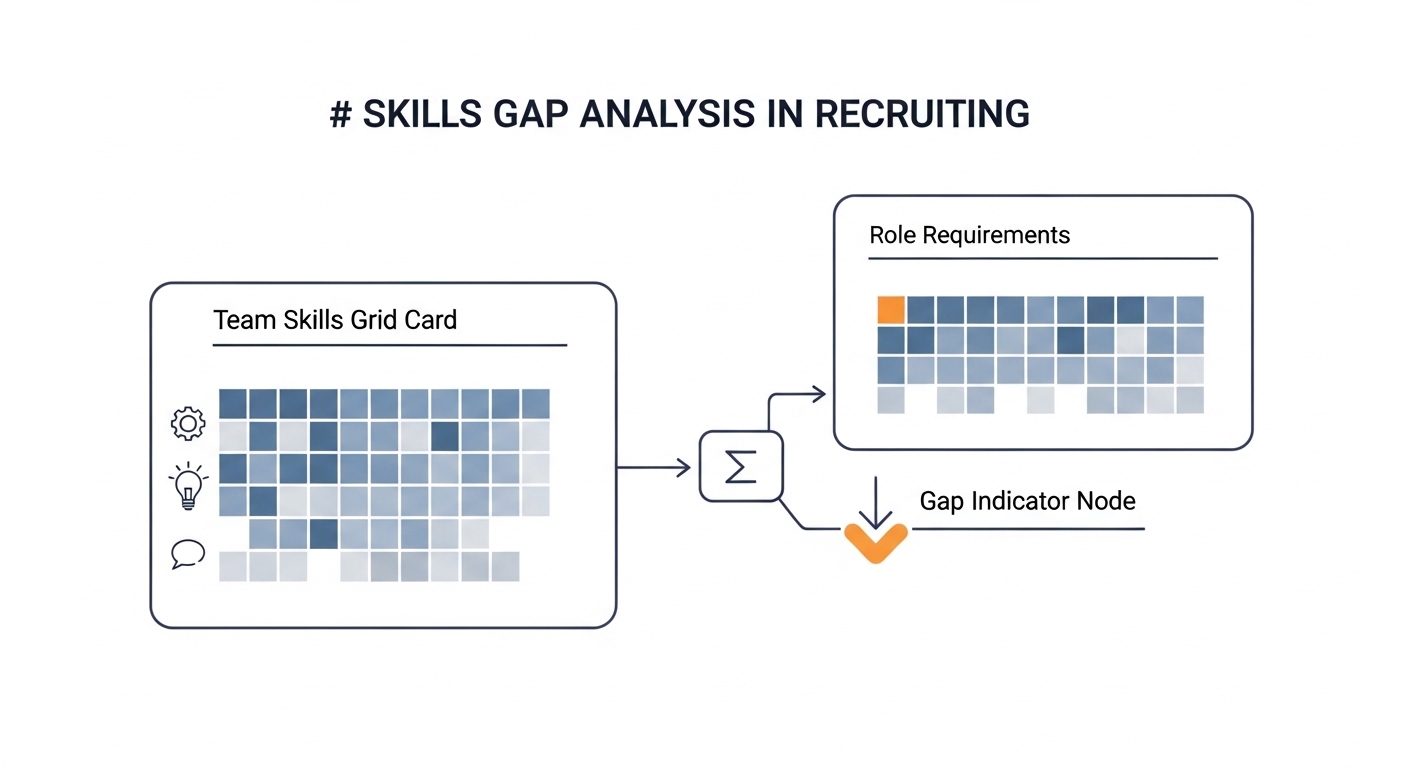
Skills gap analysis in recruiting is the structured process of mapping the capabilities a team currently holds against the capabilities a role, project, or business roadmap requires, then using the identified gap to decide whether to hire, retrain, restructure, or contract.
It answers a question that most sourcing processes skip: is hiring actually the right response to this gap? In many teams, the answer is yes. In more teams than most admit, a targeted training investment or an internal mobility move would close the gap faster and at lower cost than an external hire.
In practice
- A TA partner sits down with an engineering manager before a req is approved, maps current team skills in a spreadsheet, compares them to the roadmap requirements for the next two quarters, and surfaces that one skill gap can be closed by upskilling an existing team member, removing the need for one of three planned hires.
- A sourcing team discovers through a gap analysis that the skill they have been unable to hire for does not appear in candidate profiles because the industry uses a different term for it, which immediately improves search yield when they update the Boolean string.
- A TA leader uses a quarterly skills gap review to flag to HR leadership that three teams are hiring for the same capability in parallel, creating a case for a shared hire or an internal transfer instead.
Quick read, then how hiring teams use it
This is for recruiters, TA partners, and HRBPs who participate in intake conversations, workforce planning sessions, or headcount reviews. Skim the first section for shared vocabulary. Use the second when you are deciding how to structure a gap analysis before a search opens.
Plain-language summary
- What it means for you: Before a req opens, someone checks whether the team actually needs a new hire or whether the gap can be closed another way, saving sourcing time and budget.
- How you would use it: In the intake call, ask the hiring manager which specific skills are missing and which team members could grow into them. Document the answer before agreeing to open a search.
- How to get started: For your next intake call, add two questions: "Which three skills does the team most need?" and "Is there anyone internally who could develop in this direction?" Use the answers to frame the req scope.
- When it is a good time: At every intake, and at quarterly headcount planning when leaders request additional FTEs.
When you are running live reqs and tools
- What it means for you: A skills gap analysis makes your Boolean strings and sourcing criteria more precise because you know exactly which capabilities to prioritize rather than searching for a generic role title.
- When it is a good time: Before any search opens, especially for technical roles where skill overlap between similar titles is high and where the difference between what the team has and what it needs is narrow.
- How to use it: Extract required skills from the JD using resume parsing or a model. Compare against a summary of current team profiles. Rank the gaps by criticality and use the top three to anchor your sourcing criteria.
- How to get started: Build a standard gap analysis template with three sections: skills the team has, skills the roadmap needs, and the delta ranked by urgency. Use it in every intake for roles above a certain level or complexity.
- What to watch for: Skills gap analysis is only as good as the team profile data feeding it. If manager input is optimistic or current employee profiles are outdated, the gap assessment will be wrong. Validate against actual work output and project history, not self-reported skills.
Where we talk about this
On AI with Michal live sessions, skills gap analysis comes up in the strategy layer of AI in recruiting sessions, where we examine what AI can help identify versus what requires human judgment about team structure and business context. The goal is to make intake conversations more precise before sourcing starts. Start at Recruiting OS and bring real req examples from your current pipeline.
Around the web (opinions and rabbit holes)
Third-party creators move fast. Treat these as starting points, not endorsements.
YouTube
- Search for "skills gap analysis HR template" or "workforce planning skills matrix" on YouTube for practitioner walkthroughs of how teams structure gap analysis in spreadsheets before moving to dedicated platforms.
- SHRM and ATD publish webinars on skills-based hiring and workforce planning that cover the gap analysis methodology in depth, often with case studies from mid-size to enterprise teams.
- r/humanresources has threads on how HR teams run skills gap analysis with and without dedicated tools, including honest discussions of where the process breaks down.
- r/recruiting covers the recruiter-side experience of intake conversations where skills are poorly defined and how to surface the actual gap rather than the stated req.
Quora
- Searches for "how to do a skills gap analysis for a team" or "skills gap recruiting strategy" surface practitioner answers that vary significantly by company size and whether a dedicated L&D function is involved.
Related on this site
- Glossary: Talent intelligence, Ideal candidate profile sourcing, Competency framework, Headcount planning, Boolean search
- Blog: AI sourcing tools for recruiters
- Live cohort: Recruiting OS
- Membership: Become a member