Source of hire analytics
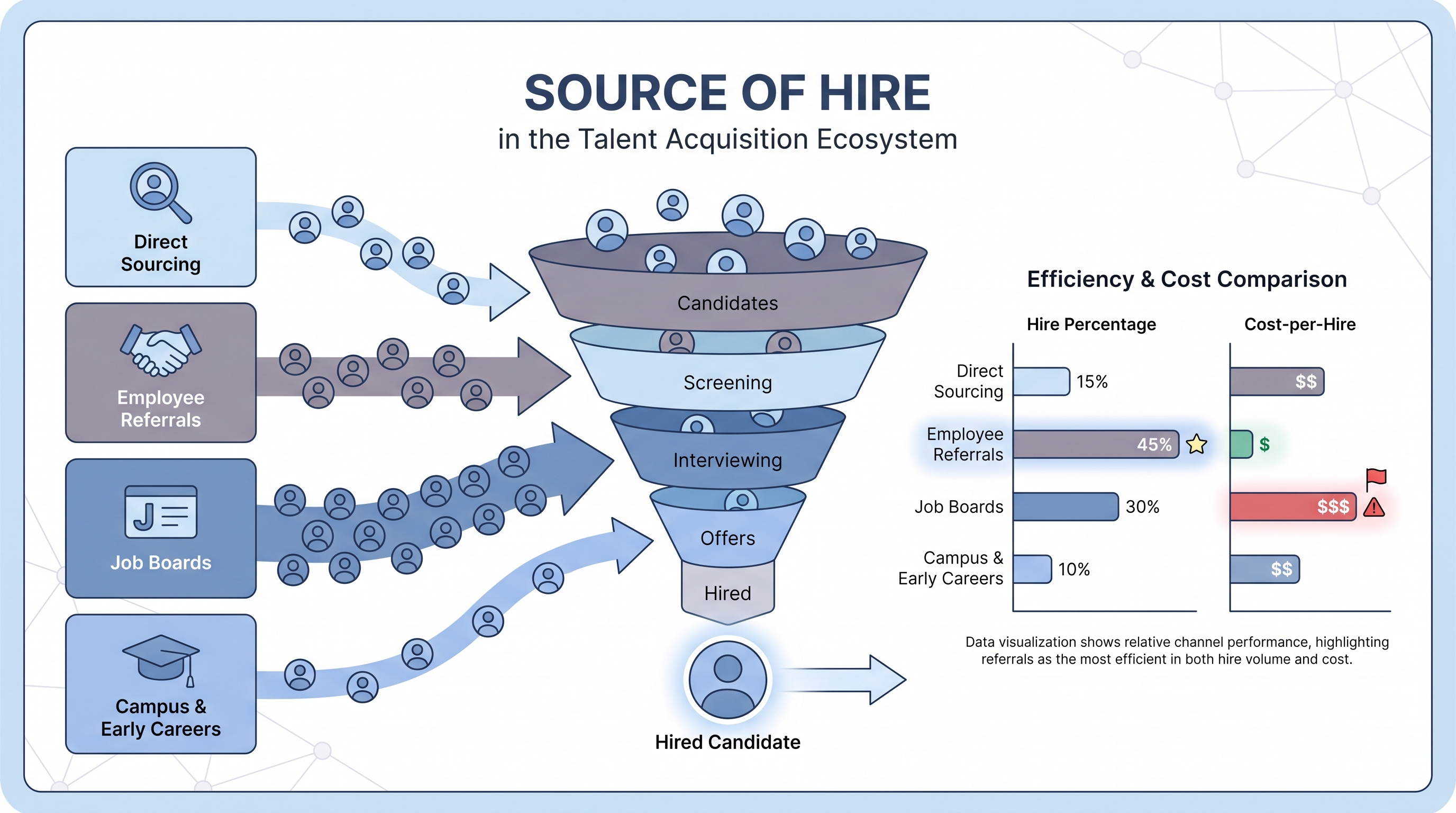
Tracking where each hired candidate first entered the pipeline, from job boards to referrals to direct sourcing, so TA teams can allocate budget to channels that produce quality hires, not just volume.
Michal Juhas · Last reviewed June 21, 2026
What is source of hire?
Source of hire is the label you attach to a hired candidate that records which channel first brought them into your pipeline. It is retrospective and intentional: for every closed requisition, you look back at each hire and answer the question, "Where did this person come from?"
The answer drives budget. If employee referrals produce 30 percent of hires at one-third the cost per hire of job boards, referrals deserve more investment. If a premium sourcing tool produces three hires a quarter at a cost that would fund two months of a junior sourcer's salary, the math needs to be visible before renewal.
In practice
- A TA ops lead runs a quarterly source of hire report and discovers that 60 percent of hires are tagged "careers site" in the ATS. She suspects misattribution. She cross-references ATS creation logs and finds that 40 percent of those careers site hires were originally sourced via LinkedIn Recruiter but never tagged. She makes source a required field on candidate creation and retags historical records where evidence exists.
- A head of talent presents a source of hire breakdown to the CFO to justify cutting the job board budget by 30 percent. The data shows that job boards produce 35 percent of applications but only 12 percent of hires, at the highest cost-per-hire of any channel. The CFO approves the reallocation.
- A sourcer notices a referral programme bonus was paused in Q2. She pulls source of hire data and shows that referral hires fell from 28 percent to 9 percent in the same quarter, while agency spend rose to fill the gap. The bonus is reinstated.
Quick read, then how hiring teams use it
This is for TA ops professionals, recruiting managers, and TA leaders who own sourcing budget decisions and need data to back them up. Skim the first section for the vocabulary. Use the second when you are building or auditing your source of hire tracking setup.
Plain-language summary
- What it means for you: Source of hire tells you which channels produce hires versus which ones produce applicant volume that wastes screening time. The two are rarely the same.
- How you would use it: Run a channel-level breakdown quarterly: volume, cost per hire, quality score. Shift budget away from high-volume-low-quality sources toward low-cost-high-quality ones.
- How to get started: Export every hire from the past 12 months with their ATS source tag. Calculate cost per hire per channel. Flag channels with zero or suspicious tagging for an attribution audit.
- When it is a good time: Before any job board or sourcing tool renewal, before the annual budget planning cycle, and after any major change to your recruiting process (new ATS, new sourcing tool, referral programme change).
When you are running live reqs and tools
- What it means for you: At scale, source of hire data is only as good as your tagging discipline. One missing source tag per 10 candidates produces material misattribution at the end of a year.
- When it is a good time: At the start of every candidate record creation, during weekly sourcing reviews, and at every monthly TA ops meeting.
- How to use it: Make source a required field in your ATS. Create a named source option for every tool in your tech stack. Build a monthly report that flags incomplete tagging by recruiter. Use it to spot both attribution gaps and tool-level performance.
- How to get started: Audit source tagging completeness for the last 90 days. Identify the three most common missing-tag scenarios. Fix them with a required field or an automation that pre-fills source from the outreach channel record.
- What to watch for: Multi-touch attribution conflicts. If your programmatic advertising team credits last-click and your sourcing team credits first-touch, the numbers will not reconcile. Pick a convention, document it, and apply it consistently year-over-year.
Where we talk about this
On AI with Michal sessions, source of hire tracking comes up when teams evaluate which AI sourcing tools are actually moving the needle. If you want to build a channel attribution model for your own TA function and connect it to budget decisions, bring your current data to an AI Recruiting Accelerator.
Around the web (opinions and rabbit holes)
Third-party creators move fast. Treat these as starting points, not endorsements, and do not copy stranger scripts that move candidate data.
YouTube
- Search "source of hire reporting" on YouTube for ATS vendor tutorials from Greenhouse, Lever, and Workday on setting up source tracking in each system.
- "Recruiting metrics that matter" talks from ERE and SHRM on YouTube often include source of hire as a foundational metric alongside time to fill and cost per hire.
- r/recruiting has several threads on "ATS source tracking" where practitioners share what breaks in each system and how they fixed it.
- r/humanresources threads on "recruiting ROI" include source of hire attribution debates between teams using first-touch versus multi-touch models.
Quora
- How do you track source of hire accurately? collects practitioner answers on ATS setup, tagging conventions, and common misattribution scenarios.
Related on this site
- Glossary: Sourcing ROI, Candidate pipeline health, Programmatic job advertising, Candidate data enrichment, Workflow automation, Time to fill
- Blog: AI sourcing tools for recruiters
- Live cohort: AI Sourcing Lab
- Course: Starting with AI: the foundations in recruiting
- Membership: Become a member