Split placement fees in recruitment agencies
A split placement fee is the commission shared between two recruiters or agencies when one holds the client relationship and job order and the other presents the placed candidate, dividing the invoice according to a pre-agreed percentage.
Michal Juhas · Last reviewed May 8, 2026
What is a split placement fee?
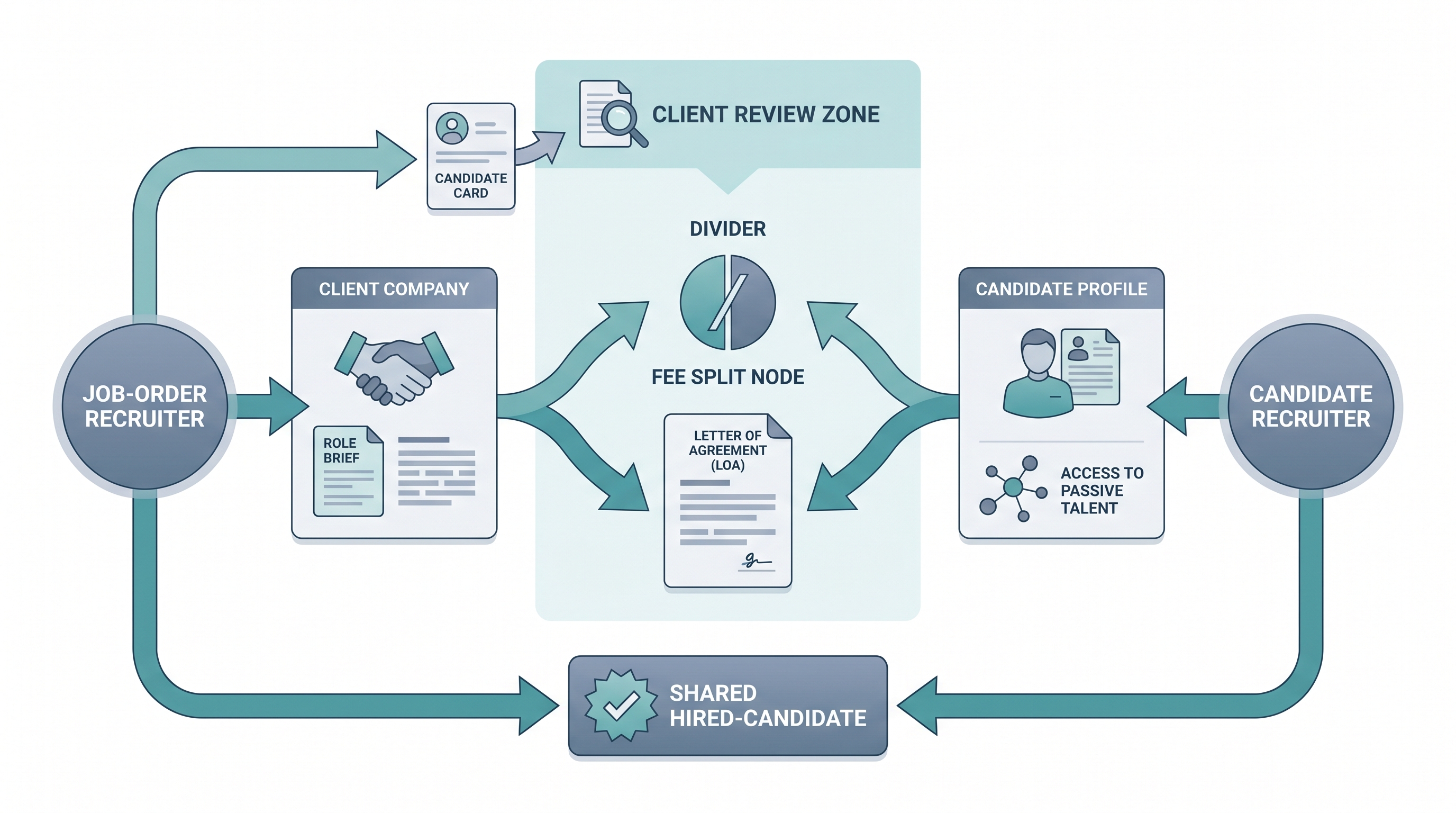
A split placement fee is what two recruiters or agencies share when they collaborate to close a job neither could fill alone. One recruiter holds the client relationship and the job order. The other holds the candidate. When the hire is confirmed and the client pays, the fee splits according to a pre-agreed percentage, most often 50/50.
The arrangement is common in independent recruiter networks where practitioners specialise by function, geography, or seniority band. A tech recruiter in London with a VP Engineering job order and a thin mobile engineering pipeline posts it to a network partner who has deep relationships in that niche. The candidate recruiter presents someone the job-order recruiter could not have surfaced independently, and both walk away with half the fee.
Split placements extend a solo practitioner's reach without requiring them to build expertise in every vertical or hire additional consultants. The tradeoff is coordination cost, shared margin, and the genuine risk of fee disputes if the agreement is not documented before any candidate name is exchanged.
In practice
- A recruiter with a strong Series B SaaS client and a VP of Sales brief that has been open for six months posts the order to a Top Echelon partner who specialises in SaaS revenue leaders. The partner presents a shortlisted candidate within two weeks; the placement closes at a senior-level fee and both recruiters split it 50/50.
- An internal ops review finds that two separate split deals billed at full value in the CRM. Both should have appeared at half value once the partner invoices arrived. The agency now tags every split deal with a custom field and reconciles partner payments monthly.
- A client emails both agencies at once: "We received the same candidate profile from two of your network partners yesterday." No LOA existed. The client now has a fee dispute to referee, the placement is on hold, and both recruiters have damaged their client relationship over a paperwork shortcut that takes fifteen minutes to avoid.
Quick read, then how agency teams use it
This is for agency recruiters, billing managers, and ops leads who need to understand, negotiate, or track split placements without relying on informal network norms. Skim the first section for the vocabulary. Use the second when you are evaluating a specific split opportunity or setting up your CRM to handle these correctly.
Plain-language summary
- What it means for you: A split placement lets you earn on a job order you cannot fill solo by partnering with another recruiter who has the right candidate, and vice versa. You share the fee; the client gets a faster, better-matched hire.
- How you would use it: Post your open job orders to a split network when your candidate pipeline for that specialism is thin. Present your strongest passive candidates to network partners who hold relevant job orders. Always sign an LOA before any name changes hands.
- How to get started: Pick one active job order that has been open more than four weeks with no strong pipeline. Search your network for a partner who specialises in that function or geography. Send an LOA and, if accepted, share the job brief before sharing any candidate names.
- When it is a good time: When the role is senior enough that half the fee is still meaningful margin, when your pipeline in that specialism is empty, and when you have a signed LOA in place.
When you are running live reqs and billing
- What it means for you: Split placements require a separate billing workflow. The invoice goes to the client under whoever holds the client contract (usually the job-order recruiter), and the second recruiter must be paid from that receipt. If your CRM does not track this separately, split revenue inflates your gross placement numbers and distorts per-consultant performance reporting.
- When it is a good time: When the full placement fee divided by two still exceeds your margin threshold, when the partner has a track record of prompt payment, and when the client's contract allows third-party candidate sources.
- How to use it: Create a custom deal type in your recruitment agency software tagged as a split. Log the partner name, LOA reference, split percentage, and the payment-pass-through deadline. Set a calendar reminder for thirty days after expected client payment to chase the partner if funds have not arrived.
- How to get started: Review your last twelve months of placements for roles that took more than eight weeks to close or went unfilled. For each one, ask whether a network partner with specialised candidate access would have shortened the cycle. That is your baseline case for joining a split network.
- What to watch for: Candidate ownership ambiguity (always send the LOA before the candidate name), fee reduction disputes after a counteroffer (specify in the LOA how this cascades), client exclusivity clauses that prohibit sub-contractors, and delayed payment chains where the candidate recruiter has no direct recourse with the client if the job-order recruiter pays late.
Where we talk about this
On AI with Michal live sessions, split placements come up in the agency business development and fee structure modules when participants are building out revenue models for independent desks or small agency teams. The retained search vs contingency session gives the broader fee framework context. If you want the full room discussion on how to evaluate a split network, negotiate an LOA, or structure your CRM for mixed solo and split revenue, start at Sourcing Lab and bring your actual billing setup.
Around the web (opinions and rabbit holes)
Third-party perspectives on split placements range from independent recruiter community threads to agency operations guides. Treat these as starting points, not endorsements, and validate any contract language with your legal counsel before applying it to a live deal.
YouTube
- Split Placements Explained for Recruiters covers the basics of how job-order and candidate recruiters divide fees and manage the partner relationship.
- How to Join a Recruiter Split Network walks through the mechanics of network membership, posting job orders, and presenting candidates to partners.
- Recruiter Fee Agreement Templates shows what a letter of agreement typically includes and where deals fall apart without one.
- Split placement experiences in r/recruiting captures practitioner stories about what worked, what caused disputes, and which networks members trust.
- How do split fees work in agency recruiting? in r/RecruitmentAgencies shows real agency operators discussing margin, network membership, and LOA practices.
- Dealing with fee disputes between agencies in r/humanresources captures the client side: what happens when two agencies submit the same candidate and there is no paper trail.
Quora
- What is a split placement in recruiting? collects recruiter and agency operator explanations of the mechanics, common percentages, and how networks facilitate introductions.
Solo placement vs split placement
| Factor | Solo placement | Split placement |
|---|---|---|
| Candidate source | Own pipeline | Partner recruiter |
| Fee received | Full placement fee | Half (or agreed share) |
| Speed to candidate | Depends on own network | Partner may surface faster |
| Coordination overhead | None | LOA, submission log, payment chase |
| Best for | Roles inside your specialism | Roles outside your pipeline depth |
| Risk | Standard delivery risk | Candidate ownership, payment delay |
Related on this site
- Glossary: Retained search vs contingency, Recruitment factoring and cash flow, Agency business development (BD)
- Glossary: Client exclusivity clauses in agency contracts, Preferred supplier list (PSL), Master services agreement for agency services
- Glossary: Recruitment agency software, Agency invoice and payment terms, Recruiter 360 vs 180 desk
- Blog: AI sourcing tools for recruiters
- Workshops: Sourcing Lab
- Course: Starting with AI: the foundations in recruiting
- Membership: Become a member