360 vs 180 desk recruiter models
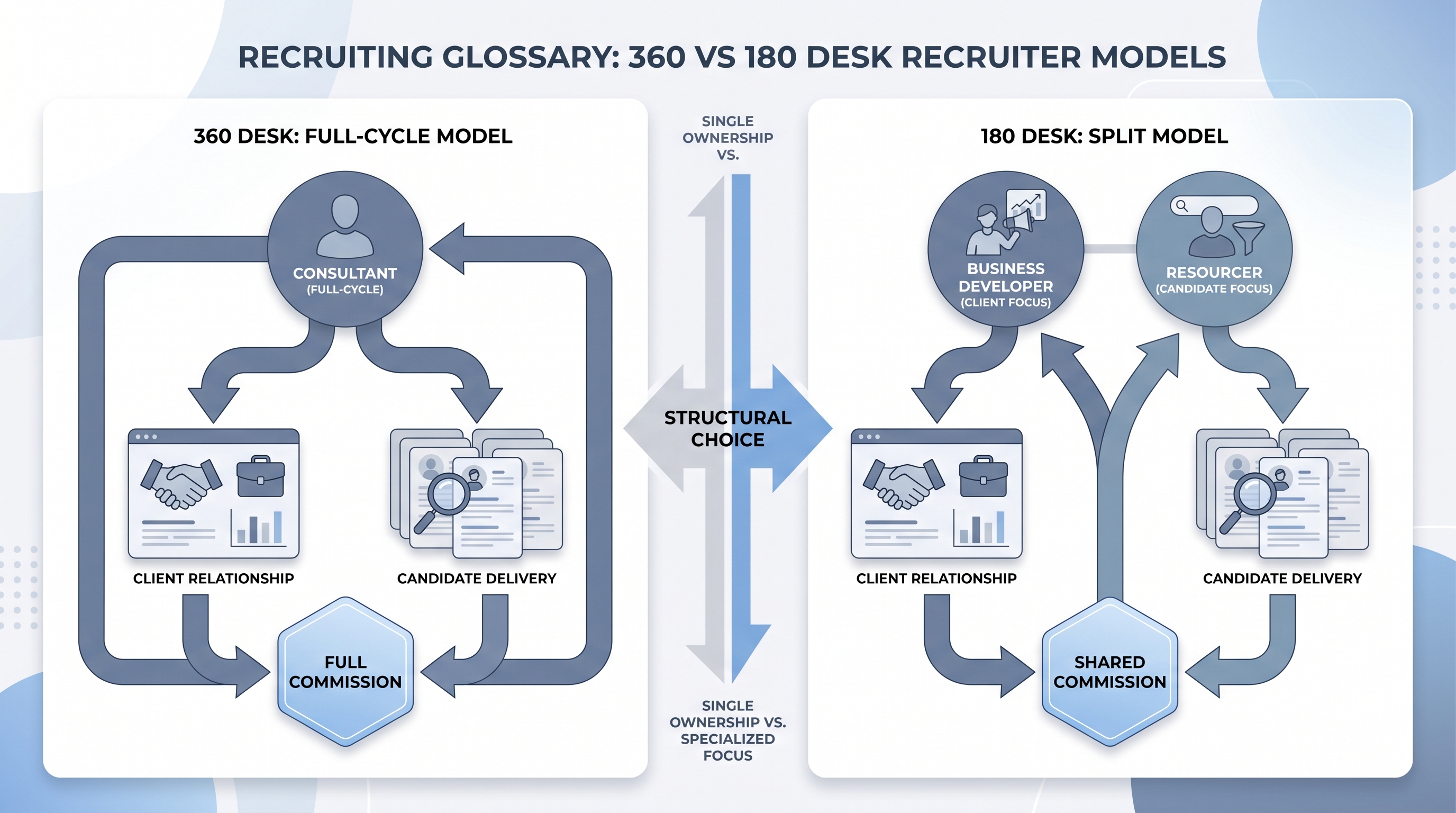
Two models for splitting or combining business development and candidate work inside a recruitment agency. A 360 desk means one recruiter owns the entire cycle from winning the client through placement. A 180 desk splits the functions so a business developer manages clients while a resourcer handles sourcing and delivery.
Michal Juhas · Last reviewed May 8, 2026
What is the difference between a 360 and a 180 desk?
In agency recruiting, the "desk" refers to the scope of work a consultant is accountable for. A 360 desk means full responsibility for the entire cycle: winning the client, defining the brief, sourcing and qualifying candidates, managing the interview process, closing the offer, and maintaining the relationship after placement.
A 180 desk splits that cycle in two. Business developers or account managers own the client side. Resourcers or delivery consultants own the candidate side. Commission and accountability are divided between both roles according to an agreed split.
Most agencies start 360 and evolve toward 180 structures as they grow, though high-billing specialist boutiques often stay 360 because deep market knowledge keeps the full-cycle model viable.
In practice
- A retained search firm placing CFOs often runs 360 desks because the client relationship is personal enough that splitting it would reduce the trust the client places in a single point of contact.
- A high-volume tech staffing agency splits into 180 structures, with dedicated resourcers building shortlists for multiple account managers who each run five or more active client accounts in parallel.
- A recruiter moving from a 360 desk to a 180 agency often describes the shift as "faster but less autonomous": shortlists move quicker, but they can no longer control quality on both sides of the placement.
Quick read, then how hiring teams use it
This is for agency recruiters deciding which model fits their working style, for agency founders thinking about team structure and headcount planning, and for in-house TA leaders who want to understand how the external agency they are working with is organised internally.
Plain-language summary
- What it means for you: 360 means you own the whole deal from client brief to placed candidate. 180 means you own one half, either the client relationship or the candidate delivery.
- How you would use it: If you are choosing between agency roles, 360 gives more autonomy and the full commission rate. 180 gives focused depth in one skill set and a team to share pressure with during busy periods.
- How to get started: Ask any agency you are evaluating where their highest-billing consultants sit on the 360/180 spectrum. The answer signals whether the agency values generalist full-cycle performance or specialist team-based delivery.
- When it is a good time: When reviewing team structure for a growing desk, when onboarding new consultants and deciding where to start their training, or when calibrating an agency partner and wanting to understand their delivery accountability.
When you are running live reqs and tools
- What it means for you: If your agency partner runs a 360 model, one person controls the whole engagement and can make fast calibration decisions. If they run 180, you may need to coordinate with both the account manager and the delivery team to get accurate status updates on live roles.
- When it is a good time: Understanding the structure matters most when negotiating terms, chasing candidate submissions, or recalibrating after a shortlist misses the brief. Knowing who owns what determines who to call.
- How to use it: Build your brief with the account manager on a 180 desk, but verify shortlist criteria directly with the resourcer when providing feedback. The two roles sometimes receive calibration at different fidelity and it is worth confirming both heard the same message.
- How to get started: If you are an agency founder, audit your top three billing consultants: what percentage of their week is BD, what percentage is delivery? If one consistently dominates, your team is already running a de facto split model and formalising it may improve output without adding headcount.
- What to watch for: Commission disputes in 180 models when a resourcer sources a candidate for a client that belongs to a different account manager. Clear desk boundary agreements in writing prevent the majority of internal attribution conflicts before they reach a hiring manager.
Where we talk about this
On AI with Michal live sessions, agency operations and desk structure come up in the context of how AI tools change the BD versus delivery time balance in practice. The Sourcing Lab cohort includes conversations where agency founders and senior consultants share how they are using AI to extend what a single 360 consultant can cover, and where the split into 180 structures still makes sense despite better tooling.
Around the web (opinions and rabbit holes)
Third-party creators cover desk structure from recruiter, agency owner, and team lead perspectives. Treat these as starting points, not endorsements. Commission percentages and structure norms vary by market and agency size.
YouTube
- 360 desk vs 180 desk recruitment explained covers practitioner breakdowns of both models, including day-to-day experience and commission mechanics.
- How to build a recruitment agency team structure walks through when agencies typically make the split decision and how they manage the transition.
- 360 recruiter career advice and working style offers career-side perspectives from recruiters who have worked under both models.
- 360 vs 180 desk in r/RecruitmentAgencies contains frank practitioner comparisons, including which model recruiters prefer and why.
- 360 vs 180 desk discussion in r/recruiting covers recruiters discussing which model to join when evaluating new roles.
- Split desk recruitment model in r/RecruitmentAgencies includes agency owner perspectives on building and managing 180 structures.
Quora
- What is a 360 recruiter? collects definitions and community takes from people who have run both models across different markets and agency sizes.
360 vs 180 desk: a comparison
| Dimension | 360 desk (full-cycle) | 180 desk (split) |
|---|---|---|
| BD responsibility | Recruiter owns full client development | Business developer or account manager role only |
| Delivery responsibility | Recruiter sources and places candidates | Resourcer or delivery consultant role only |
| Commission | Full fee to the recruiter | Fee split between BD and delivery roles |
| Training curve | Longer: must develop both skill sets | Faster: focused on one function at a time |
| Scalability | Limited by one person's capacity | Scales delivery without adding more BD headcount |
| Key risk | BD or delivery neglected when desk is busy | Internal disputes on fee attribution across team boundaries |
Most agencies end up running a hybrid: senior consultants on 360 desks where relationships are personal, with 180 structures deployed for high-volume or less specialist hiring where throughput matters more than individual client depth.
Related on this site
- Glossary: Agency business development, Agency recruiter utilization, Agency vs in-house recruiting
- Glossary: Agency invoice payment terms, Preferred supplier list (PSL), Candidate right to represent
- Glossary: Boolean search, Resume parsing, AI outreach drafting
- Workshops: Sourcing Lab
- Course: Starting with AI: the foundations in recruiting
- Membership: Become a member