Synthetic data for hiring ML
Artificially generated candidate profiles and hiring outcome data used to train, test, or de-bias machine learning models when real candidate data is too small, too sensitive, or too imbalanced to use directly.
Michal Juhas · Last reviewed June 21, 2026
What is synthetic data for hiring ML?
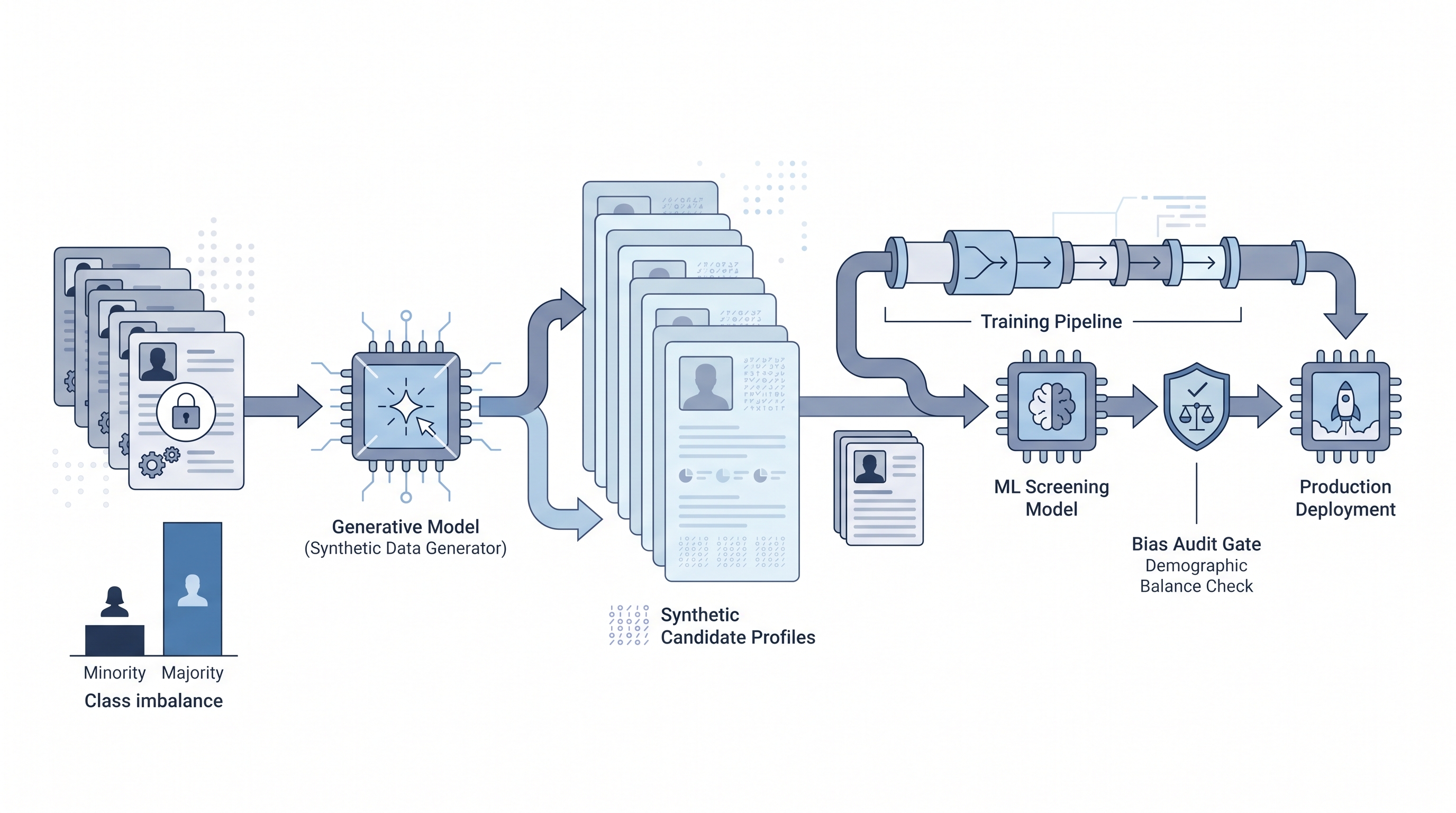
Synthetic data for hiring ML is artificially generated candidate profile and outcome data used to train, test, or re-balance machine learning models in the absence of sufficient real labelled data.
The problem it solves is straightforward: most companies do not make enough hires per role type per year to build a statistically reliable training set from scratch. A company with 300 hires a year spread across 60 job families has too little data per family to train anything beyond a simple heuristic. Synthetic generation creates thousands of plausible training examples by learning patterns from a small real dataset and sampling from them.
In practice
- An HR tech team at a mid-market company wants to build a resume screening model for high-volume contact centre roles. They have 400 real historical hire-or-no-hire decisions, which their data scientist says is insufficient. They use a synthetic data generator to produce 8,000 additional examples, validate the generator output against the held-out real set, and use the combined dataset to train. The model reaches acceptable recall on the real validation set before any production deployment.
- A TA ops lead at a global manufacturer discovers their AI screener consistently underscores candidates from certain vocational training backgrounds. They generate synthetic profiles overrepresenting that background with positive hiring outcomes to re-balance the training set, then retrain. Adverse impact monitoring confirms the gap closes.
- A researcher studying AI hiring tool fairness publishes a synthetic dataset of 50,000 candidate profiles with hiring outcomes so other teams can audit model behaviour without accessing real candidate records from any company.
Quick read, then how hiring teams use it
This is for TA ops professionals, HR data scientists, and TA leaders evaluating or deploying AI screening tools. Skim the first section for the concept. Use the second section when you are assessing a vendor's training data methodology or building an internal model.
Plain-language summary
- What it means for you: If a vendor says their AI screener was trained on millions of candidate outcomes, ask how many were real versus synthetic, and what bias checks were applied to the synthetic set.
- How you would use it: For internal model development: augment a small real dataset with synthetic examples to improve model training, then validate on a held-out real set before production.
- How to get started: Audit the size of your real labelled hiring outcome dataset per role family. If any role family has fewer than 500 labelled examples, it is a candidate for synthetic augmentation or for skipping ML entirely in favour of a rule-based screen.
- When it is a good time: When building or auditing a hiring ML model, when a vendor is pitching an AI screener, and after any change in hiring volume that changes your real data distribution.
When you are running live reqs and tools
- What it means for you: At scale, the risk is silent: a model trained on biased synthetic data produces biased outcomes that look statistically normal until someone runs an adverse impact test.
- When it is a good time: Before any AI screening tool deployment, during annual model audits, and when hiring volume drops significantly (fewer real outcomes to validate against).
- How to use it: Request training data documentation from any vendor using ML: what real data was used, what synthetic augmentation was applied, what adverse impact testing was run on the training set and on production outputs.
- How to get started: Add synthetic data provenance to your AI tool vendor assessment checklist. Require documented adverse impact results for the training dataset and for live production outputs.
- What to watch for: Vendors who describe their training data as "proprietary and diverse" without specifics. That phrasing often means they cannot or will not disclose the composition. Without knowing the data, you cannot assess the risk.
Where we talk about this
On AI with Michal sessions, synthetic data comes up when evaluating AI screening vendors or building internal hiring ML tools. If you want to assess a vendor's training data methodology or understand what questions to ask in a procurement conversation, join an AI Recruiting Accelerator.
Around the web (opinions and rabbit holes)
Third-party creators move fast. Treat these as starting points, not endorsements, and do not copy stranger scripts that move candidate data.
YouTube
- Search "synthetic data for machine learning" on YouTube for technical tutorials from Google, AWS, and data science educators on generation methods and validation approaches.
- "Fairness in ML hiring" talks from NeurIPS and ICML conference recordings on YouTube cover research on how synthetic data can both help and harm fairness outcomes.
- r/MachineLearning threads on "synthetic data bias" cover the technical problem of generative models reproducing historical patterns from skewed real datasets.
- r/recruiting threads on "AI screening bias" include practitioner experiences challenging vendors on training data transparency.
Quora
- What are the risks of using synthetic data to train AI hiring models? collects answers from data scientists and HR tech practitioners on the bias propagation problem.
Related on this site
- Glossary: AI bias audit, Adverse impact, GDPR and recruiting data, EU AI Act and hiring, Model evaluation in hiring, Fine-tuning domain models
- Blog: AI sourcing tools for recruiters
- Live cohort: AI Sourcing Lab
- Course: Starting with AI: the foundations in recruiting
- Membership: Become a member