Talent community building for sourcing
A practice of maintaining a warm audience of silver medalists, alumni, and interested professionals so sourcers can reach pre-warmed contacts when a role opens rather than starting a search cold.
Michal Juhas · Last reviewed May 5, 2026
What is talent community building for sourcing?
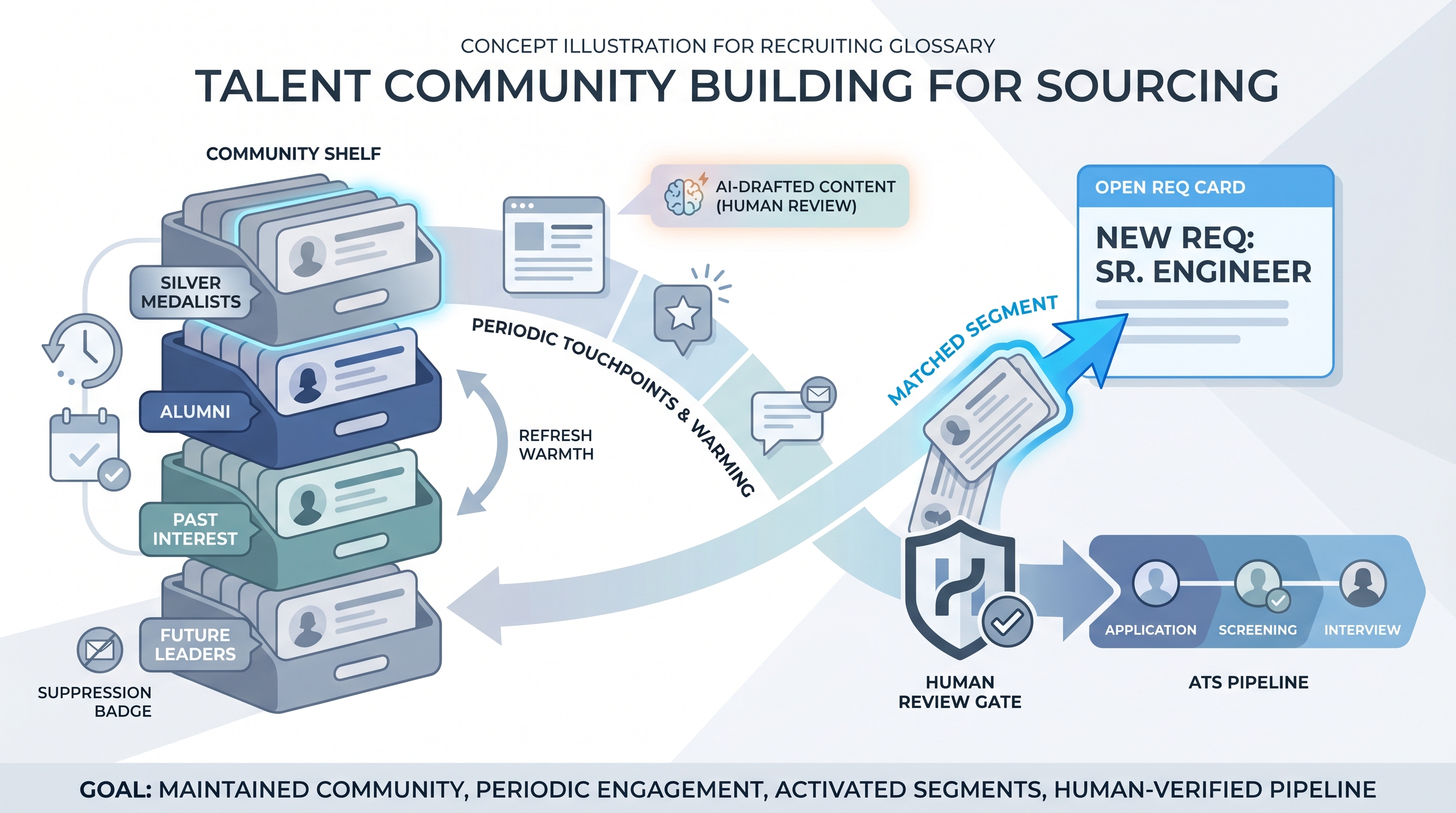
A talent community is a maintained audience of candidates who have already had some form of contact with your company: silver medalists from past searches, alumni who left on good terms, applicants who were not right for one role but would fit another, and professionals who have expressed interest without yet applying. Sourcers build and keep these communities warm through periodic, relevant touchpoints so that when a role opens, the first outreach goes to people who already know the company rather than cold contacts found that day.
The community differs from the ATS pipeline in one key way: the pipeline is reactive, organized around active requisitions; the community is proactive, organized around relationships maintained over time. The investment pays off when a hard-to-fill role opens and time-to-slate drops from weeks to days because you already have warm contacts who have said they would consider a move.
In practice
- A sourcer who ran a search six months ago keeps the top five candidates who declined or narrowly missed the offer in a tagged segment of the CRM, and sends them a relevant post about how the team has grown, not a generic monthly newsletter.
- A TA partner tells a hiring manager "I can activate the community for this role" meaning three contacts in the silver medalist group who would be a strong fit for the updated job profile.
- An HR ops person setting up a new ATS configuration asks for a "community status field" to separate active pipeline candidates from warm community members who have not been approached for a specific req yet.
Quick read, then how hiring teams use it
This is for sourcers, TA partners, and HR leaders who need shared vocabulary for what it means to proactively maintain candidate relationships before reqs open. Skim the plain-language section for context; use the operational section when deciding whether to invest in community infrastructure for a role family.
Plain-language summary
- What it means for you: Instead of starting a search cold every time a role opens, you keep a small warm group of qualified candidates who already know your company and have said they would listen to an opportunity.
- How you would use it: You track silver medalists and past-interest contacts in a tagged segment, touch them four to six times a year with relevant content, and reach out personally as soon as a matching role opens.
- How to get started: Pull every silver medalist from your last twelve months of searches in the role family you hire most often. Tag them by segment in your ATS or a lightweight CRM. Draft a first nurture message with context about why you are staying in touch.
- When it is a good time: When a role family is consistently hard to fill, when your inbound pipeline for a skill area is thin, or when a hiring manager is open to hearing from warm candidates rather than waiting for applicants.
When you are running live reqs and tools
- What it means for you: A community layer reduces sourcing lead time for evergreen or repeating roles because qualified contacts already know the company and have opted into future contact.
- When it is a good time: After you have filled the same role type at least twice and noticed that silver medalists were close decisions. That is the signal that a community for that profile is worth maintaining.
- How to use it: Segment by role family and seniority level, set a cadence of four to six touches per year, use AI to draft segment-specific content, and wire a suppression list that removes anyone who opts out automatically from all future sends. Treat every reply as a priority warm outreach trigger.
- How to get started: Pick one role family and one segment (silver medalists only). Tag them in your ATS, draft three touchpoint messages with AI, and schedule the first one. Review reply rates at 30 days and adjust content relevance before expanding to more segments.
- What to watch for: GDPR retention limits (remove or re-request consent after 12 to 24 months), stale segments that go untouched for more than six months, automated sends firing without a human review of the send list, and over-reliance on one segment that skews the community profile.
Where we talk about this
On AI with Michal live sessions, talent community building comes up across the sourcing automation and AI in recruiting tracks: sourcing automation covers how to segment a community, wire nurture sequences to the ATS, and use AI drafting without creating compliance gaps. The AI in recruiting block connects community maintenance to broader pipeline health and hiring manager trust. If you want the full live discussion with real stack questions, start at Sourcing Lab and bring your silver medalist process and ATS source field configuration.
Around the web (opinions and rabbit holes)
Third-party creators move fast. Treat these as starting points, not endorsements, and double-check anything before you wire candidate data.
YouTube
- Search YouTube for "talent community recruiting strategy" or "talent pool nurturing TA" to find practitioners walking through segmentation, CRM setup, and cadence design. Content from TA ops and sourcing-specialist channels is usually more grounded than vendor demos.
- Look for videos covering "silver medalist programs" and "talent pool management" for practitioner walkthroughs that are role-specific rather than tool-specific.
- r/recruiting has threads on "keeping candidates warm" and "talent community CRM" that surface what smaller teams do without dedicated software. Search those phrases for practitioner debate on cadence, opt-in mechanics, and what actually earns a reply.
- r/humanresources occasionally covers community programs from an HR ops angle, especially when a company is trying to reduce agency spend by building internal pipelines.
Quora
- Search Quora for "how to build a talent community" and "talent pipeline management recruiting" for a range of practitioner answers. Quality varies; cross-check against your own pipeline data before acting on any specific cadence recommendation.
Talent community versus cold outbound sourcing
| Dimension | Talent community | Cold outbound |
|---|---|---|
| Candidate warmth | Already expressed interest | No prior contact |
| Setup time | Months of relationship building | Immediate |
| Response rate | Higher, typically 2 to 4 times | Lower for same volume |
| GDPR lawful basis | Documented consent or LI | First-touch privacy notice |
| Best for | Repeating role families | New skill areas or markets |
Related on this site
- Glossary: Proprietary talent pool, Outbound talent sourcing, Employee referral sourcing activation, Niche talent pool strategy, Candidate data enrichment, GDPR first touch outreach, Workflow automation
- Blog: AI sourcing tools for recruiters
- Guides: Sourcers
- Live cohort: Sourcing Lab
- Membership: Become a member