Talent sourcing playbook
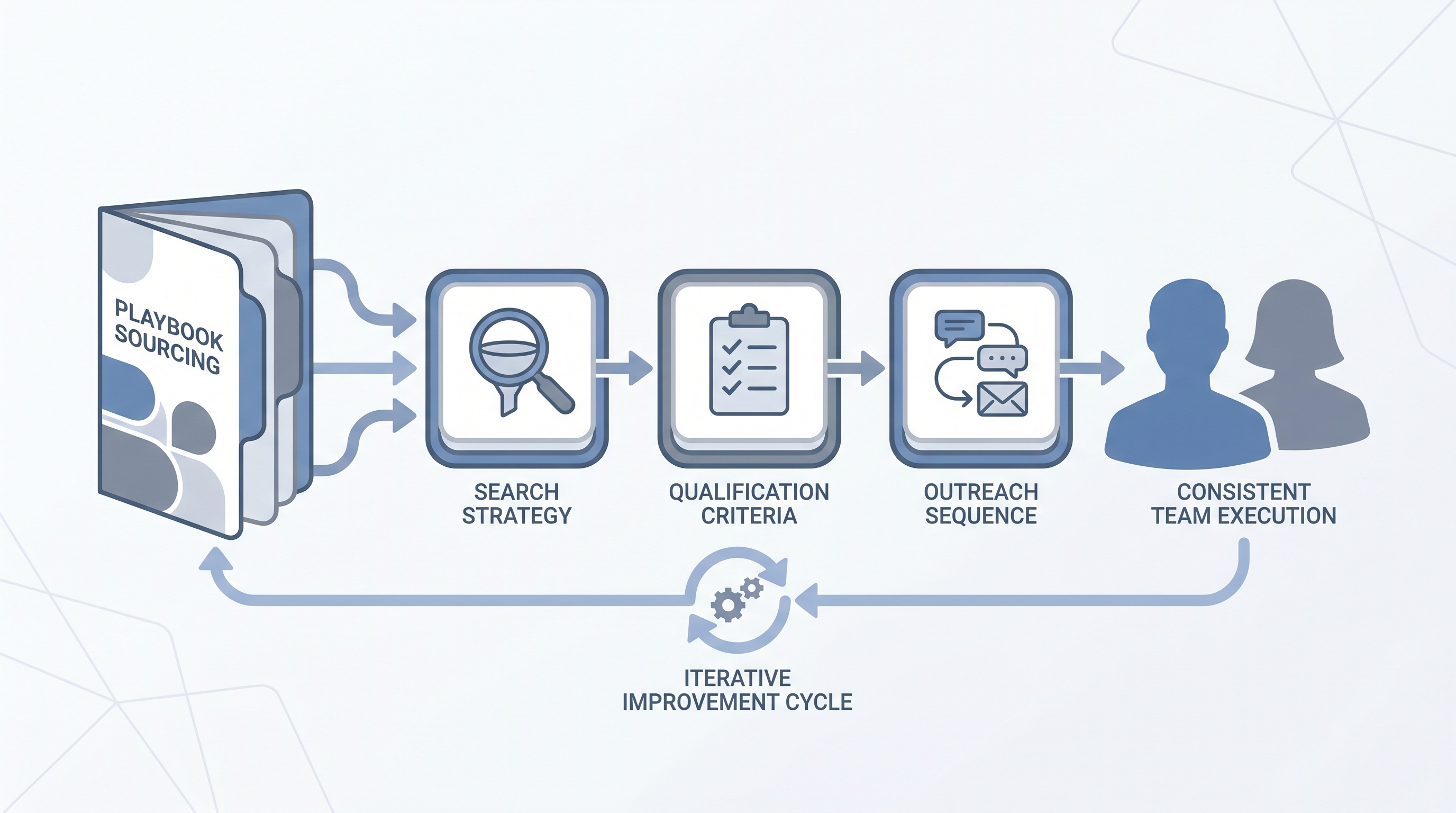
A documented, repeatable system for finding and engaging passive candidates, covering search strategies, outreach sequences, qualification criteria, and handoff points, built so a team can run consistent sourcing on any role without starting from scratch each time.
Michal Juhas · Last reviewed May 4, 2026
What is a talent sourcing playbook?
A talent sourcing playbook is a documented, repeatable system for finding and engaging passive candidates. It covers where to look, how to qualify a profile before outreach, how to write and sequence messages, and where the hand-off happens to a recruiter or hiring manager. The goal is for anyone on the team to run a consistent sourcing campaign on any role without rebuilding the process from zero each time.
A playbook is not a job description template or a list of platforms. It is the decision logic behind how your team sources: which sources produce which types of candidates, what criteria qualify a profile before it enters the outreach queue, and what a good hand-off looks like.
In practice
- When a new sourcer joins a team and can run their first search campaign without a two-hour knowledge transfer call because the criteria, Boolean strings, and outreach templates are documented, that is the practical payoff of a sourcing playbook.
- A senior sourcer who opens a Notion page and follows a checklist for a machine learning engineering search (sources, screening criteria, outreach message variant, follow-up timing) is using a playbook as operational infrastructure rather than institutional memory.
- A team where every sourcer explains the qualification criteria differently in debrief, and reply rates vary by 40 percent across sourcers on identical roles, is a team that needs a playbook.
Quick read, then how hiring teams use it
This section is for sourcers, recruiters, TA managers, and team leads who want a shared vocabulary for discussing sourcing consistency, AI integration, and process documentation. Skim the first part for the core concept. Read the second when you are building or auditing your team's sourcing system.
Plain-language summary
- What it means for you: A sourcing playbook is how your team stops reinventing the search every quarter. It captures the search logic, qualification criteria, and outreach approach so good sourcing practice becomes institutional rather than individual.
- How you would use it: You document one role family per sprint: where to find candidates, what qualifies them, how to engage them, and when to hand them off. You update it after each hiring cycle.
- How to get started: Pick your highest-volume role family. Document how your best sourcer runs a search for it, including what they look for, what they skip, and what their first outreach says. That is your first playbook entry.
- When it is a good time: Whenever a new team member joins, whenever reply rates drop, or whenever two sourcers explain the same role differently in a debrief.
When you are running live reqs and tools
- What it means for you: At scale, a playbook is the interface between your process and your tools. AI-assisted sourcing (semantic search, candidate data enrichment, personalised outreach via prompt chains) compounds in value when the human logic behind it is documented and reviewed regularly.
- When it is a good time: Before you connect any workflow automation to outreach. Automating an undocumented process just multiplies the inconsistency.
- How to use it: Keep the playbook in the format the team actually opens (Notion, Confluence, a shared drive folder). Pair narrative guidance with ATS templates so the logic and the execution live near each other.
- How to get started: Audit your current sourcing process by role family. For each one, document: primary source, qualification criteria, outreach sequence, and last time reply rates were reviewed. Gaps in that list are the playbook entries you write first.
- What to watch for: A playbook that reflects market conditions from 18 months ago. Assign a quarterly review owner per role family and treat the review as seriously as you treat a pipeline meeting.
Where we talk about this
On AI with Michal sessions, building a sourcing playbook is a running thread across both the AI in recruiting and sourcing automation tracks. We walk through live role briefs, search strategies, and outreach sequence logic together, and participants leave with draft documentation for their own role families rather than a generic template. If you want the room conversation and peer review on your specific playbook, start at Sourcing Lab and bring a role brief you are actively sourcing.
Around the web (opinions and rabbit holes)
These are starting points, not endorsements. Playbook content, especially sourcing strategy, is highly market-specific. Read critically and test before adopting.
YouTube
- The Complete Recruiting Process Explained covers end-to-end recruiting process including sourcing strategy, useful context before you document your own approach.
- LinkedIn Sourcing Masterclass walks advanced LinkedIn search tactics that belong in most sourcing playbooks as one channel entry.
- Boolean Search for Recruiters is a practical refresher on Boolean logic for anyone writing the search section of a playbook.
- How do you structure your sourcing process? in r/recruiting is a candid thread on how practitioners document (or do not document) their approach.
- What does your outreach sequence look like? in r/recruiting covers message timing and follow-up logic, core components of any sourcing playbook.
- Building a recruiting playbook from scratch in r/RecruitmentAgencies has agency sourcer perspectives on what to include.
Quora
- What should be in a talent sourcing strategy? collects varied practitioner views on sourcing system components.
Related on this site
- Glossary: Outbound talent sourcing, Candidate data enrichment, Semantic search, Prompt chain, Scorecard, Multi-channel talent sourcing, Talent sourcing software, Boolean search, Human-in-the-loop
- Blog: AI sourcing tools for recruiters
- Guides: Sourcers
- Workshops: AI Sourcing Lab
- Courses: Starting with AI: the foundations in recruiting
- Membership: Become a member